
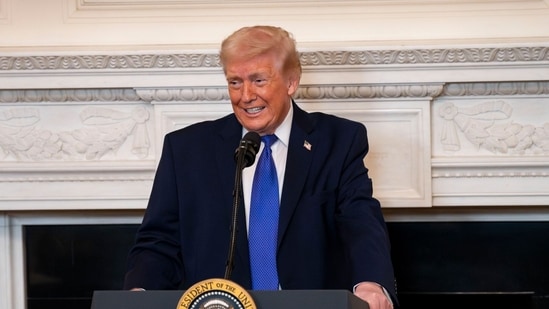
President Donald Trump’s economic agenda was handed a massive blow on Friday, after the Supreme Court struck down the ‘Liberation Day’ tariffs in a 6-3 vote. The apex court stated that Trump exceeded his authority in imposing tariffs, and the International Emergency Economic Powers Act (IEEPA) ‘does not authorize the President to impose tariffs’.
Which of Trump’s tariffs are being struck down and which remain in place?
The ruling, however, does not impact sector-specific duties that Trump has separately imposed on imports of steel, aluminum, and various other goods. Friday’s decision upends the set of tariffs that the president imposed using IEEPA. That includes the ‘Liberation Day’ tariffs the president slapped on nearly every country in the world last spring, as well as and other IEEPA-based levies he imposed on Canada, Mexico and China.
FOLLOW: Trump tariff live updates: No word from POTUS or White House as US Supreme Court strikes down Trump’s global tariffs
Several tariffs remain in place. Trump used Section 232 of the 1962 Trade Expansion Act to slap sectoral tariffs on steel and aluminum, cars, copper, lumber and products like kitchen cabinets worldwide.
What tariffs are gone
- The 10% ‘baseline’ tariff on all trading partners (Liberation Day tariffs)
- Higher ‘reciprocal’ tariffs on dozens of countries
- Drug trafficking tariffs on Canada (25%), Mexico (25%), and China
What tariffs remain
- Section 232 tariffs: Section 232 tariffs are import duties imposed under the Trade Expansion Act of 1962, allowing the president to restrict imports, typically steel and aluminum, if the Department of Commerce deems them a threat to national security.
- Section 301 tariffs: Section 301 tariffs are punitive duties imposed by the US Trade Representative (USTR) under the Trade Act of 1974, targeting foreign trade practices deemed unfair, such as intellectual property theft or forced technology transfers.
- Any tariffs imposed under other statutory authorities
Trump reacts
President Trump called the Supreme Court ruling ‘a disgrace’ when he was notified during his morning meeting with several governors, sources told The Associated Press.
The Treasury had collected more than $133 billion from the import taxes the president has imposed under the emergency powers law as of December, federal data shows. The impact over the next decade was estimated at some $3 trillion.
(With AP inputs)


