
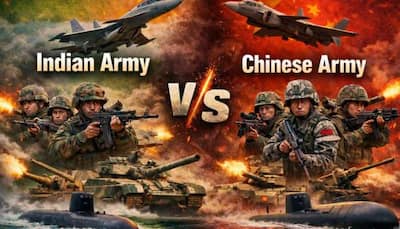
New Delhi: The Chinese People’s Liberation Army (PLA) holds a significant numerical advantage over the Indian Army in terms of manpower and major hardware, according to a comparative analysis of their conventional military strengths. The assessment comes amid a prolonged border standoff between the two nuclear-armed neighbours.
Key Takeaways
- The PLA is the world’s largest army with over 2 million active personnel, compared to India’s 1.2 million.
- China leads in major platforms: tanks (5,000+ vs 4,000+), aircraft (3,000+ vs 200+), submarines (70+ vs 20+), and artillery pieces (8,000+ vs 4,000+).
- India’s force is noted for its extensive combat experience and high-altitude warfare readiness.
Manpower and Major Platforms: A Numerical Comparison
Indian Army Strength
As the world’s second-largest standing army, the Indian Army fields over 1.2 million active soldiers. Its armoured corps operates more than 4,000 tanks, including the indigenous Arjun and Russian-origin T-90 and T-72 models. The army’s aviation and support elements comprise over 200 aircraft, while its submarine fleet numbers more than 20 vessels. Artillery strength exceeds 4,000 pieces.
Chinese Army (PLA) Strength
The PLA is the largest standing military force globally, with over 2 million active personnel. Its tank inventory surpasses 5,000, featuring modern types like the Type 99, Type 96, and the newer Type 15 light tank. China’s airpower is substantial, with more than 3,000 aircraft. Its submarine force, one of the world’s largest, has over 70 boats. The PLA’s artillery arsenal is extensive, with more than 8,000 pieces.
Comparative Firepower and Missile Systems
Indian Army’s Arsenal
The Indian Army deploys a diverse array of artillery, including howitzers, mortars, and multi-barrel rocket launchers. Its missile capabilities are highlighted by the BrahMos supersonic cruise missile, a joint venture with Russia.
Chinese Army’s Arsenal
The PLA possesses a vast inventory of artillery systems. Its missile forces include advanced systems like the DF-21D anti-ship ballistic missile, designed to target naval assets.
Analysis: Beyond the Numbers
While the PLA enjoys clear numerical superiority across most conventional metrics, analysts point to qualitative factors where India holds an edge. The Indian Army is widely regarded as a more experienced and battle-hardened force, with extensive operational experience in diverse terrains, including high-altitude warfare along the Himalayan borders.
Military experts consistently note that raw numbers alone don’t determine effectiveness. Training, technology absorption, logistical networks, and morale are critical determinants. Both nations are engaged in significant, ongoing military modernisation programs.
The India-China military balance is a multifaceted issue with no simple verdict. Both nations remain formidable military powers in Asia, with their strategic competition likely to shape the region’s future.


