
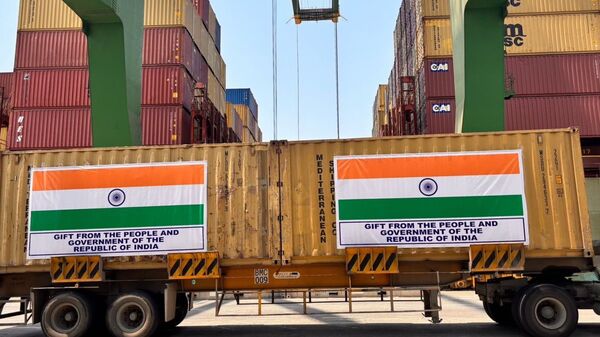
The Ministry of External Affairs (MEA)’s spokesperson, Randhir Jaiswal, on Wednesday announced that India has sent a consignment of 1,000 metric tonnes of rice to Burkina Faso as humanitarian assistance.
Jaiswal announced in a post on X and wrote, “India has sent a consignment of 1000 metric tons of rice to Burkina Faso as humanitarian assistance. This is aimed at supporting food security for vulnerable communities and internally displaced persons. The gesture reflects India’s continued commitment as a reliable developmental and HADR partner to Global South countries.”
The development comes at a time when Burkina Faso, a landlocked country in West Africa, is grappling with one of the world’s most neglected humanitarian crises, according to the United Nations Office for the Coordination of Humanitarian Affairs (UN OCHA). The crisis is reportedly driven by insecurity amid adverse climatic conditions. UN OCHA added that these challenges are pushing many people in the country, who are already living with limited means, to the brink of survival.
According to data from UN OCHA, at least 4.5 million people in Burkina Faso need humanitarian assistance in 2026.
Humanitarian access difficult in Burkina Faso
As per reports, humanitarian access remains difficult in the country, significantly limiting relief operations. Multiple routes leading to impacted areas pose danger, thereby forcing communities to rely on expensive air deliveries or escorted supply convoys.
Over two million displaced amid crisis
Years of ongoing insecurity have displaced over two million people from their homes. However, as of 31 October 2025, more than 1.1 million internally displaced persons had been able to return to their communities of origin, according to the National Council for Emergency Relief and Rehabilitation, largely due to coordinated efforts by the Government of Burkina Faso and its partners.
Burkina Faso marred by political instability
The humanitarian assistance from India, which represents itself as the voice of the Global South, comes at a time when the country has been marred by political instability. According to a BBC report, earlier in January, Burkina Faso’s junta announced a ban on all political parties, whose activities have been suspended since the military seized power in 2022.
Citing Burkina Faso’s Interior Minister Emile Zerbo, the ban on political parties is part of a plan to “rebuild the state” after what he said were “numerous abuses” in the country’s multiparty system. He added that the system had been “promoting division among citizens and weakening the social fabric.”
Before the military seized power, Burkina Faso had over 100 registered political parties, with 15 represented in parliament after the general election of 2020. The parties were previously banned from organising public gatherings; however, the new order stops them from operating altogether.
Jihadists kill 12 in a Burkina Faso village
Apart from the humanitarian crisis and the political instability, the country is also dealing with attacks from jihadists. According to AFP, in March, suspected jihadists targeted a village in Burkina Faso and killed at least 12 civilians. This included nine members of a volunteer force that backs the military and security forces.
The West African country, which has been led by a military junta since a 2022 coup, has faced deadly violence by jihadists linked to Al-Qaeda and the Islamic State group for more than a decade.


