

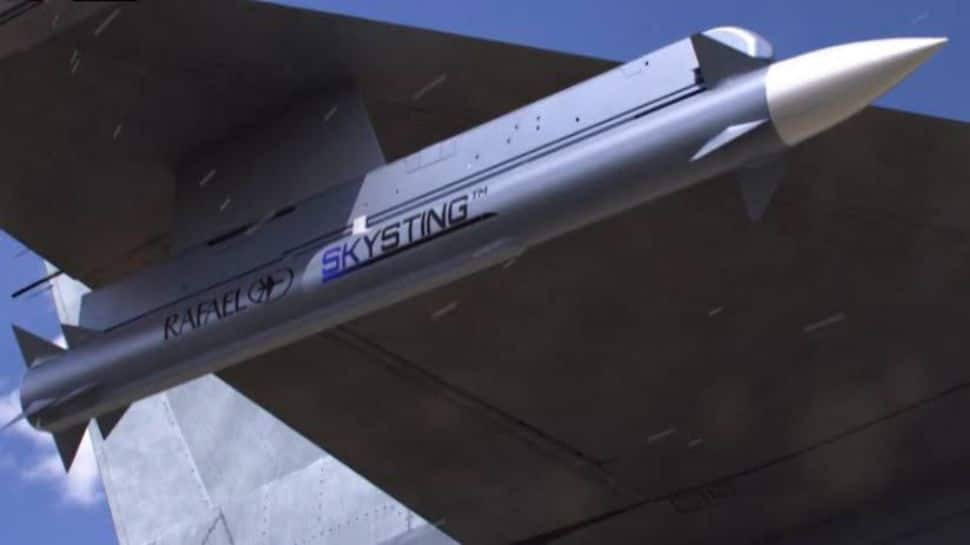
New Delhi: As Prime Minister Narendra Modi pays his second state visit to Israel, India is keen to take forward the talks on acquiring the Israeli-origin ‘Sky Sting’ beyond-visual-range air-to-air missile (BVRAAM) for the Indian Air Force (IAF). Still under development, this missile promises to enhance India’s fighter jet capabilities and counter reported Chinese and Pakistani advantages in long-range aerial combat.
Weighing between 180-200 kg, the missile is light enough to be carried by aircraft such as the Tejas Mk1A, while also being compatible with Su-30MKI fighters. It boasts a range of 250 km, with a three-pulse solid-fuel rocket motor enabling end-game speeds exceeding Mach 5.
Its radio-frequency seeker, supported by AI-driven target discrimination and jam-resistant technology, allows precise early lock-on and robust electronic counter-countermeasures. A two-way data link ensures real-time communication between the pilot and the missile during engagements.
Reports indicate that India may first acquire the missile off-the-shelf, followed by localised production in collaboration with Rafael Advanced Defense Systems. Integration trials would be conducted before the system becomes fully operational.
Addressing challenges faced in integrating India’s domestically developed Astra Mk1 missile with the radar, the Sky Sting is expected to be paired with the Israeli ELM-2052 AESA radar on the Tejas Mk1A. At present, the IAF operates several Rafael-origin systems, including the I-Derby ER and Python-5 air-to-air missiles, SPYDER air defense systems and precision strike weapons such as SPICE and Rampage, which have been deployed in strikes such as Balakot in 2019 and Operation Sindoor last year.
The missile’s acquisition could give the Tejas Mk1A a boost in BVR combat capability. However, some defense analysts caution that relying on the Israeli missile may slow India’s indigenous Astra programme, which is being developed by the Defence Research and Development Organisation (DRDO) and produced by the Bharat Dynamics Limited.
Astra Mk1 has a range of around 110 km, with Mk2 expected to exceed 200 km and the upcoming Mk3, based on solid-fuel ducted ramjet technology, projected to reach 350 km.
Despite these concerns, defense experts argue that importing select advanced systems does not necessarily undermine domestic development. It allows the IAF to maintain operational readiness while the Hindustan Aeronautics Limited (HAL) continues refining the Tejas programme.
Historically, India has pursued a similar strategy with the Tejas Mk1A and Rafale co-production deal to balance foreign technology with local development.
Israel has been a critical partner in India’s Tejas programme, providing radar systems, targeting pods, air-to-air missiles and helmet-mounted displays that are integrated across the fleet. The Mk1A variant is expected to continue this collaboration with advanced radar, targeting pods and missile systems from Israel until India’s homegrown UTTAM AESA radar and integrated Astra variants are ready.
At a time when the IAF is facing its lowest squadron strength since 1962, with just 29 active squadrons and aging fighter fleets approaching retirement, the Sky Sting acquisition is seen as a practical solution. It lets the Tejas Mk1A become fully operational while the HAL finishes domestic integration, keeping India ready now without hurting long-term self-reliance plans.
By importing the missile in the short term and co-developing technologies domestically, India is seeking a balanced path, which is enhancing immediate combat readiness while supporting the growth of its own defense industrial base. The growing India-Israel defense partnership helps meet immediate needs while supporting homegrown projects. This strengthens the Tejas programme and overall IAF modernisation.