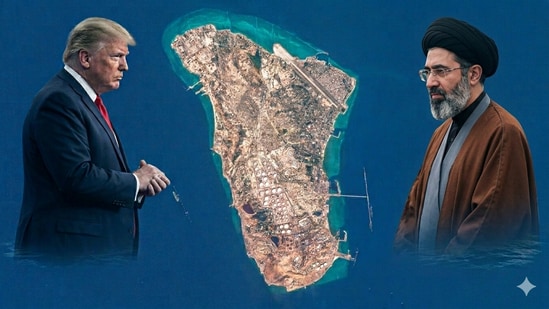
Kharg Island, a small but strategically vital Iranian outpost in the Persian Gulf, has emerged as a focal point in the escalating war between Iran and the United States. The island’s significance lies not in its size, but in what it represents: the heart of Iran’s oil and a critical lever in global energy markets.
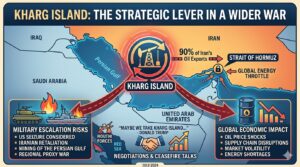
Recent remarks by Donald Trump have thrust Kharg Island back into geopolitical headlines. In an interview with the Financial Times on Monday, Trump floated the possibility of US forces seizing the island, saying, “Maybe we take Kharg Island, maybe we don’t,” while acknowledging that such a move would require a prolonged American presence.
Track Live Updates on US-Iran war here
The oil lifeline at stake
Kharg Island serves as Iran’s primary oil export terminal, handling the bulk of the country’s crude shipments. Any disruption here would directly impact global oil supply chains, which are already under strain due to the ongoing conflict.
The island’s proximity to the Strait of Hormuz, through which a significant portion of the world’s oil passes, amplifies its strategic importance. Iran’s longstanding ability to threaten or control this narrow passage has rattled global markets, pushing up oil prices and raising fears of supply shocks.
Trump’s suggestion of seizing Kharg Island aligns with his broader rhetoric about “taking the oil,” a move that would mark a dramatic escalation and potentially shift the war from aerial and naval engagements to a ground invasion.
A trigger for wider escalation
Any attempt to capture Kharg Island would almost certainly provoke a fierce Iranian response. Tehran has already warned it could mine the Persian Gulf if its territory is invaded, a step that could paralyse maritime trade.
Iran has also signalled that it could activate regional proxies, including Houthi forces in Yemen, to open new fronts – potentially targeting shipping routes in the Red Sea. Such actions would transform the conflict into a broader regional war involving multiple theatres.

The US, meanwhile, has been steadily increasing its military footprint in the region, with thousands of troops and amphibious units positioned within striking distance of Iran and its key infrastructure, including Kharg Island.
War, markets, and global fallout
The battle over Kharg Island is not just about territory – it is about control over energy flows. The conflict has already driven oil prices sharply higher, disrupted air travel, and triggered shortages in sectors like fertilisers that depend on stable energy supplies.
Strikes on energy infrastructure, ranging from Iranian petrochemical plants to Israeli refineries, underscore how both sides are targeting economic lifelines. The result is a war with global consequences, where a single escalation around Kharg Island could send shockwaves far beyond the Middle East.
Negotiations and contradictions
Even as tensions rise, diplomacy continues in parallel. Trump has claimed that Iran has conceded to most US demands in ceasefire talks, though Tehran has publicly rejected Washington’s conditions.
This dual-track approach – negotiations alongside military escalation – has added to uncertainty. While Trump insists talks are “going very well,” he has also warned that negotiations do not rule out further military action.
Why Kharg matters now more than ever
Kharg Island sits at the intersection of military strategy, economic leverage, and geopolitical signalling. For the US, seizing it could cripple Iran’s oil revenues. For Iran, defending it is essential to both its economy and sovereignty.
As the war intensifies, the island has become more than just an terminal—it is now a symbol of control over the region’s most critical resource. Any move against it risks transforming an already volatile conflict into a full-scale regional crisis.