
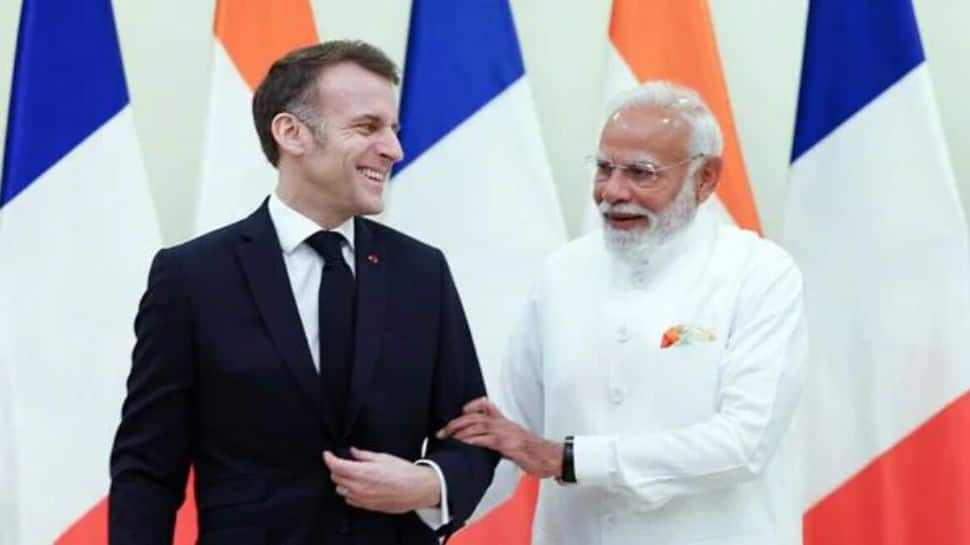
New Delhi: India and France have elevated their defence relationship to a new strategic level, opening a bigger chapter in military cooperation that stretches from fighter jets to submarines and emerging technologies. During high-level talks in Mumbai on February 17, Prime Minister Narendra Modi and French President Emmanuel Macron agreed to expand bilateral ties into what has been described as Special Global Strategic Partnership.
The decision shows a growing level of trust between the two countries in critical security areas. Approvals were cleared for the Indian Navy to acquire 26 carrier-based Rafale-Marine fighter jets. Plans also moved forward for the procurement of 114 new multi-role combat aircraft for the Indian Air Force. The partnership places strong emphasis on co-design and co-production of advanced defence systems inside India. It indicates a long-term industrial and operational partnership.
In the field of aerospace manufacturing, India’s first private helicopter assembly facility has begun operations through a partnership between Tata Advanced Systems and Airbus. The unit will support local production and future exports.
Both countries have also increased cooperation in space security, cyber strength and maritime monitoring. This has expanded their defence partnership into new fields.
Military-to-military engagement will receive an institutional push. Officers from the armed forces of both nations will begin cross-deployment postings from 2026. The initiative is expected to build operational familiarity and strengthen institutional understanding between the services.
Defence aviation collaboration has registered one of the most visible leaps. Along with the Rafale-Marine induction for aircraft carriers, talks with regard to the 114-fighter programme include domestic manufacturing. French engine maker Safran will work with Indian partners to produce fighter aircraft engines within India. The move is expected to strengthen domestic capability in high-end propulsion technology.
Missile and weapons manufacturing have also entered a new phase. India’s Bharat Electronics Limited and Safran will jointly produce HAMMER precision-guided munitions locally. The localisation plan aims to expand indigenous weapons integration across air platforms.
Leaders from both countries also inaugurated the final assembly line for the H125 helicopter in India. Built through the Tata-Airbus partnership, the project represents the first private-sector helicopter manufacturing ecosystem in the country and is expected to serve both domestic and international markets.
Undersea cooperation is another pillar of the partnership. The Scorpene submarine programme under Project-75 has already delivered six submarines to the Indian Navy. These boats belong to the Scorpène-class submarine family developed with French collaboration. Both nations have agreed to continue working together on next-generation submarine technologies and undersea systems.
Joint military exercises will continue to anchor operational synergy. Bilateral drills such as Varuna, Shakti and Garuda will expand in scale and complexity to strengthen interoperability across naval, land and air forces.
A Joint Advanced Technology Development Group will be created to focus on emerging and critical technologies. The platform will drive collaboration in areas such as artificial intelligence, next-generation sensors and networked warfare systems. Space defence cooperation will also intensify. India’s Defence Research and Development Organisation will work with France’s Directorate General of Armaments on space situational awareness and orbital security.
Both sides reaffirmed their shared vision for a free, open and rules-based Indo-Pacific region. The expanded partnership shows a long-term convergence of strategic interests, industrial capability and defence preparedness between New Delhi and Paris.


