
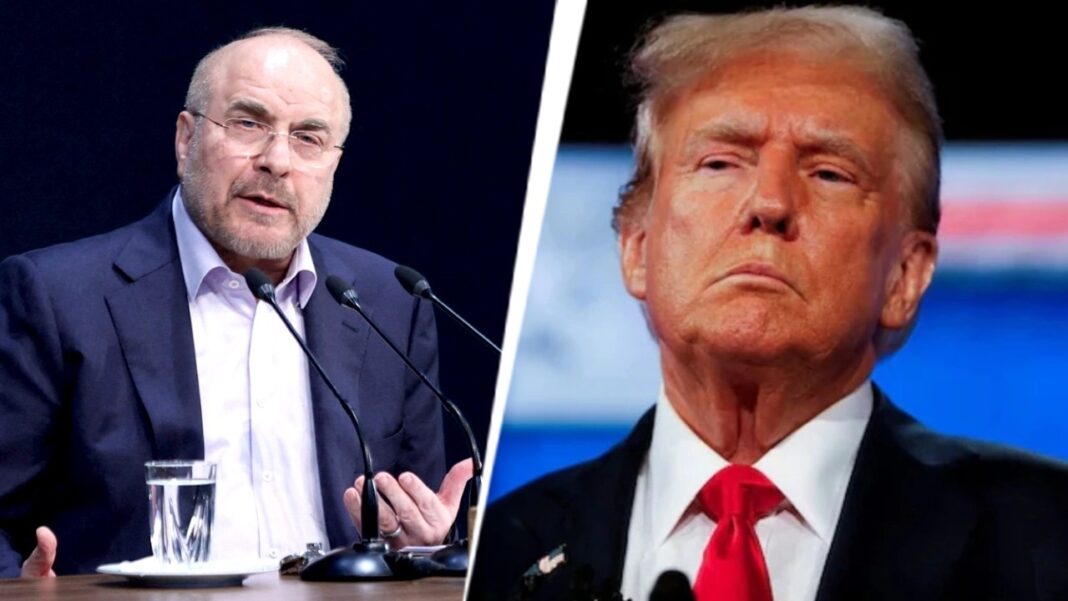
Iran’s Parliamentary Speaker Mohammad Baqer Qalibaf, who was part of the peace talks with the US, issued a sharp warning to Washington after Donald Trump announced that he will shortly begin blockading ships attempting to enter or leave the Strait of Hormuz in response to failed talks in Islamabad.
In remarks carried by Iranian state media, Qalibaf dismissed Trump’s recent threats, saying they would have no impact on the Iranian nation. He also stressed that Iran had approached recent talks with the United States in good faith. “We’ve had very good initiatives to show Iran’s goodwill, which led to progress in the negotiations,” Qalibaf said on Sunday.
However, he coupled that message with a clear warning. “If they fight, we will fight, and if they come forward with logic, we will deal with logic. We will not bow to any threats, let them test our will once again so that we can teach them a bigger lesson,” Mohammad Bagher Ghalibaf told reporters after returning to Tehran from Islamabad.
The talks in Pakistan’s capital, which followed the announcement of a ceasefire last Tuesday, were the first direct US-Iranian meeting in more than a decade and the highest-level discussions since the 1979 Islamic Revolution. “The bad news is that we have not reached an agreement, and I think that’s bad news for Iran much more than it’s bad news for the United States of America,” said Vice President JD Vance, who headed the US delegation.
HORMUZ BLOCKADE SIGNALS MAJOR ESCALATION
The prospects of a truce dimmed further after US President Donald Trump today said Washington would shortly begin blockading ships attempting to enter or leave the Strait of Hormuz, marking a big escalation after US-Iran talks failed to produce an agreement.
“Effective immediately, the United States Navy will begin the process of BLOCKADING any and all Ships trying to enter, or leave, the Strait of Hormuz,” he said. He also claimed Iran had failed to honour assurances to keep the waterway open, alleging that threats of naval mines had already deterred shipping activity. “They say there may be a mine out there somewhere — what ship owner would want to take the chance?” he said.
In response, the Revolutionary Guards said the Strait of Hormuz remains under the full control and “smart management” of its navy, warning that any military vessels approaching the waterway would be treated as a ceasefire breach and dealt with strongly.
US UNABLE TO GAIN TEHRAN’S TRUST, IRAN’S PARLIAMENT SPEAKER SAYS
Earlier in the day, Baqer Qalibaf said the US failed to gain Tehran’s trust during ceasefire talks that ultimately ended without a breakthrough. In a series of posts on X, he said Iran had entered the talks with “good faith and will”, but past conflicts had left Tehran sceptical of Washington’s intentions.
He added that Iran’s delegation had presented forward-looking initiatives during the discussions, but said those efforts were not enough to bridge the trust gap. The senior Iranian leader also suggested that the responsibility now lies with Washington to rebuild confidence. “America has understood our logic and principles, and now it’s time for it to decide whether it can earn our trust or not?” he said.
With inputs from agenices


