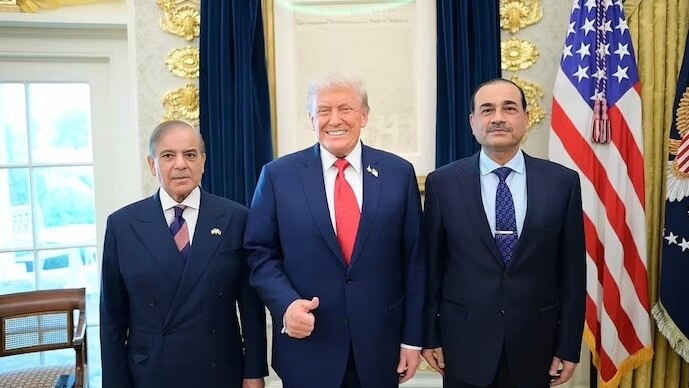
US President Donald Trump on Sunday returned to one of his most bizarre and repeated geopolitical claims – that he prevented a catastrophic India-Pakistan war – while offering some of his strongest praise yet for Pakistan Army chief Asim Munir and Prime Minister Shehbaz Sharif.
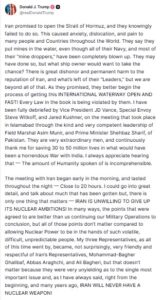
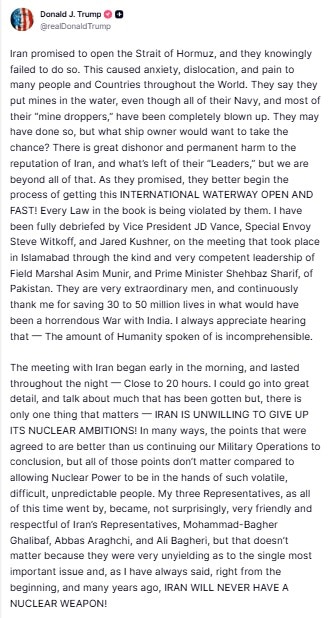
In a lengthy Truth Social post warning Iran to reopen the Strait of Hormuz, a “vital international waterway” and accusing it of causing “anxiety, dislocation, and pain” globally, Trump pivoted to Islamabad. He said he had been “fully debriefed” after a meeting led by Munir and Sharif, crediting them with “kind and very competent leadership”.
FROM ‘COMPETENT’ TO ‘EXTRAORDINARY’
That praise did not stop there. Trump, who has previously spoken positively about Pakistan’s leadership while recounting his version of events, raised the pitch this time, calling Munir and Sharif “very extraordinary men”.
“They continuously thank me for saving 30 to 50 million lives in what would have been a horrendous war with India,” he wrote, adding, “I always appreciate hearing that — The amount of humanity spoken of is incomprehensible.”
A CLAIM THAT KEEPS GROWING
Trump’s account of the India-Pakistan crisis has evolved with each telling. In February, he said Sharif told him 35 million people could have died in a potential nuclear conflict.
On Sunday, that number stretched further to “30 to 50 million”, continuing a pattern of rising figures alongside the emphasis he places on his role.
Trump has repeatedly cited the India-Pakistan episode as one of several conflicts he claims to have helped defuse across the globe.
INDIA’S POSITION REMAINS UNCHANGED
India has consistently denied any third-party involvement, including that of the US, in resolving the conflict with Pakistan. External Affairs Minister S Jaishankar had earlier dismissed Trump’s claims, maintaining that the de-escalation was the result of direct military-level communication between New Delhi and Islamabad.
According to the Indian government, the ceasefire understanding was reached after Pakistan’s military initiated contact through established channels, without external mediation.
THE CONFLICT BEHIND THE CLAIM
The tensions referenced by Trump trace back to the April 22 terror attack in Pahalgam, which killed 26 people. India responded with Operation Sindoor on May 7, targeting terror infrastructure in Pakistan and Pakistan-occupied Kashmir.
Officials have said the situation stabilised following direct engagement between the two militaries, a version that contrasts with Trump’s repeated claims.
TALKS WITH IRAN FAIL ON ‘ONE POINT THAT MATTERED’
Trump’s remarks on Pakistan came mid-way through a post dominated by Iran. He accused Tehran of violating “every law in the book” and warned it must reopen the Strait of Hormuz “FAST”.
Trump said marathon talks with Iranian officials in Islamabad, stretching close to 20 hours, resulted in agreement on several issues but collapsed on what he called the only point that mattered — Iran’s nuclear programme.
“The meeting went well, most points were agreed to, but the only point that really mattered, NUCLEAR, was not,” he said, adding that Iran remained “unyielding” on its nuclear ambitions. He stressed that any progress on other fronts was ultimately irrelevant without movement on the nuclear question.
CEASEFIRE WINDOW, BUT NO BREAKTHROUGH
The talks followed a 14-day ceasefire announced earlier in the week to create space for negotiations, but the pause in hostilities failed to yield a breakthrough.
Iranian Parliament Speaker Mohammad Baqer Qalibaf, who led the delegation alongside Foreign Minister Abbas Araqchi, said the discussions faltered due to a lack of trust, despite what he described as constructive proposals from Tehran.
“The US has understood Iran’s logic and principles, and it’s time for them to decide whether they can earn our trust or not,” Qalibaf said in a post on X.
FIRST DIRECT CONTACT IN YEARS
The Islamabad meeting marked the first direct engagement between the two sides in over a decade and the highest-level contact since the 1979 Islamic Revolution.
US Vice President JD Vance said Iran had ultimately chosen not to accept American conditions, including a commitment to forgo nuclear weapons, underscoring the central sticking point that continues to block any deal.