
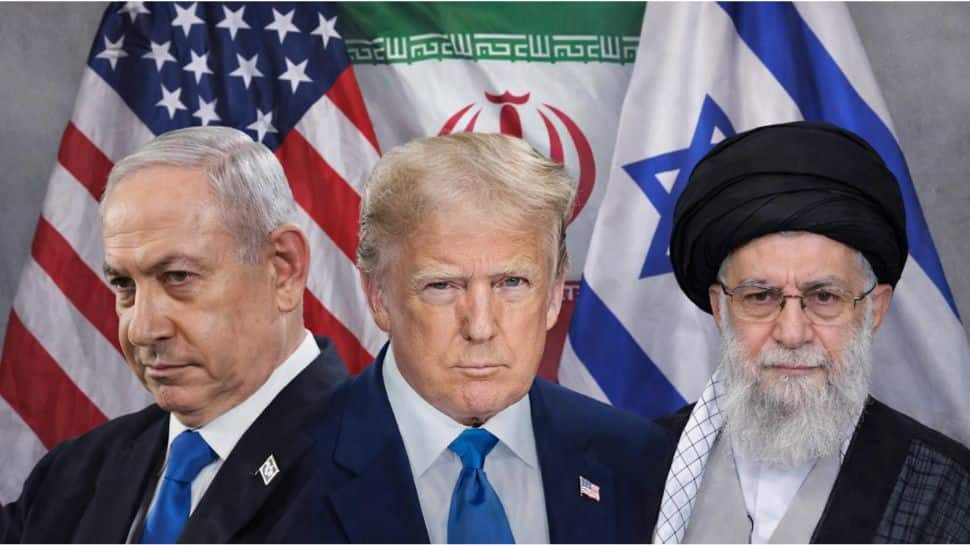
US and Iranian officials in Geneva tentatively agreed on “guiding principles” for US-Iran nuclear negotiations amid accumulating storm clouds on February 17. Abbas Araghchi, the Iranian Foreign Minister, praised it as “constructive,” saying, “We were able to reach broad agreement… drafts would be exchanged, and a third round date would be set.”
However, US Vice President JD Vance crushed the hope in a matter of hours, “The President has set some red lines that the Iranians are not yet willing to actually acknowledge.”
This fragile progress now hangs by a thread, with Israeli Prime Minister Benjamin Netanyahu’s shadow looming largest.
From Jerusalem’s unyielding demands to Iran’s Strait of Hormuz drills and America’s surging naval armada, the pieces are aligning for catastrophe. Experts warn that a US-Iran war feels increasingly inevitable.
Is Israel behind the US-Iran deadlock and the seemingly close war in West Asia?
Netanyahu’s Washington Power Play
It was not long ago that Israeli Prime Minister Benjamin Netanyahu, sensing a critical moment, Netanyahu pushed forward his visit to the White House by seven days to meet US President Donald Trump on February 10.
The discussions were dominated by Iran. Meanwhile, armed with new information on Tehran’s missile development, Netanyahu declared, “On this trip, we will discuss… first and foremost, negotiations with Iran.”
Ahead of the talks, Israeli officials insisted the US not budge on four key demands:
- Iran must transfer its highly-enriched material to another country.
- Halt nuclear enrichment completely.
- Cease ballistic missile production.
- Stop funding proxies like Hezbollah, Hamas, and the Houthis across the Middle East.
A senior Israeli official said, “Every agreement that does not include these conditions is a bad agreement. This administration has proven its commitment to Israel in every area, and specifically in the Iranian area”, according to a report by The Times of Israel.
Any softer deal is seen by Israel as an existential threat. Netanyahu’s group called on Washington to demand absolute control, citing the “Libyan model” of complete nuclear surrender. Following the meeting, Netanyahu reiterated, saying, “The necessity of dismantling Tehran’s entire nuclear framework” is essential for peace. Trump listened sympathetically, affirming, “Yeah, that would be acceptable, but right up front, no nuclear weapons”, accroding to a report by Al jazeera.
Critics argue that Israel’s lobbying has hardened US positions, transforming potential compromise into deadlock. Netanyahu departed empowered, but Tehran was enraged.
The Road to Deadlock: from Oman to Geneva
Trump’s envoy, Steve Witkoff, set America’s red line during the first round of indirect negotiations mediated by Omanis: “We cannot allow even 1% of an enrichment capability,” as it paves the way for bombs. Iran retorted obstinately, with Araghchi stating that “Enrichment… will continue with or without a deal,” restricting, “Enrichment… will continue with or without a deal,” limiting scope to nukes alone, no missiles or proxies.
Geneva’s second round yielded principles on sanctions relief and inspections, but Iran’s refusal to budge on core issues stalled momentum. No third meeting is scheduled.
Israel’s expansive wishlist, amplified by Netanyahu’s trip, clashes violently with Tehran’s narrow focus. US Vice President JD Vance hinted at consequences post-Geneva: strikes loom if red lines hold. Trump’s openness to diplomacy masks a ticking clock, pressured by Jerusalem.
US ‘Armada’ to Iran’s Strait of Hormuz gambit
Iran made the decision to make a major show of force as the Geneva negotiations drew near on February 17. Iran’s Islamic Revolutionary Guard Corps (IRGC) kicked off its “Smart Control of Hormuz Strait” drills right in response, temporarily shutting down parts of this super-important waterway.
The US is continously increasing its presence by sending the enormous USS Gerald R. Ford, the biggest aircraft carrier in the world, which surged toward the Middle East, joining the USS Abraham Lincoln strike group already in the Arabian Sea since late January.
This heavy buildup included F-35 stealth fighters, destroyers, Patriot missile defences in Qatar, and pilots on five-minute alert, all aimed at the Strait of Hormuz.
Iran flexed hard just before the diplomats met, testing ways to block oil flows and push back against US-Israeli pressure.
Supreme Leader Khamenei piled on with his taunt that same week: “A warship is certainly a dangerous weapon, but even more dangerous is the weapon capable of sinking it.” Tehran was sending a clear message: they won’t back down easily.
Is war Inevitable: What’s next?
War isn’t set in stone yet, but it’s getting dangerously close, with Netanyahu wanting either a full US military win over Iran or terms that cripple the regime, ‘no room for weak diplomacy’.
With a building coercion spiral, where Iran’s Hormuz drills clash head-on with US carriers, and one wrong move could spark a fight.
What comes next? Maybe a third round of talks, if they swap draft proposals. But if that fails, things could explode fast, the US might bring back tough sanctions, Israel could strike Iran’s nuclear sites first, and Iran might hit back through proxies or by mining the Hormuz Strait.
War isn’t guaranteed, the deadlock with tough demands and bold refusals, and the staring contest between naval armadas make it feel to real.


