
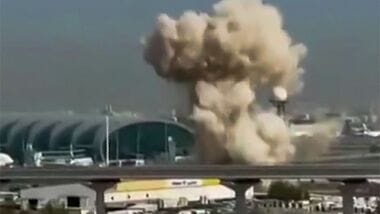
Iran war: An Emirates flight operating from Kerala’s Thiruvananthapuram International Airport (TRV) to Dubai was compelled to turn back mid-journey on Monday (16 March) after Dubai International Airport suspended all flight operations following a drone attack that set a fuel tank ablaze near the airport perimeter.
The aircraft has since landed safely at Thiruvananthapuram, and passengers are being transferred to the terminal, according to the airport’s public relations office, ANI reported.
Drone Strike on Fuel Tank Triggers Temporary Shutdown of Dubai Airport
Dubai authorities confirmed they had brought the fire under control by Monday afternoon. No injuries were reported.
“A drone incident in the vicinity of Dubai International Airport affected one of the fuel tanks,” the Dubai media office stated on X. Road and tunnel links to the airport were temporarily closed by police, and the Emirates airline suspended all departures from Dubai.
A number of inbound flights were diverted to Al Maktoum International Airport, the city’s secondary hub, the Dubai media office added. Authorities did not specify when normal operations were expected to resume.
Third Incident at Dubai Airport Since Iran Launched Gulf Strikes
Monday’s attack is the third targeting the Dubai airport since Iran commenced its campaign of missile and drone strikes against Gulf states following US and Israel’s attack on Tehran on 28 February.
Monday’s strike makes Dubai, one of the world’s most heavily trafficked aviation hubs, a recurring flashpoint in the widening conflict.
On 11 March, two drones fell near the airport, which had already sustained damage on the opening night of the conflict during a large-scale overnight Iranian assault across the Gulf region.
Iran’s Attacks on Gulf States: Civilian Infrastructure in the Crosshairs
Tehran has framed its strikes as targeting the United States military presence in the region. The United Arab Emirates (UAE), Iraq, Jordan and Turkey all host American military facilities.
However, Iran’s campaign has struck civilian infrastructure, including airports, hotels, and ports, rather than military installations alone. Gulf Arab states have now endured more than 2,000 missile and drone attacks since the start of the Iran war, with targets ranging from United States diplomatic missions and military bases to critical oil infrastructure as well as residential and commercial properties.
The UAE has borne a disproportionate share of the attacks. Having normalised relations with Iran’s principal adversary, Israel, in 2020 under the Abraham Accords, the UAE has been a particularly conspicuous target. All Gulf Arab states, however, have been affected, and all have issued formal condemnations of Iran’s actions.
Global Aviation in Turmoil as Middle East Airspace Remains Largely Closed
The broader conflict, framed as the United States-Israel war against Iran, has sent shockwaves through global aviation. Flights across the region have been cancelled, rescheduled or rerouted en masse, with most Middle Eastern airspace remaining closed amid sustained fears of missile and drone incursions.
The crisis has also driven aviation fuel prices sharply higher, compounding pressure on airlines already navigating disrupted routing. IniGo has already announce hight flight tivcket fares amid fuel price surge.
What Passengers at TRV Can Expect
Passengers aboard the diverted Emirates flight are being accommodated at Thiruvananthapuram International Airport as the situation at Dubai develops. Travellers with onward connections through Dubai are advised to monitor updates from Emirates and the airport directly.


