

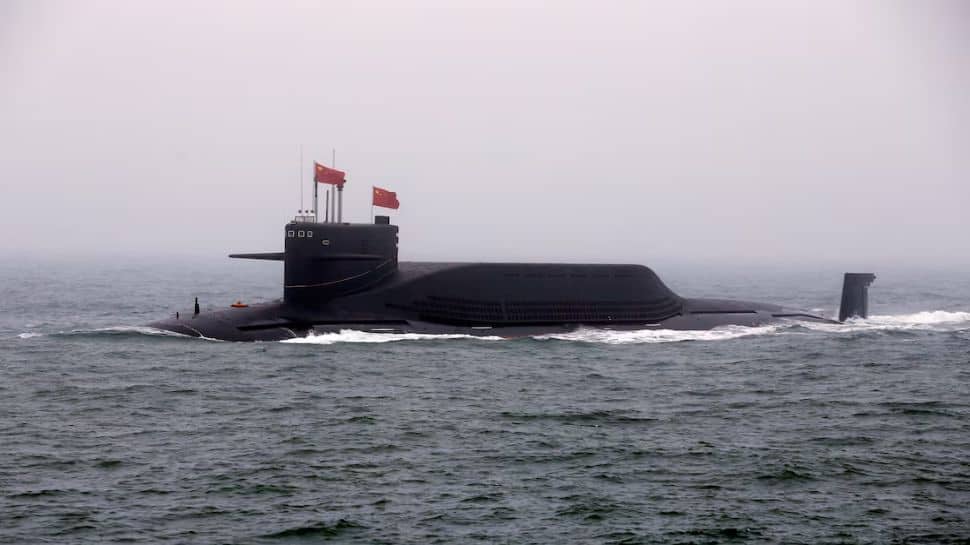
Beijing: China has been building nuclear-powered submarines faster than ever. This is changing the balance of undersea power and catching the attention of the United States. A study by an international security institute shows that Beijing is launching more submarines than Washington. This raises concerns about the future balance of sea power.
In the past five years, China launched 10 nuclear-powered submarines, compared with seven by the United States. The report says China’s submarines are bigger and heavier than those of the United States. This shows that Beijing is building its undersea fleet much faster.
Since China does not publish official numbers for its submarine inventory, analysts based their findings on satellite monitoring of shipyard activity.
This pace of construction shows a change from the period between 2016 and 2020, when Beijing added only three nuclear boats while the United States launched seven. Although submarine launches do not mean immediate deployment, and Washington still maintains a far larger active fleet, the trend highlights a new intensity in China’s military shipbuilding.
By early 2025, China had 12 operational nuclear-powered submarines that were split evenly between ballistic-missile platforms and attack boats. In contrast, the United States maintained a fleet of 65 nuclear submarines, with 14 capable of launching strategic missiles.
China also fields a substantial fleet of conventionally powered submarines that do not rely on nuclear reactors but fuel regularly. The United States has no vessels in this category.
The expansion has been supported by upgrades at the Bohai Shipbuilding facility in northern China, where docks and production lines have grown to sustain larger submarine construction.
This comes at a time when US production goals have lagged. Official reports to the Congress last month highlighted that American shipyards have struggled to deliver even a single Virginia-class attack submarine per year. It fell short of the planned two-per-year rate.
Meanwhile, work on the next generation of US strategic submarines is behind schedule, with the first expected delivery now set for 2028.
The Chinese fleet’s growth is especially visible in its strategic submarine force. The report points to recent launches of Type 094 ballistic-missile submarines that enhance Beijing’s ability to deploy nuclear weapons at sea, an important component of its strategic deterrent along with land-based missiles and long-range bombers. More advanced designs, including a new Type 096 class expected later this decade, are already in preparation.
Along with these long-range platforms, China has brought forward guided-missile nuclear submarines designed with vertical launch systems that could fire modern anti-ship missiles. It highlights Beijing’s focus on expanding capabilities across mission types. Such developments have drawn attention from defence experts around the world.
Despite the rapid expansion, the report finds areas of relative weakness in Chinese submarine design. It points out that many Chinese-made submarines are probably louder and less sophisticated than Western-built boats. This gives the United States and European navies an advantage in stealth and avoiding detection.
But observers caution that sheer numbers matter in naval operations. Countries with larger fleets enjoy greater reach and strength in extended maritime competition. China already fields the world’s largest collection of destroyers, frigates and other surface warships. Its expanding submarine force adds depth to that strength.
Across the Pacific, US naval leaders have acknowledged the challenges. Recent testimony before lawmakers described American shipbuilding programmes as stretched, with delays and cost overruns affecting multiple platforms.
Independent assessments warn of a coming dip in US attack submarine numbers in the late 2020s, as older boats retire faster than new ones enter service. This temporary reduction could leave the US fleet at its lowest point in decades. It will add pressure on policymakers as they balance fleet commitments with global security responsibilities.
While Washington pursues partnerships, including submarine sales to allies as part of broader security pacts, analysts say careful attention to undersea forces will be central to future military balance. The coming years promise to be a defining period for submarine power, with implications that stretch from strategic deterrence to operations under the waves.


