17.1 C
Delhi
Sunday, January 18, 2026

Lost Prehistoric Pit Circle Discovered Near Stonehenge

Massive Prehistoric Pit Circle Discovered Near Stonehenge

Archaeologists have confirmed the existence of a massive ring of pits near Stonehenge, potentially making it Britain’s largest prehistoric structure. The discovery reveals sophisticated planning capabilities of Neolithic people 4,500 years ago.

Key Findings

  • Over 20 pits forming a mile-wide circle around Durrington Walls and Woodhenge
  • Some pits measure 10 meters deep and 5 meters wide
  • Multiple scientific techniques confirm human construction
  • Could represent earliest evidence of counting in Neolithic Britain

The Monumental Discovery

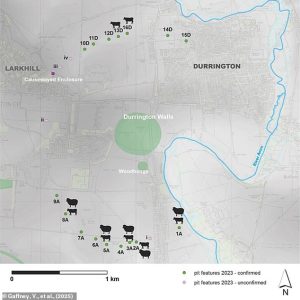
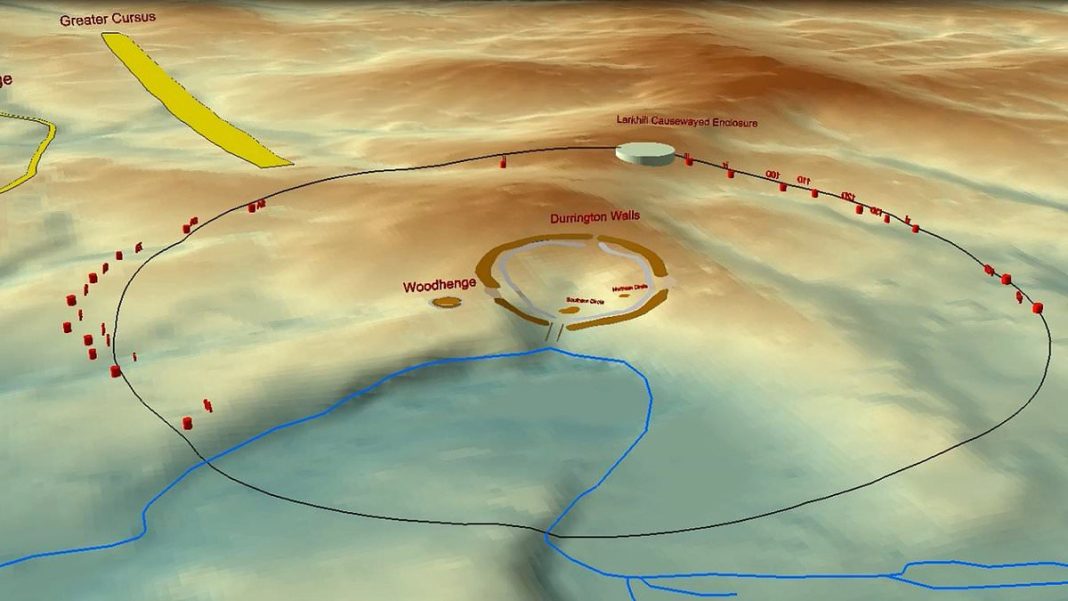
The ring of more than 20 pits extends in an arc more than a mile across, with some reaching 10 meters deep and five meters wide. At the center lie the ancient sites of Durrington Walls and Woodhenge, located 1.8 miles northeast of Stonehenge, where ritual feasts were held by henge builders.

Scientists have proven the existence of a lost ring of pits nearby Stonehenge, which is likely the UK's largest prehistoric monument
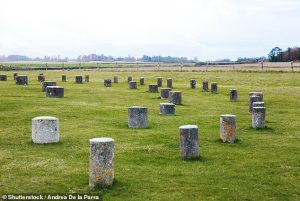
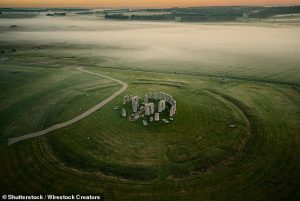
The pits surround ancient sites of Durrington Walls and Woodhenge, 1.8 miles (2.9 kilometres) northeast of Stonehenge (pictured). These sites are believed to be where the Stonehenge builders held ritual feasts

First discovered in 2020, the pit circle further cements the Salisbury Plain’s reputation as a uniquely important religious site for Britain’s Neolithic people. The area contains interconnected ceremonial structures, stone circles, and cemeteries from the Stone Age.

Scientific Verification

Researchers used multiple techniques to prove the pits were human-made rather than natural formations. Professor Vincent Gaffney from the University of Bradford described the structure as a ‘cosmological statement.’

The pits encircle the ancient sites of Durrington Walls and Woodhenge. Woodhenge was an enormous timber monument built around 2500 BC, consisting of six concentric rings of posts of varying size forming an oval monument 40 metres across. Pictured: Stone pillars marking the locations of Woodhenge's timber posts
Scientists had questioned whether the pits were really man-made. So scientists used an array of scientific tests to work out their exact shape and structure

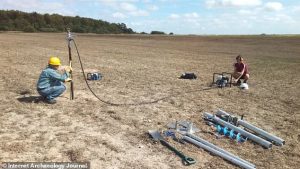
The research team employed electrical resistance tomography, radar, magnetic imaging, and sediment core analysis. They used optically stimulated luminescence to determine when soils were last exposed to sunlight and extracted plant and animal DNA directly from the dirt.

‘This in itself did not prove these features to be man-made,’ Professor Gaffney explained. ‘So sediment cores were extracted and an array of techniques, including novel geochemistry, were used to characterise the nature of the soils.’

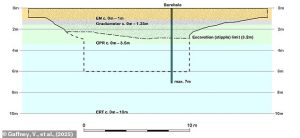
The researchers used a technique called electrical resistance tomography, which measures changes in electrical resistance at the surface to work out the size of underground structures (illustrated)
The researchers found that the pits had a consistent pattern of layers and even contained DNA of cattle and sheep. This suggests that they were deliberately built by humans

Historical Significance

The discovery reveals that Neolithic society was capable of complex planning and mobilizing large numbers of people for religious purposes. The near-perfect circular arrangement suggests the pits were laid out by pacing, indicating early numerical counting capabilities.

‘It confirms that this structure – probably the largest prehistoric monument in Britain at least – is a purposefully constructed monument in a landscape which is itself exceptional,’ Professor Gaffney stated.

However, researchers acknowledge we will ‘probably not’ ever know exactly why these massive pits were constructed.

Stonehenge Construction Timeline

The current Stonehenge monument represents the final stage of a four-part building project completed about 3,500 years ago.

  • First stage (3100 BC): Earthwork comprising ditch, bank and Aubrey holes
  • Second stage (2150 BC): Transportation of 82 bluestones from Wales
  • Third stage (2000 BC): Arrival of larger sarsen stones from Marlborough Downs
  • Final stage (1500 BC): Rearrangement of bluestones into current formation
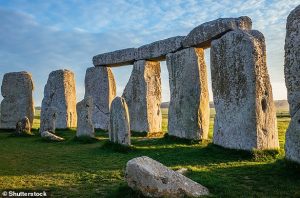
Stonehenge (pictured) is one of the most prominent prehistoric monuments in Britain

The discovery of the pit circle adds another layer of complexity to our understanding of Britain’s ancient ceremonial landscape and Neolithic engineering capabilities .
Latest

Trump Threatened Denmark with Tariffs Over Greenland Purchase Bid

Donald Trump reveals he considered tariffs and reduced protection to pressure Denmark into selling strategic Greenland, citing Russian and Chinese threats.

Putin Warns of ‘Catastrophic’ War in Calls with Israel, Iran Leaders

Russian President urges Netanyahu and Pezeshkian to de-escalate tensions, warning further conflict could lead to catastrophic violence across the Middle East.

Doctor’s Viral Senate Testimony: “Biologically, Men Cannot Get Pregnant”

Dr Nisha Verma's exchange with a US senator on pregnancy and gender terminology goes viral, highlighting post-Roe reproductive rights debates.

Trump Nominated for Nobel Peace Prize Over Abraham Accords Role

US lawmaker nominates Donald Trump for the Nobel Peace Prize, citing his historic role in brokering the Abraham Accords. This marks his fourth nomination.

US Lawmaker Calls Pakistan a Failed State, Contrasts with India

Congressman Rich McCormick's speech contrasts India's investment role with Pakistan, which he accuses of harbouring terrorism and being a Chinese client state.

Topics

Elon Musk Shares OpenAI President’s Files, Alleges Fraud Conspiracy

Elon Musk releases internal OpenAI documents, accusing leadership of a 'conspiracy to commit fraud' in an escalating legal and public feud.

Japan Investigates Elon Musk’s Grok AI, Warns Social Media Firms

Japan launches probe into Grok AI's data and content practices, issuing a compliance warning to all social media companies in a major regulatory move.

Trump Threatened Denmark with Tariffs Over Greenland Purchase Bid

Donald Trump reveals he considered tariffs and reduced protection to pressure Denmark into selling strategic Greenland, citing Russian and Chinese threats.

Putin Warns of ‘Catastrophic’ War in Calls with Israel, Iran Leaders

Russian President urges Netanyahu and Pezeshkian to de-escalate tensions, warning further conflict could lead to catastrophic violence across the Middle East.

RIL Q3 Profit Rises 11% to ₹19,641 Crore, Beats Estimates

Reliance Industries posts strong Q3 results with profit up 10.9%, EBITDA growth of 16.7%, and robust performance across all business segments.

Budget 2026: Education Sector Demands Focus on Skills and Jobs

Industry and academia seek higher funding for skill development, NEP implementation, and tax incentives in the upcoming Union Budget to boost employability.

Mumbai Voter Turnout Hits 32-Year High in Lok Sabha Elections

Mumbai recorded 55.38% voter turnout in 2024 Lok Sabha polls, its second-highest in 32 years. Analysis reveals what drove the surge and what it means for the city's civic engagement.

Indian Scientists Uncover Cell’s Life-or-Death Decision Mechanism

Breakthrough research reveals how cells choose survival or self-destruction under stress, opening new paths to treat cancer, heart attacks, and Alzheimer's.
spot_img

Related Articles

Popular Categories

spot_imgspot_img