

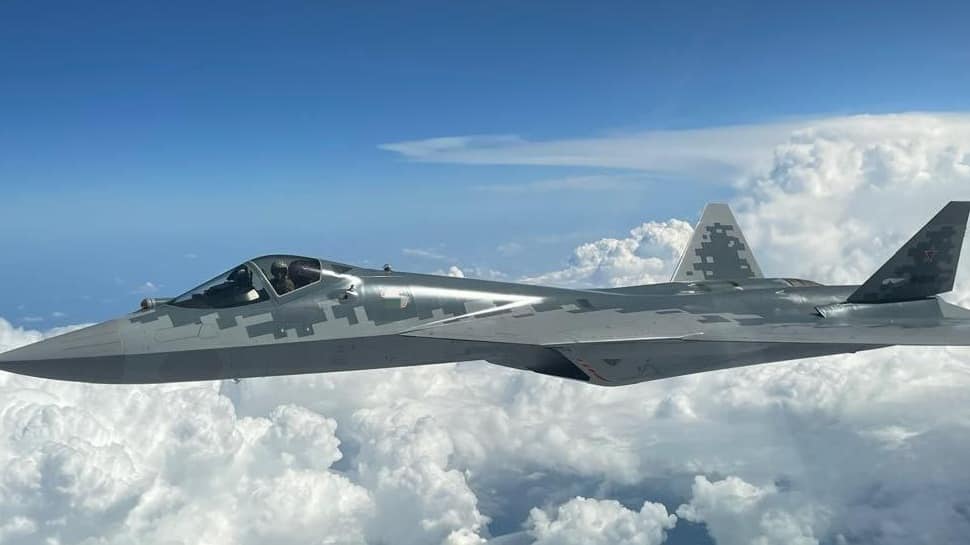
India has set in motion its procurement process for additional Rafale fighter jets for the Indian Air Force and Indian Navy. Notably, Rafale is the 4.5-gen aircraft and India has been looking to build or buy the fifth-generation aircraft specially since the Chinese have displayed their new fighter jets resembling fifth and sixth-gen capabilities. Despite America’s push for F-35 sales to India, the Russian Su-57 has reportedly emerged Indian Air Force’s first choice.
While the official negotiations are yet to begin, the Russian offer to the Indian Air Force is being explored and its technicalities are being weighed upon.
Why Su-57 and not F-35?
According to analysts, India is well aware that buying the F-35 will mean full dependence on America for even its operations and weapon integration challenges. The F-35 won’t allow Indian weapons integrations and thus, the Indian Air Force will have to depend on western weapons as well. The F-35 offer to India also doesn’t include ToT or tech transfer to India. American fighter jets can operate only with the permission of the US government, as the sorties are monitored by them. This poses a significant challenge for India.
On the other hand, Russia has not only offered full tech transfer to India but also localised production to support indigenous capacity development. This offer suits the needs of the Indian Air Force. Su-57 had already made its flying debut at Aero India in Bengaluru last year. China has operational fifth-generation fighter jets J-20 and J-35 and according to reports, Beijing will be extending them to Pakistan as well. Thus, Su-57 has become the frontrunner for the IAF as a stopgap arrangement.
The Su-57 Deal
The fifth-generation fighter jet has been developed by Russia under the PAK FA programme. It has required stealth characteristics with high manoeuvrability. The integration of Indian weapons and missiles will make the long-range strike possible, thus benefiting the IAF.
The proposed Su-57 deal with India is said to include the acquisition of 36–40 aircraft, with the total cost estimated at approximately $7 billion. The Indian Air Force (IAF) reportedly views the platform as a stopgap fifth-generation solution while the AMCA programme continues to progress.
The Su-57 features stealth-oriented design elements, internal weapons bays, and sophisticated avionics aimed at lowering radar detectability. It is currently powered by the AL-41F1 engine, with plans to upgrade to the more advanced Izdeliye 30 engine, which is expected to deliver greater thrust and improved fuel efficiency.