“We did Iwo Jima. We can do this. The Marines. My money is always on the Marines. I don’t know if you take the island or you blockade the island, but I know this.” Lindsey Graham, a senior member of the US senate from President Donald Trump’s Republican Party, said this while calling for pointed American action to take Iran’s oil hub, Kharg Island.
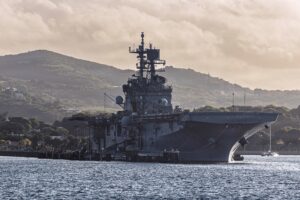
Graham’s recall of the World War 2 battle between the US and Japan is part of growing talk within the American political sphere of using the 31st Marine Expeditionary Unit (MEU), centered around the warship USS Tripoli, to seize and occupy Kharg Island at the northern corner of the Persian Gulf.
But Iwo Jima was not won as easily as Graham seems to suggest.
What was the Iwo Jima battle 8 decades ago?
The island of Iwo Jima was a Japanese stronghold, which the Americans wanted as an airbase as the war escalated in mid-1945, near its eventual end.
Three US Marine divisions, more than 80,000 men, were assigned to the assault that began on February 19, 1945. But the first wave of Marines had more trouble with the terrain than enemy fire, as the Japanese responded quickly from their dug in positions and swept the beaches with concentrated fire, as per the US government’s retelling.
The island, only about 8 square miles (or 20 sq kilometres) in area, was considered crucial, because capturing it would put heavy bombing jets within strike range of mainland Japan using the island’s three airfields, says the US Department of Defense (or War, as recently renamed by Trump).

Consisting of Marine divisions, besides troops from the US Army and Navy, the invasion fleet consisted of about 80,000 fighting men. With them were naval engineers needed to reopen the island’s three airfields once it was invaded.
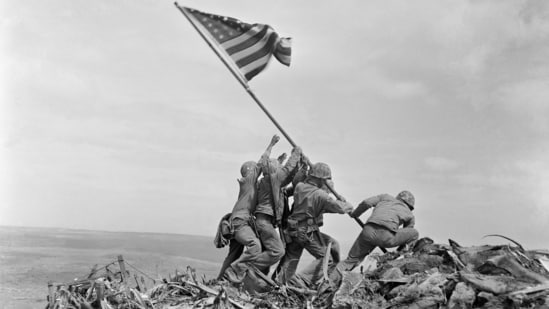
By February 23, 1945, the Marines took control of a key position, Mount Suribachi, where they famously raised the American flag after struggling with string winds. This moment was etched in history with a click by Joe Rosenthal, an American photographer who received the Pulitzer Prize for this iconic shot.
But the romance of that photograph came with the tragedy of thousands of lives lost.
The battle for Iwo Jima lasted 36 days, and the final death toll among US Marines was 5,931 killed; more than twice the number of Marines killed in all of World War 1, the US government noted. Counting the deaths of other US troops, doctors and engineers, nearly 6,800 Americans were killed and over 19,000 were wounded, making it one of the costliest battles in US Marine Corps history.
Japan lost approximately 18,000 of its roughly 21,000 defenders, with very few choosing to surrender.
The US government defines its losses thus: “More than 800 Americans gave their lives for every square mile of Iwo Jima’s black volcanic sand.” The battle win hastened the end of the Second World War.
What US has done so far about Kharg
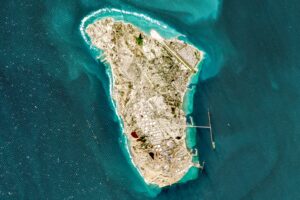
Cut to now: Iran’s Kharg Island is roughly the same size, 8 square miles of about 20 sq km. The island is largely covered by petroleum storage and pipelines that move 90% of Iran’s oil exports to sea from the mainland, which is about 25 km away. The island also houses Iranian military installations.
The US has undertaken some strikes on Kharg, but largely spared the oil infra so far. Successfully invading the island can further cripple Iran’s economy, analysts say.
And now that Trump and the Khamenei regime are still going back and forth on the possibility of talks to end the war, a US invasion of Kharg could provide a bargaining chip to force Tehran to reopen the oil export route Strait of Hormuz, which is at the nub of the global impact of the conflict.
“The day we control that island, this regime, this terrorist regime, has been weakened,” Lindsey Graham told American TV channel Fox News at the start of this week.
“I’m sort of tired of all this armchair quarterbacking. This has been an amazing military operation,” he said referring to the US-Israeli attack on Iran that began on February 28. “We’ve got two Marine expeditionary units sailing to this island… And here’s what I want to do: I want to sprint to peace. As the war winds down, I want peace to ramp up,” he argued.
Will ops on Kharg be similar to Iwo Jima?
But taking Kharg Island may be a big risk for little reward, according to James Stavridis, a retired US Navy admiral and former Supreme Allied Commander of NATO.
“The first challenge, before even contemplating boots ashore on Kharg, would be getting the MEU (Marine Expeditionary Unit) ships through the Strait of Hormuz. As they approach the strait, US Central Command (CENTCOM) will have to assume the ships have been geolocated either by the Iranians or their Russian allies, who are providing very granular intelligence to Tehran. The 31st MEU on the (US warship) Tripoli will be the top target — both for protecting Kharg and for the publicity and morale boost the Iranians would get for successfully striking the elite force,” James Stavridis wrote for Bloomberg on Tuesday.
He said that even if the force traverses the strait without significant loss, the Iranians are likely to pepper the ships with drone attacks.
If they manage to land on Kharg, the troops may not face challenges as big as Iwo Jima from 80 years ago, he noted.
“Fortunately, Kharg is made of coral (unlike the volcanic sands the Marines faced at Iwo Jima in 1945), meaning it would be hard for the Iranians to dig in and defend. And at the moment it is lightly protected — although this could quickly change,” Stavridis, Dean Emeritus at the Fletcher School of Law and Diplomacy at Tufts University in the US, wrote further.

He underlined that there remain significant risks and potential pitfalls: “There are roughly 20,000 Iranians on the island (almost all civilian oil workers) who would need to be contained in their homes or evacuated; the Iranians may have planted sophisticated booby traps; Iran could successfully strike one of the big amphibious ships (as the Argentines did to the British in the Falklands War in 1982). US casualties would almost certainly rise quickly from the 13 who have so far been killed during Operation Epic Fury.”
He said the invasion is possible but won’t be “surgical”, and still leave Iran with plenty of other potential steps to create mayhem and improve its bargaining position.
Vietnam recall ringing already
Already, the US administration is facing questions if the war, which Trump had claimed would be “swift and decisive”, is turning into another Vietnam.
Iran’s foreign minister Abbas Araghchi last week drew that analogy, too.
He said that while Trump continues to say the US “is winning” in Iran, the situation on the ground is different.
He pointedly referred to one of the most discredited episodes in US military history, the so-called “Five O’Clock Follies”. These were daily military press briefings in Saigon in the 1960s projecting optimism even as the US lost over 50,000 soldiers of its own in a conflict that killed nearly 3 million people.
Trump is already facing heat from within, too, over the war. His counter-terror chief Joe Kent resigned by saying that Israel had essentially forced Trump-led US into this war. Even now, when Trump has spoken of “talks”, Kent said the Israelis will have to be “retrained” before a negotiated end to the war may be reached.
As for Iwo Jima, it is part of Japan’s Volcano Islands territory now, located around 1,250 kilometres from Tokyo, that’s uninhabited except for a military garrison.