
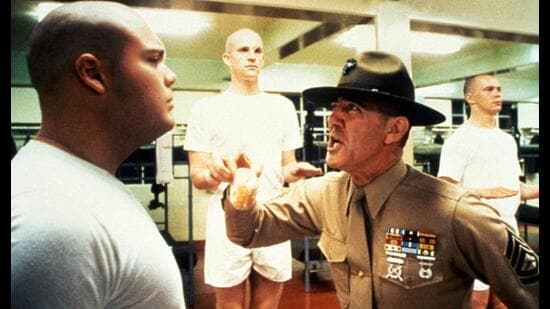
‘I wanted to meet interesting and stimulating people of an ancient culture… and kill them. I wanted to be the first kid on my block to get a confirmed kill!’ Give Stanley Kubrick every award possible for giving us such a prescient scene in Full Metal Jacket. Private Joker’s bright smile contrasted with the nothingness of his bespectacled eyes, just like the “Communist” peace badge on his chest militated against his US military ‘Born To Kill’ helmet throughout.
Exactly 53 years ago, the Vietnam War officially ended with the departure of the last of the US combat troops. The war that elicited countless expressions of contradictions like Private Joker’s very persona. The war that gave the US its first unequivocal defeat. The war that failed to deter the US from making military interventions in different parts of the world. Today, we are again discussing the contradictions in yet another war being waged by the US — the one on Iran, which is already being predicted by some to become the next Vietnam for the American military.
Even before the first American boots sank into the mud of Vietnam, Graham Greene had already diagnosed the pathology of the aggressor’s contradictions in The Quiet American. His Alden Pyle — soft-spoken, principled, and devastatingly sincere — embodies a bloodthirsty innocence: The belief that violence, if guided by the right ideas, can produce a just world. Pyle intellectualises violence. The dead become unfortunate necessities in the service of an abstract good.
Now place beside him Kubrick’s Pyle. The continuity is not accidental — it is incremental, just like the US wars. Greene’s Pyle is the idea leading to the outcome of Kubrick’s Pyle. One theorises intervention, the other enacts its cost. The former speaks the language of policy papers and moral frameworks; the latter screams in the silence of a barracks bathroom, rifle in hand, mind fractured by the very system that demanded his transformation. Both of them, of course, unleash highly avoidable violence. This is the arc – from conviction to conditioning. And between them lies the formidable American machinery of war. Joker, with his “Born To Kill” helmet and peace badge, merely recognises the contradiction. Pyle, both in Greene and Kubrick avatars, lives it.
The US frames its involvement as stabilising, Israel as defensive, and Iran as resistance. Each narrative contains some truth. And each, like Pyle’s ideology, is a shield against self-interrogation. The result is a recursive cycle. Ideas generate interventions; interventions generate systems; systems produce consequences that demand new ideas. At every stage, the original contradiction persists. The desire to do good, or at least appear to be doing good, through means that systematically produce harm. Joker’s uneasy awareness becomes, in this sense, the exception rather than the rule.
What makes this continuity so unsettling is its invisibility to those who sustain it. Greene’s Pyle never recognises himself as a precursor to tragedy; Kubrick’s Pyle never understands the forces that produced him. Similarly, contemporary actors rarely see the full arc of their own actions. The rhetoric has evolved to include sterile-sounding phrases like “precision strikes,” “deterrence frameworks,” “rules-based order,” et cetera. The underlying faith remains the same. Violence, properly managed, is still imagined as a tool of order.
The enduring relevance of The Quiet American and Full Metal Jacket lies in how seamlessly they map onto each other and onto our present. Greene gives us the moral architecture and Kubrick reveals the human wreckage it creates. Together, they form a single, continuous narrative of modern warfare, one that stretches from the drawing rooms of policy to the shattered psyche of the individual. The US, Israel, and Iran are not merely participants in a geopolitical struggle, they are also authors of competing fictions. Each forcing coherence on a reality that resists it.
Public discourse oscillates between outrage, uneasiness, and fatigue, rarely settling into sustained engagement. The bystanders are either Thomas Fowler, the cynical narrator of Greene or the Jung-quoting Joker of Kubrick. The spectacle of conflict, which was once experienced through delayed reports and grainy footage, is now immediate and immersive on our screens. But the Fowlers and the Jokers of the world cannot initiate any collective action.
Fifty-three years after the Vietnam War, all lessons remain unlearnt. Greene’s Pyle still drafts the blueprint, confident in his abstractions. Kubrick’s Pyle still pays the price, moulded and broken by their implementation. And in the uneasy space between them, the world continues to replay the same tragic script. It is facelifted by technology, relocated in geography, but unchanged in its essential ugliness.
Nishtha Gautam is an academician and author. The views expressed are personal


