
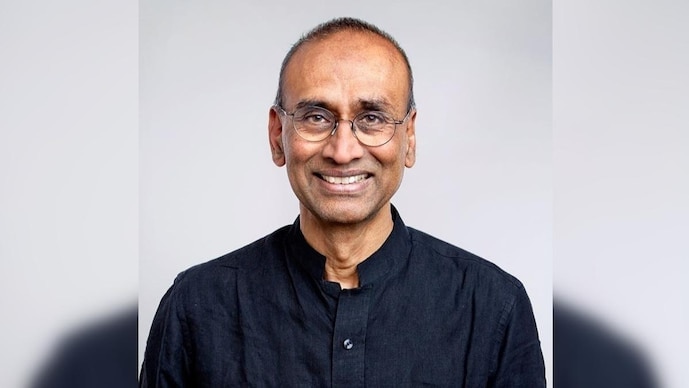
In India, exams like IIT-JEE are often viewed as the defining gateway to success. Years of intense preparation, constant pressure, and societal expectations can make it seem as if your entire future depends on a single rank.
But what if that moment doesn’t go your way? The life of Venkatraman Ramakrishnan answers that question powerfully.
He didn’t clear IIT-JEE. He didn’t get into Christian Medical College, Vellore. By conventional standards, those could have been seen as setbacks.
Yet, he went on to win the Nobel Prize in Chemistry, one of the highest honours in the world.
His story challenges the very idea of “one exam decides everything.” It reminds us that true success is not built on a single result, but on curiosity, resilience, and the courage to keep going even when things don’t unfold as planned.
WHO WAS VENKI RAMAKRISHNAN BEFORE THE NOBEL PRIZE?
Born in 1952 in Chidambaram, Tamil Nadu, and raised in Vadodara, Gujarat, Venki grew up in a deeply scientific environment. Both his parents were scientists, and discussions at home often revolved around research and discovery.
However, he wasn’t always an exceptional student. He struggled at times during school. Things changed when a teacher, TC Patel, made science and mathematics engaging and meaningful. That spark ignited a lifelong curiosity.
Interestingly, Venki also loved subjects like English and history, but science gradually became his path.
WHAT HAPPENED WHEN HE TRIED TO GET INTO IIT AND CMC?
Like many Indian students, Venki aimed for top institutions. He appeared for IIT entrance exams and applied to Christian Medical College (CMC), Vellore.
He didn’t get into it either. For many, this would feel like a crushing failure. But his family didn’t panic. They didn’t equate rejection with failure. Instead, they believed that success depends on the individual, not the institution.
That mindset made all the difference.
WHAT PATH DID HE CHOOSE AFTER MISSING IIT?
Around this time, Venki earned the National Science Talent Search Scholarship, which encouraged him to pursue basic sciences.
He attended Maharaja Sayajirao University of Baroda to study Physics.
This decision, away from prestige and toward genuine interest, became a turning point. It gave him a strong academic grounding and, more importantly, nurtured his curiosity for research.
HOW DID PHYSICS LEAD HIM TO BIOLOGY AND BREAKTHROUGH RESEARCH?
After completing his degree, Venki moved to the United States for higher studies. There, he made a bold and unconventional shift, from physics to biology.
He became fascinated by ribosomes, tiny molecular machines that read genetic instructions and build proteins essential for life.
Studying them was incredibly complex. Progress was slow, and challenges were constant. But Venki stayed committed.
WHAT DID HE DISCOVER THAT WON HIM THE NOBEL PRIZE?
In 2009, Venkatraman Ramakrishnan mapped the atomic structure of the ribosome, a groundbreaking discovery that transformed our understanding of how cells produce proteins.
This achievement had far-reaching implications: it advanced fundamental biology, helped scientists design better antibiotics, and solved a scientific mystery that had puzzled researchers for decades.
For this remarkable work, he was awarded the Nobel Prize in Chemistry in 2009, proving that the student who didn’t crack IIT-JEE could still reach the pinnacle of global science.
Venki’s contributions continued well beyond his Nobel-winning work. He served as President of the Royal Society from 2015 to 2020 and was honoured with India’s prestigious Padma Vibhushan in 2010.
Alongside his scientific achievements, he also became an author, writing books like The Gene Machine, where he shares his journey and insights into science.
Today, at 73, Venkatraman Ramakrishnan remains inspired by the academic environment of Cambridge, continuing to contribute to both science and literature.
CAN FAILURE ACTUALLY BE A NEW BEGINNING?
The life of Venkatraman Ramakrishnan makes one thing clear: a single exam does not define your future. He didn’t crack IIT-JEE, nor did he get into the institutions he once aimed for.
Yet, instead of letting those moments define him, he chose curiosity over comparison, growth over disappointment, and persistence over self-doubt. His journey shows that missing out on a “top” college is not the end of the road, it may just be the beginning of a different, more meaningful one.
What truly shapes your future is your willingness to keep learning, to adapt when things don’t go as planned, and to continue moving forward despite setbacks. Sometimes, the paths we never intended to take lead us to the most extraordinary destinations.
So if things haven’t gone your way, remember, your story is still unfolding, and its best chapters may still lie ahead.


