
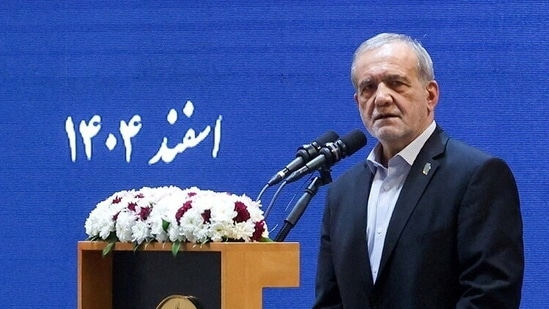
Iran’s President Masoud Pezeshkian on Wednesday released an open letter addressed to the American people, calling for a shift away from conflict and suggesting the possibility of diplomatic engagement.
The letter came just hours before Donald Trump was set to address the nation with what he described as an “important update” on the Iran war. Earlier in the day, Trump had claimed on social media that Iran was seeking a cease-fire, a statement that Iran’s Foreign Ministry spokesman Esmaeil Baghaei called “false and baseless.”
Why he wrote the letter
Pezeshkian addressed his letter not to the American government but to the American people. But he did not address Iran’s closure of the Strait of Hormuz which has caused significant disruption to the global economy.
“The Iranian people harbor no enmity toward other nations, including the people of America, Europe, or neighboring countries,” he wrote.
“Even in the face of repeated foreign interventions and pressures throughout their proud history, Iranians have consistently drawn a clear distinction between governments and the peoples they govern. This is a deeply rooted principle in Iranian culture and collective consciousness not a temporary political stance,” he added.
According to New York Times, The letter came on a day of mixed signals from Tehran. Earlier on Wednesday, Trump claimed on social media that Iran had requested a cease-fire. Iran’s Foreign Ministry spokesman Esmaeil Baghaei shot that down, calling the claim “false and baseless.”
Pezeshkian’s letter did not directly address the cease-fire question but signaled a willingness to talk.
“Today, the world stands at crossroads,” he wrote in the letter which was released by his office. “The choice between confrontation and engagement is both real and consequential; its outcome will shape the future for generations to come.”
Iran had never started the war, he says
A significant portion of the letter was devoted to Iran’s historical identity and its grievances against the United States. Pezeshkian argued that Iran, despite being one of the oldest continuous civilizations in history has never been the aggressor.
“Iran has never initiated a war. Yet it has resolutely and bravely repelled those who have attacked it,” he wrote.
He also traced the roots of Iranian-American hostility back to the 1953 coup which he described as an illegal American intervention that disrupted Iran’s democratic process and reinstated dictatorship. He went on to cite America’s support for the Shah, its backing of Saddam Hussein during the Iran-Iraq war in the 1980s, decades of what he called the most comprehensive sanctions in modern history and most recently, military strikes launched on February 28 which he said came in the middle of ongoing nuclear negotiations.
Despite all of this, he argued that Iran has not been weakened. “All these pressures have failed to weaken Iran. On the contrary, the country has grown stronger in many areas,” he wrote, pointing to improvements in literacy, higher education, technology and healthcare since the Islamic Revolution.
“What Iran has done and continues to do is a measured response grounded in legitimate self-defense, and by no means an initiation of war or aggression,” he wrote.
Letter signals openness to talk amid war tensions
Even though the letter sounds open to dialogue, it is unclear how much influence it has. In Iran’s system, President Masoud Pezeshkian does not have the final say. That power lies with Supreme Leader Mojtaba Khamenei who decides on major issues like talks with the US or ending the war.
The Islamic Revolutionary Guards Corps has also become more powerful during the conflict with senior commanders playing a bigger role. It is still not clear if the letter was approved by Khamenei or reflects the full view of Iran’s leadership.
For now, the letter shows how Pezeshkian wants the world to see Iran but what happens next will depend on decisions beyond his control.


