Every year when the new school session begins, there’s a budget, often a huge one, that parents and families keep aside only for books and related expenses. But they have no right to decide where to buy their children’s books, notebooks or even a pencil from and for how much. Then who does?
The answer is: schools.
India Today investigates how, year after year, some private schools have been nudging, and at times forcing, parents to buy books and stationery from specific shops. It is not just about what is being bought, parents say, but how little choice they are left with in the process.
A ground report from Uttar Pradesh’s Lucknow tells a wider story about it.
For example, if textbooks in the CBSE system are largely guided by NCERT, then why are families being directed towards costly bundles from private publishers and fixed vendors?
That question sits at the centre of what many parents call a growing “book mafia”.
A LIST THAT DECIDES EVERYTHING
It often begins with something as simple as a school list.
But as India Today found, these lists can be unusually detailed and restrictive. For nursery students, parents were told exactly which brand of chalk to buy, such as Chorus or Hi-Fi.
The crayons had to be Faber-Castell, paintbrushes, Weldon. At one school, parents said they were handed complete stationery kits, pencils, erasers, everything packed together, as part of a “mandatory” purchase.
Then come the notebooks. Lots of them.
One parent shared that a Class 2 student was asked to bring over 20 notebooks, many of which stayed untouched throughout the year. Another pointed out how these notebooks are often customised in a way that they are not available in regular markets. So even if you want to buy them elsewhere, you simply cannot.
And when you do buy them from the suggested shop, the price difference is hard to ignore. A set that could cost around Rs 500 to Rs 600 outside is sold for Rs 3,000 to Rs 4,000 through these channels.
At that point, it stops feeling like a list. It starts feeling like a bill.
‘BUY THE SET, OR GET NOTHING’
The experience becomes sharper when parents try to push back.
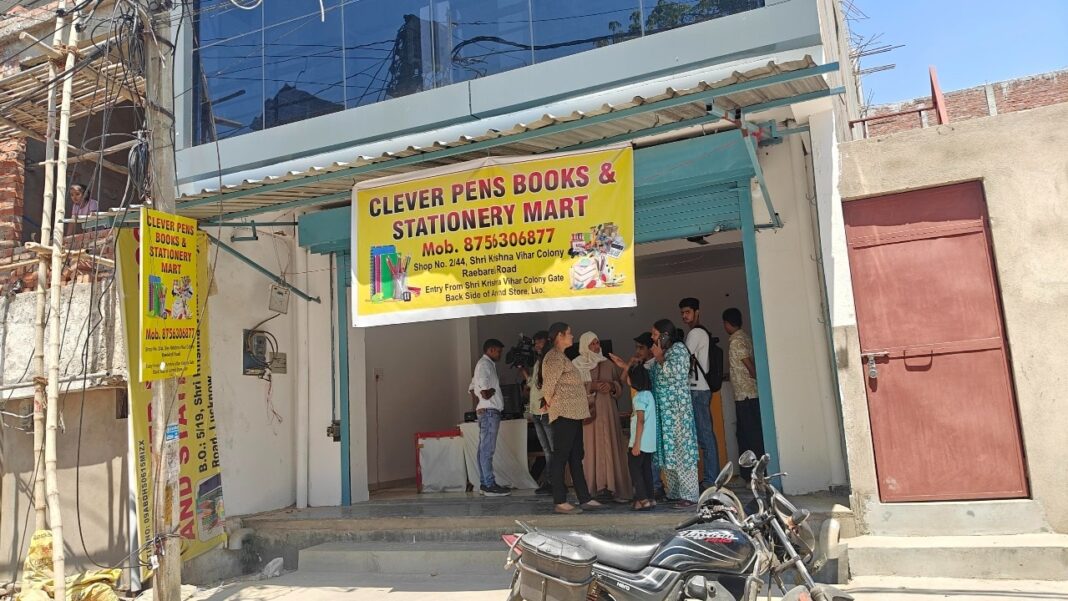
In Lucknow, Prince Lenin, a resident of Neelmatha, found himself in exactly that situation. His two children study in Classes 7 and 3. When he went to buy their textbooks from a store linked to the school, Clever Pace Book Store in Vrindavan Sector-9, he was told he could not purchase books alone.
The condition was clear: buy the full set, including notebooks.
Lenin says he had already bought notebooks from Aminabad at nearly half the price, and of better quality. But that did not help. The shop refused to give him the textbooks. When he returned on April 4, the answer was the same, instructions from the distributor, he was told.
He has since filed a complaint at the PGI police station in Lucknow.
What makes this more concerning is the timing. The school session began on March 24, yet his children were still without textbooks. “Because of this book syndicate,” he said, his children’s studies were being affected.
And he is not alone.
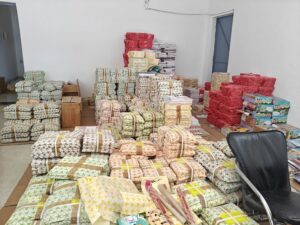
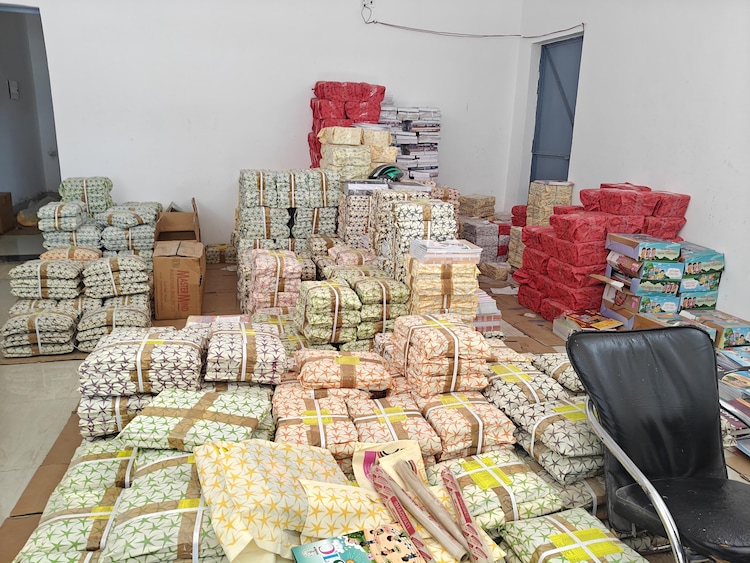
At the same store, India Today saw pre-packed bundles of books and stationery stacked neatly, ready to go, class-wise, fixed and non-negotiable.
Parents present there said they were under pressure from schools to buy only from this shop. Some pointed out that book sets for Classes 6 and 7 were priced above Rs 7,000 to Rs 8,000.
Many described it in the same way: a system driven by commissions, where the middle-class parent quietly pays the price.
WHEN CHOICE DISAPPEARS
There is also a quieter shift that parents have noticed.
Earlier, books could be reused, passed down from an elder sibling to a younger one. Now, parents say, syllabi seem to change frequently, or new editions are pushed every year.
Even slim textbooks from private publishers are priced at Rs 600 to Rs 800, with some as high as Rs 400 for a single subject like music.
All of this raises a simple concern: where does necessity end and pressure begin?
CBSE guidelines already say that schools should prefer NCERT books where available and be careful while prescribing private publishers. In fact, for Classes 9 to 12, NCERT textbooks are meant to be followed in subjects where they exist. That makes the push towards expensive alternatives harder to justify.
THE LAW IS CLEAR, BUT IS IT FOLLOWED?
Interestingly, this is not a grey area in Uttar Pradesh.
The Uttar Pradesh Self-Financed Independent Schools (Fee Regulation) Act, 2018 clearly states that schools cannot force parents to buy books, uniforms or accessories from a specific vendor. Parents are free to purchase these from anywhere.
The key provisions regarding books and school accessories are as follows:
No compulsion to purchase from designated shops: According to Section 3 of the Act, no school can compel a student or parent to purchase books, shoes, socks, or uniforms from a specific shop or vendor. Parents are free to purchase these items from anywhere, according to their own convenience.
Restrictions on uniform changes: Schools cannot change their uniforms within a period of less than five years. If a change is deemed necessary, prior permission must be obtained from the District Fee Regulatory Committee (DFRC) by providing valid reasons.
NCERT books: In accordance with the State Government’s directives, priority must be given to NCERT books in schools to ensure that parents are not burdened by the high cost of books published by private publishers.
Complaints and penalties: If any school violates these regulations, parents may lodge a complaint with the District Fee Regulatory Committee (DFRC) or the District Inspector of Schools (DIOS).
It also lays down penalties: Rs 1 lakh for a first violation, Rs 5 lakh for a second, and even the possibility of losing recognition for repeated offences.
On paper, the protection is strong.
In practice, parents say enforcement is where things fall apart.
BETWEEN RULES AND REALITY
School representatives acknowledge the issue, at least partly.
Anil Agarwal, President of the Unaided Schools Association, said instructions have been issued to schools against arbitrary practices and that book pricing cannot be inflated without reason. He added that discussions are ongoing, and a decision is expected.
On the administrative side, Lucknow’s District Inspector of Schools, Rakesh Kumar, said the District Magistrate has taken note of such complaints and a committee will be formed to investigate them.
That offers some hope. But for many parents, the concern is immediate.
As new sessions unfold and Class 11 admissions begin after CBSE results, families are once again walking into bookstores with long lists in hand, unsure whether they are making a choice, or simply following one.
And that is where the story truly sits: somewhere between what the rules promise and what parents actually experience.