
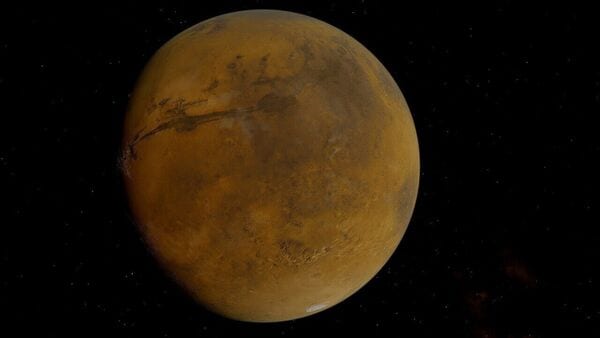
As NASA and other space agencies set their sights on sending astronauts to Mars in the coming decade, scientists are now trying to figure out if the human body is actually capable of surviving in this alien environment. While it is already known that zero-gravity environments tend to severely weaken the human body, scientists are now trying to figure out what happens to astronauts when they enter the surface of Mars, which actually has roughly one-third the gravity of Earth.
A recent study published in the journal Science Advances studies how lower gravity affected skeletal muscle tissue in 24 mice sent to JAXA’s Kibo experimental module onboard the International Space Station (ISS). Notably, skeletal muscle tissue is the most abundant tissue in the human body and accounts for around 40 percent of the total body mass.
“While we can simulate spaceflight on Earth in humans, it’s extremely complicated and costly,” said Mortreux. “We have centrifuges that can be used to temporarily expose humans to certain gravity levels, but it is not homogeneous nor constant.”
What did scientists study?
For a period of 27–28 days, the scientists placed the mice, which were subjected to four different levels of gravitational force: microgravity, 0.33 g, 0.67 g, and 1g (Earth’s gravity).
The scientists then analysed the weight, strength, and movement of the mice upon their return to Earth. They found that mice experienced severe muscle atrophy in microgravity, particularly in the soleus muscle (a vital calf muscle heavily reliant on gravity).
However, exposure to even 0.33g gravity was sufficient to partially mitigate this mass loss.
Despite this, the results showed that the 0.33g group still suffered a significant decline in forelimb grip strength. According to the researchers, a gravitational force of at least 0.67g is required to effectively preserve muscle performance and halt the activation of these muscle-degrading genes during spaceflight.
The samples of the mice were examined by the Metabolism and Muscle Biology Lab (MMBL) at the Department of Nutrition at the University of Rhode Island (URI). Professor Marie Mortreux, who leads the MBBL, told Rhody Today, “While we can simulate spaceflight on Earth in humans, it’s extremely complicated and costly. We have centrifuges that can be used to temporarily expose humans to certain gravity levels, but it is not homogeneous nor constant.”
“We used gravity levels that were equally separated to have a better picture of the dose-response of each system to gravity. The test group that was exposed to 0.33g was extremely close to Martian gravity (0.38g). Our findings for that group can be translated into actions to enable Mars exploration,” Mortreux added.


