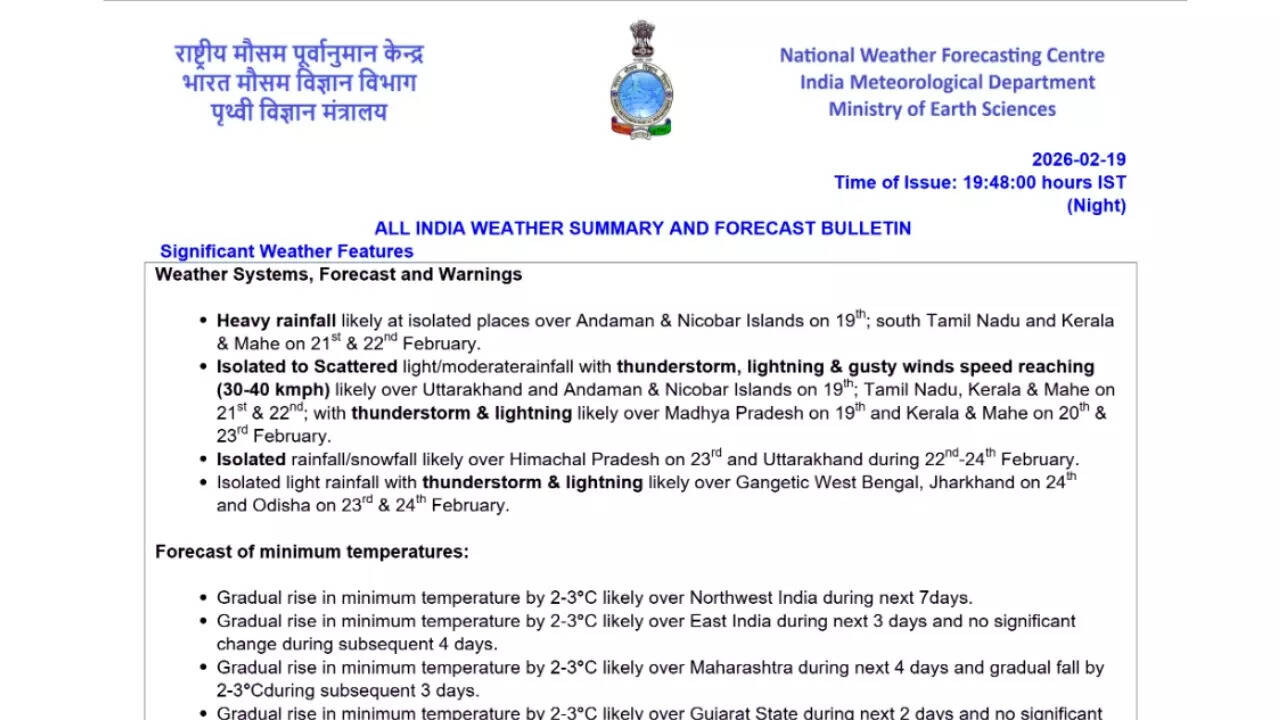
Travellers planning to visit southern India and the Andaman Islands may have to monitor the weather closely. As per the latest All India Weather Summary and Forecast Bulletin issued on 19 February 2026, heavy rain, thunderstorms, gusty winds, and squally sea conditions are expected to occur in various tourist spots between 20 and 23 February, while the entire northern part of the country is expected to witness an increase in temperatures.
Andaman and Nicobar Islands: Heavy rain and rough seas
Travellers planning to visit the Andaman and Nicobar Islands may have to face heavy rain and thunderstorms. The bulletin states that there will be heavy rain at isolated places, along with lightning and gusty winds reaching 30-40 kmph. Rainfall activity was reported in the islands, with Car Nicobar and Nancowry reporting measurable rainfall.
Sea conditions are also expected to turn rough. Squally winds with speeds of 45–55 kmph, gusting up to 65 kmph, are likely over parts of the southwest Bay of Bengal and adjoining Equatorial Indian Ocean.
Ferry services and small boats may have to temporarily shut down, and tourists are advised to check with local authorities before engaging in any marine activities.
Kerala and Tamil Nadu: Heavy Rainfall Ahead
The biggest disruption to travel plans in the coming days is expected in Kerala and Tamil Nadu, especially on 21 and 22 February.
Heavy rainfall is expected at isolated places in Kerala, Mahe, Tamil Nadu, Puducherry, and Karaikal on 21 and 22 February. Thunderstorms with lightning and gusty winds (30-40 kmph) are also very likely.
For tourists traveling to places like hill stations, backwater destinations, or temple towns in southern India, occasional heavy showers may disrupt road travel and sightseeing activities.
On 20 February, Kerala is also expected to have isolated thunderstorms with lightning, even before the heavy rainfall phase begins. Tourists planning trekking, wildlife, or houseboat holidays must be prepared for any last-minute changes in the weather.
Sea conditions near the Gulf of Mannar and Comorin area are also expected to remain squally through 20–22 February. This may affect coastal tourism and fishing-related excursions along southern shores.
Uttarakhand and Himachal Pradesh: Rain and snow
In the Himalayan region of the country, Uttarakhand may experience isolated rain/snow on 22-24 February, while Himachal Pradesh may experience isolated rain/snow on 23 February due to the approaching western disturbance.
For tourists planning to visit hill stations or undertake a religious pilgrimage in these states, there may be road hold-ups due to weather conditions, especially in the higher reaches. Although there are no indications of major disruptions, tourists planning to visit mountainous regions must be prepared for a fall in temperature and some rainfall.
Eastern states: Isolated thunderstorms
In the eastern region of the country, isolated rain with thunderstorms and lightning is expected in Gangetic West Bengal and Jharkhand on 24 February and in Odisha on 23 and 24 February. Although there are no indications of major disruptions, rain and lightning may cause temporary disruptions in outdoor activities.
Rising temperatures Across North India
While southern India prepares for rain, much of northwest India will experience a gradual warming trend. Minimum temperatures are expected to rise by 2–3 degrees Celsius over the next seven days across the region. The maximum temperatures are also expected to rise by 3-4 degrees Celsius.
This could result in more pleasant sightseeing experiences during the day in the northern plains and Rajasthan, especially for people who like warmer winter conditions. However, the significant rise in maximum temperatures in some areas may lead to warmer afternoons than usual for late February.
Travel advisory
At present, no widespread red-level alerts have been issued, but heavy rainfall and squally winds in southern coastal areas may affect flight schedules and road connectivity, particularly in Kerala, Tamil Nadu, and the Andaman Islands. Travellers are advised to monitor local weather updates before departure, allow buffer time for road travel in rain-prone areas, avoid marine excursions during squally wind warnings, and stay indoors during thunderstorms and lightning activity.