Clicking photos and shooting videos is my favourite hobby, and in many ways it is also how I earn my bread. I genuinely believe that a camera has to inspire you to take images. At least, that is how it works for me. I do not care much about specifications, nor about the marketing narratives that brands build around their cameras. This holds true whether it is a phone or a dedicated camera.

You can see this reflected in the cameras I have chosen for my own work. The Sigma fp, the Sony RX100 IV and the Canon 70D are not necessarily the most conventional choices, yet each of them inspired me to refine my craft. And now, after spending the weekend with the Xiaomi 17 Ultra, I can say that it inspired me as well.
So while I will mention the specifications here and there in this review of the Xiaomi 17 Ultra’s camera, the primary area I want to focus on is the feeling. How I felt while taking these images and after capturing them. If you are interested in understanding the perspective of a fashion cinematographer turned tech journalist, read on.

Leica colour science at play
To put it plainly, Xiaomi seems to have mastered the colours here. You have two Leica colour modes to choose from, Leica Authentic and Leica Vibrant. Leica Authentic colour science is closer to what you would get with Leica cameras, while Leica Vibrant is more in line with how other flagship phones tend to perform. It is brighter and more social media ready. Personally, I believe people with a more artistic inclination will prefer the Leica Authentic look. I certainly do.


hese colour modes, you also get built in filters such as Positive Film, Negative Film, Leica Vivid, Leica Natural, Leica Black and White, Leica Black and White High Contrast, Leica Sepia, Leica Blue, Cinematic and more. I mostly shot with the Leica Natural filter in its light setting. I also used Positive Film for some shots. These filters are implemented quite well and can produce genuinely beautiful images when used appropriately.
My advice would be to simply shoot in Leica Authentic mode using the original setting. If you want to experiment later, you can always change things afterwards. After all, these are filters rather than colour science. The colour science itself can be selected from the top right of the interface between Leica Authentic and Leica Vibrant.

Right from the start, the images appear highly detailed, even in the 12.5 megapixel mode. Things change quite dramatically once you switch to the 50 megapixel mode. The one inch sensor used here provides a very natural depth of field. In many situations, you do not even need to rely on portrait mode because the natural background blur from the sensor itself is strong enough.
Another aspect I truly appreciated is the autofocus speed, which is incredibly quick. I spent some time understanding how the autofocus behaved while moving around, shooting on the run, taking shots from the hip and capturing moments quickly. The phone consistently managed to lock on to faces almost instantly and rarely missed a shot.

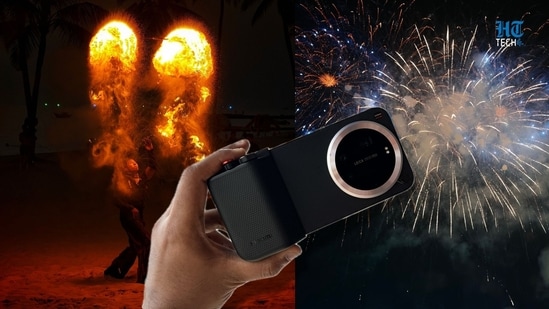
It also helps that the photography kit, which now comes bundled, makes the experience easier. You can half press the shutter button to focus and then fully press it to capture the photo. This simple addition makes the phone behave much more like a real camera.
LOFIC. Underrated, but very promising
Let us now talk about LOFIC, which stands for Lateral Overglow Integration Capacitor. The name sounds like complex technical jargon, and I think you should forget about it. But in simple terms it allows the Xiaomi 17 Ultra’s one inch sensor to capture a wider range in its images. This technology is exclusive to the primary 50 megapixel sensor and does not apply to the telephoto or ultra wide sensors.
To understand its impact, I tried shooting some extremely bright scenes. In most situations I was pleasantly surprised by the amount of detail the one inch sensor was able to retain in both highlights and shadows.

Take, for example, a particularly tricky shot I captured against the sun, where vines were hanging with harsh sunlight behind them. The phone managed to retain plenty of detail without producing an overly HDR looking image. In simple terms, it feels as though there is less artificial processing and more reliance on the hardware itself. Xiaomi seems to be leaning heavily into the hardware approach here, and it shows. The images don’t fall apart like the way they do with some rivals, and I like this approach. You can’t beat physics.


The telephoto camera also surprised me. The continuous zoom telephoto between 75 mm and 100 mm captures a remarkable amount of detail, and the images look remarkably natural. They genuinely resemble the output of a proper dedicated camera. In fact, I did not miss my Sigma fp at all while shooting.
Portrait photography is another area where the phone performs exceptionally well. The edge detection is accurate and the bokeh fall off looks natural rather than artificial. The subjects I captured appeared realistic, and the phone was even able to separate fine strands of hair from the background.

This is clearly an area Xiaomi has improved compared to its earlier phones. I remember shooting a portrait in a particularly tricky lighting situation where the phone managed to create a perfect cut out around a person’s head, capturing even the smallest strands of hair.
The bokeh also behaves in a gradual manner. It does not suddenly blur the background like many competing phones. Instead, it begins subtly and gradually increases as the background moves further away.
Personally, I shot most of my portraits using the telephoto camera. I prefer the compression that telephoto lenses offer, and the phone did not disappoint. It is also worth mentioning that this telephoto sensor allows you to shoot high resolution 200 megapixel images across the 75 mm to 100 mm range in a lossless manner.

Capturing a 200 megapixel image does take a little time, but once the image is processed the level of detail is worth checking out. You can easily reframe the entire shot afterwards. That said, I would not recommend using this mode in every situation. Since it takes time to process, you could miss a fleeting moment. It works best in controlled environments where you know you have the time to capture maximum detail.
Video. Stable, detailed and organic
Video performance is another area where I was genuinely impressed. The detail captured is excellent, but what stood out to me even more was the minimal noise in extremely dark scenes. Xiaomi seems to have caught up to Apple in this regard.
Small details also make a difference here. The lens transitions are handled very well. The shift between 3x and 4.3x is naturally smooth because of the continuous zoom system, but even transitions between 1x all the way up to 30x feel surprisingly fluid. I would say this is the smoothest zoom transition I have seen outside the iPhone..
That said, there is some colour shifting between the lenses during these transitions. Personally, I can live with this, especially if you shoot in Pro mode and lock your settings.
Another aspect I appreciated is the natural bokeh produced by the one inch sensor while recording video. It creates a pleasing background fall off and shallow depth of field when filming subjects. This is particularly useful for product shots and even for self facing videos. In many ways, it behaves very much like a dedicated camera with strong background separation.
The phone can also record slow motion video up to 4K at 120 fps, and the 4K 120 fps footage it produces looks extremely crisp.
What can Xiaomi improve?
Of course, not everything is perfect. The phone features a 50 megapixel front facing camera, but despite its specifications it does not quite match the quality of the rear cameras. In my opinion, the iPhone 17 series still sets a very high benchmark for selfies. Sometimes the Xiaomi’s selfies can appear slightly dull or ashy and a tad too bright.
That said, the front camera does include autofocus, which helps in capturing reasonably detailed images. In reality, I suspect most people buying this phone will not be overly concerned about the selfie camera. This device is clearly built for enthusiasts who care more about the rear camera system. For occasional selfies it will do the job, but it is not on the same level as the rear cameras.

Another small complaint is the processing time. After capturing several images in quick succession, especially in the 50 megapixel or 200 megapixel modes, the phone can take a few seconds to process them.
Verdict: The Xiaomi 17 Ultra makes it surprisingly difficult for me to justify carrying a bulky camera anymore
At ₹1.4 lakh, the Xiaomi 17 Ultra is undeniably an expensive phone. That said, card offers bring the effective price down to around ₹1.3 lakh, and Xiaomi is also bundling the photography kit at this price, which does add meaningful value to the overall package.
At this price point, it goes head to head with the Samsung Galaxy S26 Ultra and the iPhone 17 Pro. But after spending time with it, I genuinely feel the Xiaomi 17 Ultra stands out as the more camera focused device of the three. There were several moments over the past few days where I instinctively reached for it instead of my dedicated cameras.

The colour science is beautiful, the portraits come out stunning, and the level of detail the cameras capture is simply impressive. Everything about the experience feels built around people who genuinely enjoy photography.
Yes, the price has gone up compared to the Xiaomi 15 Ultra. But if mobile photography is something you truly care about, the ₹1.3 lakh asking price could still make sense. Especially if you are someone who would rather not carry a bulky camera everywhere. After using it, I can honestly say it is getting harder for me to justify doing that myself.