

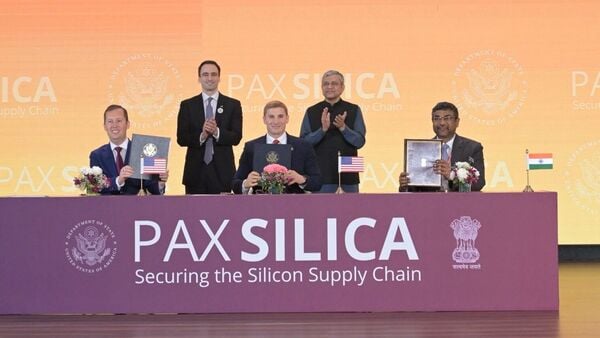
India AI Impact Summit 2026: India formally joined Pax Silica –the US-led effort on artificial intelligence and supply chain security – today, 20 February, on the sidelines of the India AI Impact Summit, being held here in the national capital.
India signed and exchanged the Pax Silica declaration in the presence of visiting Under Secretary of State for Economic Affairs Jacob Helberg, US Ambassador Sergio Gor, and S Krishnan, Secretary, Electronics and Information Technology, today, the fourth day of the India AI Impact Summit.
Union Minister of Electronics and Information Technology, Ashwini Vaishnaw, and Google CEO, Sundar Pichai, were also present on the occasion.
“Pax Silica is our declaration that the future belongs to those who build and when free people join forces, we do not wait for the future to be given to us. We build it ourselves,” Helberg said after India became a Pax Silica signatory.
Helberg will also hold bilateral meetings and deliver remarks at the conference to further the United States’ economic relationship and partnerships in emerging technologies with India and help launch the next phase of the American AI Exports Program, part of the AI Action Plan.
What is Pax Silica?
Launched in December 2025, Pax Silica is the US Department of State’s flagship effort on AI and supply chain security, advancing economic security consensus among allies and trusted partners a new.
The name combines “Pax” (Latin for peace) and “Silica” (referencing silicon chips), symbolising a stable, cooperative, and peaceful technological order.
The coalition aims to secure the entire AI technology stack, from mineral extraction to advanced manufacturing and logistics. It seeks to counter coercive dependencies and enhance economic security.
The Pax Silica Declaration underlines the importance of a reliable supply chain indispensable to mutual economic security and recognises AI as a transformative force for long-term prosperity.
“We recognise that a reliable supply chain is indispensable to our mutual economic security. We also recognise that artificial intelligence (AI) represents a transformative force for our long-term prosperity and that trustworthy systems are essential to safeguarding our mutual security and prosperity,” reads the Pax Silica Declaration.
One of the key pillars of Pax Silica is establishing a durable economic order to drive AI-powered prosperity across partner nations.
As per an official statement by the State Department, while Australia, Greece, Israel, Japan, Qatar, the Republic of Korea, Singapore, the UAE, and the UK are the signatories of the declaration, the non-signatory participants include Canada, the European Union, the Netherlands, the Organisation for Economic Cooperation and Development and Taiwan.
How significant is Pax Silica for India?
The participation in the US-led bloc would mean India would play a role in shaping future supply chains that underpin AI and advanced computing. In January, S Krishnan, Secretary, Electronics and Information Technology, had said that it was crucial for India to be part of groups such as Pax Silica that focus on critical mineral security.
“From a strategic point of view, it’s important that India be at the high table on these important issues. Fundamentally, it’s about addressing the supply chains for critical minerals and materials. It’s important for a country like India to be part of that. I think it’s a recognition, again, of the trust,” Krishnan said, responding to a question on Pax Silica at an event in Delhi.
‘India’s push in AI and semiconductors’
India’s existing policy push in AI and semiconductors aligns closely with the goals of Pax Silica, Mint reported earlier. The India AI Mission, approved in 2024 with a ₹10,372 crore outlay over five years, seeks to democratise artificial intelligence, support startups and build foundational models for Indian languages.
The India Semiconductor Mission is an even greater effort, with a ₹76,000 crore corpus allocated in 2021 to position the country as a chipmaking hub.
India hosts more than 2,975 global capability centres (GCCs) and accounts for the world’s largest share of such centres, according to a 2024 Nasscom–Zinnov report.
Jaishankar attends Critical Minerals Ministerial
The development comes shortly after India participated in the Critical Minerals Ministerial convened by US Secretary of State Marco Rubio earlier in February, represented by External Affairs Minister S Jaishankar.
On the sidelines of the Ministerial, EAM Jaishankar told news agency ANI that India extended its support to the Forum on Resource, Geostrategic Engagement (FORGE), a newly launched initiative unveiled at the inaugural Critical Minerals Ministerial, which succeeds the US-led Mineral Security Partnership.
Jaishankar attended the inaugural Critical Minerals Ministerial in Washington DC on Wednesday (local time), during which the EAM called for structured international cooperation to “de-risk” critical mineral supply chains, noting that “excessive concentration” poses a major global risk.
India AI Impact Summit 2026
The India AI Impact Summit 2026, the first global AI summit hosted in the Global South, has brought together policymakers, industry leaders, academics and civil society representatives to deliberate on responsible AI governance and inclusive technological advancement.
On Thursday, the summit saw a number of world leaders, CEOs and business leaders from across the globe come together to share their views on artificial intelligence and announce dozens of deals.
India expects more than $200 billion in investments over the next two years, and US tech titans unveiled new deals and infrastructure projects this week.
Prime Minister Narendra Modi stressed the need to democratise artificial intelligence, while calling for a transparent approach to data sharing.
We recognise that a reliable supply chain is indispensable to our mutual economic security.
Speaking at the opening ceremony of The India AI Impact Summit 2026, PM Modi also presented India’s MANAV Vision for AI, which he said will serve as a crucial link in advancing humanity’s welfare.
(With agency inputs)