
The way software is being built inside large tech companies is changing faster than expected, and fresh comments from Praveen Neppalli Naga offer a clear picture of it. In a fresh post, Uber’s Chief Technology Officer (CTO) spoke about the rapid rise of AI-led coding within the company, where machines are no longer just assisting software engineers but are increasingly taking over the task of writing code itself. Interestingly, big tech companies like Google and Microsoft have already started doing this. Naga also revealed what human engineers are now doing, as AI agents are now able to do most coding tasks. Here is everything he said.
Uber CEO reveals all codes are now written by AI
Naga revealed that Uber is now seeing large-scale adoption of what he described as “agentic software engineering.” According to him, around 1,800 code changes every week are being written entirely by the company’s internal AI coding agent, without direct human input in the writing process.
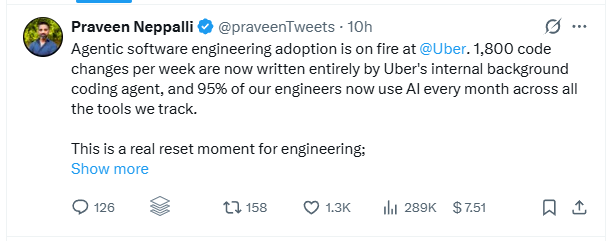
He also noted that nearly 95 per cent of Uber’s engineers are actively using AI tools each month. Even within traditional coding environments, close to 70 per cent of the code that gets committed is now generated by AI systems.
The change goes beyond simple code suggestions or auto-complete features. Engineers are increasingly relying on AI agents that can independently generate code in the background. In fact, Uber’s internal coding agent has moved from contributing to less than 1 per cent of code changes to about 8 per cent in just a few months, all without human authorship.
Naga described this phase as a “reset moment” for engineering, adding that the adoption is being driven organically by developers experimenting with AI tools rather than being pushed by top management.
What are human software engineers at Uber doing?
As AI takes over much of the coding work, the role of human engineers at Uber is changing. Instead of writing every line of code, Naga revealed that developers are now focusing more on designing systems, reviewing AI-generated outputs, and ensuring that the final product works as intended.
He asserted that engineers are moving from simply accepting AI suggestions to delegating entire tasks to these systems. This means developers are spending more time guiding AI tools, validating their outputs, and making key decisions about how software should be structured.
The transition also involves working with “agent-style workflows,” where AI systems operate more independently. He also confirmed that around 84 per cent of AI users within Uber are already using such workflows, indicating a clear move towards automation at a deeper level.
At the same time, the human element remains critical. Engineers are still responsible for defining product requirements, coordinating across teams, and ensuring that AI-generated code aligns with business goals. The focus is basically moving from execution to oversight and problem-solving.
Google, Anthropic, Microsoft already doing this
Uber is not alone in this transition. Several major tech companies have reported similar changes, suggesting that AI-driven coding is becoming an industry-wide standard.
Satya Nadella said in 2025 that about 20 to 30 per cent of code within Microsoft repositories is already written by software. Likewise, Sundar Pichai has stated that AI contributes to well over 30 per cent of new code at Google.
At Anthropic, internal tools like Claude Code are reportedly generating nearly all of the company’s code. Despite this, the company continues to hire engineers, suggesting that the demand for skilled developers remains strong, even if their responsibilities are changing.
Industry leaders like Jensen Huang and Mark Zuckerberg have also echoed similar views. They believe AI should handle routine coding tasks, allowing engineers to focus on more complex challenges, innovation, and decision-making.