
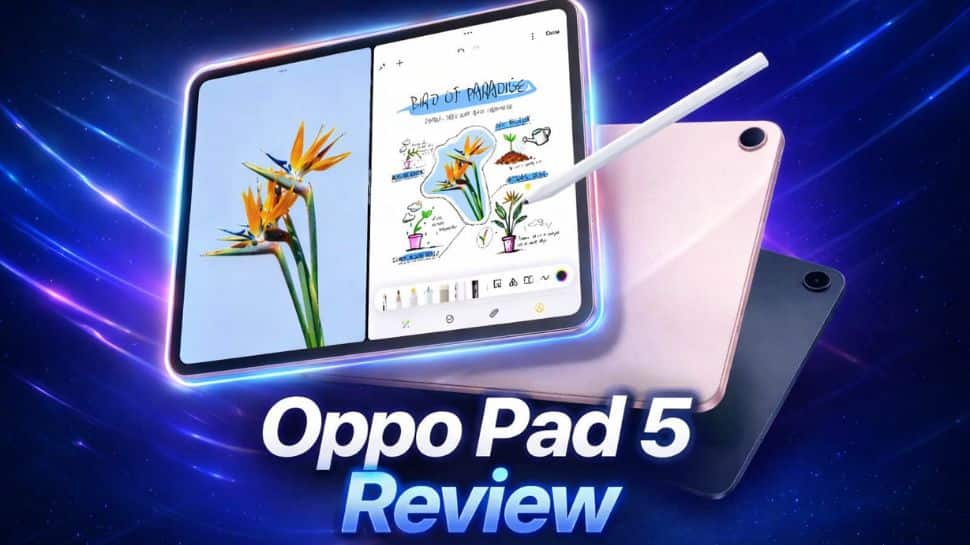
Oppo Pad 5 Review 2026: The Oppo Pad 5 enters the mid-range tablet segment with a strong focus on productivity, multimedia consumption, and AI-powered features. With a large 2.8K display, a powerful MediaTek chipset, a massive battery, and stylus support, Oppo aims to deliver a well-rounded device for students, professionals, and casual users alike. Here is a detailed review of the tablet after examining its design, display, performance, battery, camera, and AI capabilities.
Oppo Pad 5 Review: Design and build quality
The Oppo Pad 5 features a sleek and premium design that gives it a modern tablet look. The device has a slim body with rounded edges, making it comfortable to hold during long reading or streaming sessions. The back panel has a subtle shimmering texture that enhances the overall aesthetics. Oppo offers the tablet in Starlight Black and Aurora Pink colour options, both of which look stylish and elegant. Despite its large screen, the tablet remains fairly portable and easy to carry, making it suitable for students, professionals, and entertainment users.
Oppo Pad 5 Review: Display
One of the biggest highlights of the Oppo Pad 5 is its large and vibrant display. The tablet comes with a 12.1-inch LCD display with 2.8K resolution (2800 × 1980 pixels) that delivers sharp visuals and detailed content. It supports a 120Hz adaptive refresh rate, which makes scrolling, gaming, and UI navigation smooth and fluid. The screen offers 284 PPI pixel density and up to 900 nits brightness, ensuring clear visibility even in bright environments. The tablet also features a unique 7:5 aspect ratio, which provides more vertical space for reading documents, browsing websites, or multitasking.
Oppo Pad 5 Review: Performance and hardware
The Oppo Pad 5 is powered by the MediaTek Dimensity 7300-Ultra processor, an octa-core chipset designed to balance performance and power efficiency. The tablet is paired with LPDDR5X RAM and UFS 3.1 storage, which helps deliver smooth multitasking and faster app loading. For graphics, it uses the Mali-G615 MC2 GPU, which can handle casual gaming and multimedia tasks comfortably. In everyday use, the tablet performs well for activities like video streaming, browsing, note-taking, and online meetings. It runs on ColorOS 16, offering productivity features like split-screen multitasking and floating windows.
Oppo Pad 5 Review: AI features
Oppo has integrated several smart AI tools to enhance productivity and creativity on the Pad 5. The tablet includes AI Summary, which can quickly extract key points from long articles or documents, helping users understand information faster. Another feature called AI Writer assists in creating reports, social media posts, and written content directly within apps. The tablet also supports AI handwriting formula calculation, allowing users to write mathematical equations and get instant solutions. Additionally, AI tools like Mind Map help organize complex information into visual structures, making studying and brainstorming easier.
Oppo Pad 5 Review: Camera
While cameras are not the primary focus of tablets, the Oppo Pad 5 offers decent camera hardware for everyday needs. The device includes an 8MP rear camera with f/2.0 aperture, which can capture basic photos, scan documents, and record videos up to 1080p at 30fps. On the front, there is an 8MP selfie camera, designed mainly for video calls, online meetings, and virtual classes. The camera quality is sufficient for casual photography and communication, though it cannot compete with smartphone cameras in terms of detail and dynamic range.
Oppo Pad 5 Review: Battery and charging
Battery life is one of the strong aspects of the Oppo Pad 5. The tablet packs a massive 10,050mAh battery, which can easily last a full day with mixed usage such as browsing, watching videos, and attending online meetings. For charging, the tablet supports 33W SUPERVOOC fast charging, which helps refill the battery relatively quickly compared to standard charging solutions. The large battery capacity makes the tablet reliable for travel, long study sessions, and extended entertainment use.
Oppo Pad 5 Review: Audio, connectivity and other features
The Oppo Pad 5 is designed as a multimedia device, and it includes a quad-speaker system that delivers loud and immersive sound for movies, music, and gaming. In terms of connectivity, the tablet supports Wi-Fi 6, Bluetooth 5.4, and USB Type-C, ensuring fast wireless connections and compatibility with modern accessories. The tablet also features facial recognition for unlocking and includes multiple sensors like an accelerometer, ambient light sensor, and hall sensor for improved usability. These features make the device versatile for both productivity and entertainment purposes.
Oppo Pad 5 Review: Conclusion
Overall, the Oppo Pad 5 offers a balanced combination of design, display quality, performance, and battery life. The 2.8K 120Hz display, AI productivity tools, and large battery make it a strong option for students, professionals, and entertainment users. While the cameras are basic and the chipset targets mid-range performance, the tablet still delivers a reliable experience for everyday tasks, content consumption, and light productivity.
Oppo Pad 5 Review: Pros
Large, Vibrant Display: A 12.1‑inch 2.8K screen with 120 Hz refresh rate and Dolby Vision makes it excellent for movies, streaming and browsing.
Strong Battery Life: The massive 10,050 mAh battery delivers long endurance, easily lasting through a day (or more with light use).
Smooth Everyday Performance: The MediaTek Dimensity 7300 Ultra and 8 GB RAM handle apps, multitasking, streaming and light gaming smoothly.
Good Audio and Build Quality: Quad speakers offer loud, rich sound, and the clean, practical design feels sturdy without being too heavy.
Oppo Pad 5 Review: Cons
Mid‑range performance limits: While fine for everyday tasks, the processor isn’t powerful enough for heavy gaming or laptop‑class workloads.
Basic cameras: The 8 MP front and rear cameras are serviceable for video calls or scanning docs but nothing special for photography.
Slow charging and limited variants: 33 W charging isn’t very fast for a big battery, and variant options (storage vs. 5G) feel restrictive.


