
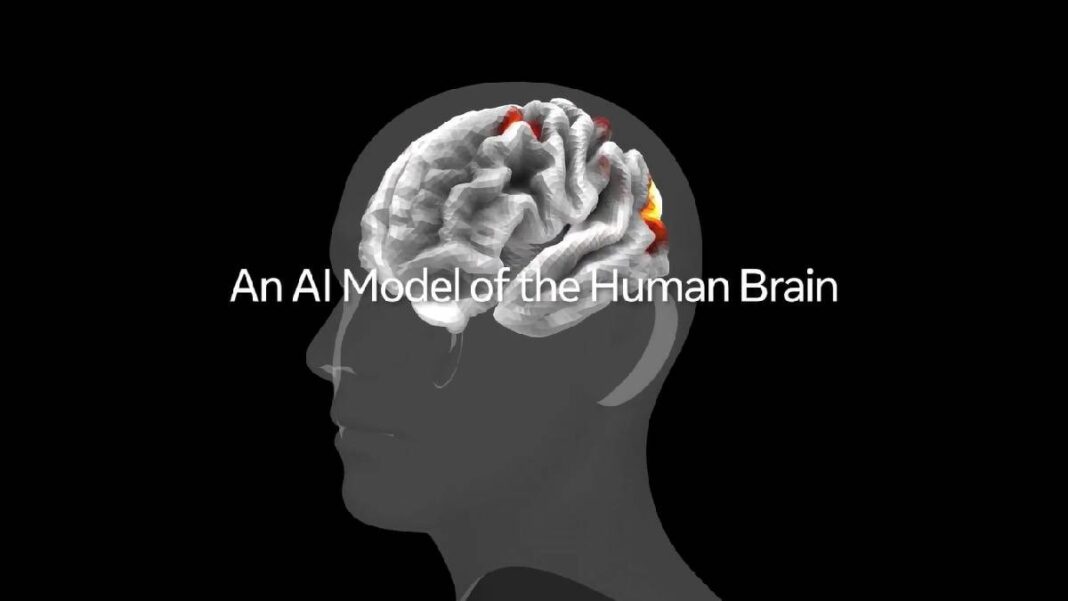
Meta has launched TRIBE v2 (Trimodal Brain Encoder), a foundation model designed to predict how the human brain responds to almost any sight or sound. The model mirrors how the brain reacts to sight, sound and language, and Meta says it could help neuroscientists conduct new experiments more efficiently. The development could bring the company closer to achieving superintelligence, a stage of AI that surpasses human intelligence and reacts to the physical world much like how humans do.
Understanding how the brain works often requires new brain recordings for every experiment. However, collecting this data can make the research process slow, costly and difficult to scale.
TRIBE v2 aims to address this challenge by turning months of laboratory work into seconds of computation.
“Today, we’re releasing TRIBE v2. This foundation model acts as a digital mirror of human brain activity in response to sight, sound and language – transforming months of lab work into seconds of computation,” Meta wrote in a blog post.
TRIBE v2 predicts brain activity through a three-stage pipeline. In the first step, the model converts sounds, visuals and text into numbers so it can analyse them. In the second step, it combines this information and identifies general patterns in how humans process information. Finally, the system predicts which parts of the brain are likely to activate when a person sees, hears or reads something and connects those patterns to actual brain activity.
Improved accuracy compared to earlier model
Meta says TRIBE v2 provides a much more detailed map of brain activity compared to the earlier version. The model is trained on more people and larger datasets, which helps it work better in new situations and produce more accurate predictions than previous approaches.
When scientists record brain activity using fMRI, the data is not always perfectly clean. Individual scans can contain noise caused by factors such as movement or other signals unrelated to thinking or perception.
Instead of capturing raw signals, TRIBE v2 predicts what a typical brain response should look like when someone sees or hears something. Because real fMRI scans can be noisy, Meta says the model’s prediction can sometimes match the average brain response more closely than a single scan.
Meta has released the TRIBE v2 paper, code and model weights as open source. The company says this move is intended to accelerate research across three key areas: neuroscience, artificial intelligence and healthcare.


