
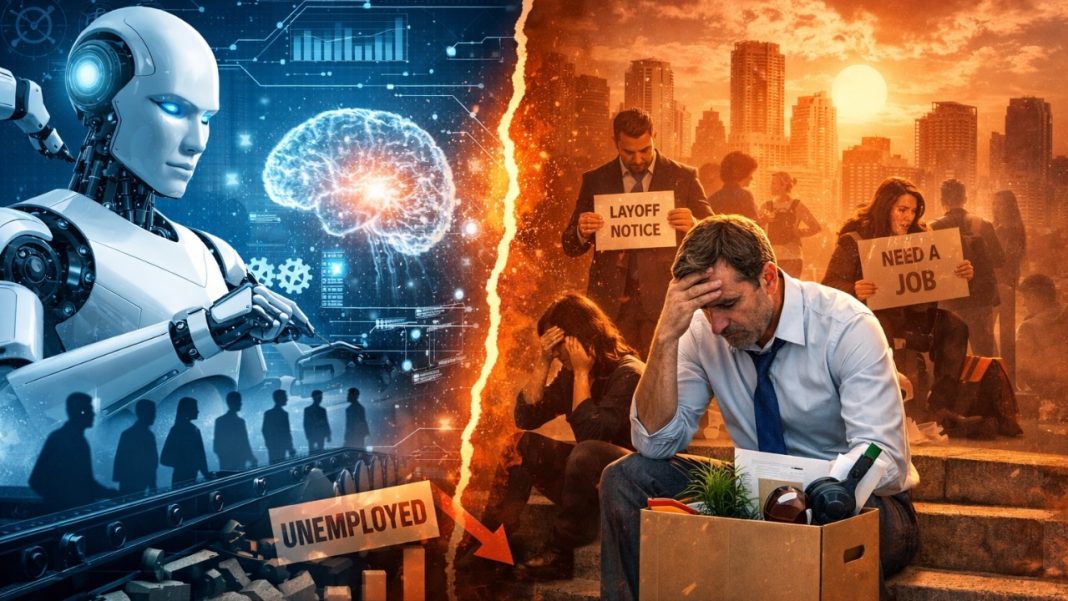
Goldman Sachs: AI Could Automate 25% of All Work Hours
A new Goldman Sachs report warns that artificial intelligence could soon automate a quarter of all work hours globally, exposing 300 million full-time jobs to significant change.
Key Takeaways
- 25% of all work hours could be automated by AI.
- 300 million full-time jobs are exposed to automation.
- Advanced economies like the US and Europe face higher risks.
- AI could boost global GDP by 7% over a decade.
Which Jobs Are Most at Risk?
The report, “The Potentially Large Effects of Artificial Intelligence on Economic Growth,” finds that roughly two-thirds of jobs in the US and Europe are exposed to some degree of AI automation. Administrative (46%) and legal (44%) professions face the highest risk. In contrast, physically intensive trades like construction (6%) and maintenance (4%) have much lower exposure.
Economic Impact and Labour Market Disruption
Goldman Sachs economists Joseph Briggs and Devesh Kodnani note AI’s dual impact. While it promises significant labour cost savings and a 7% boost to annual global GDP over 10 years, it also risks “significant disruption” to the labour market.
“If generative AI delivers on its promised capabilities, the labour market could face significant disruption.”
The report adds that displaced workers are likely to find new jobs created by the technology, but may face lower pay during the transition.
Complement, Not Just Replacement
The economists stress that most jobs are only partially exposed. They are more likely to be complemented by AI rather than fully replaced. They compare the impact to past technologies like spreadsheets and ATMs, which automated tasks but also created new roles over time.
Broader Expert Warnings
This warning aligns with other studies. In March, research from OpenAI and the University of Pennsylvania found that around 80% of the US workforce could have at least 10% of their tasks affected by large language models like GPT-4.


