
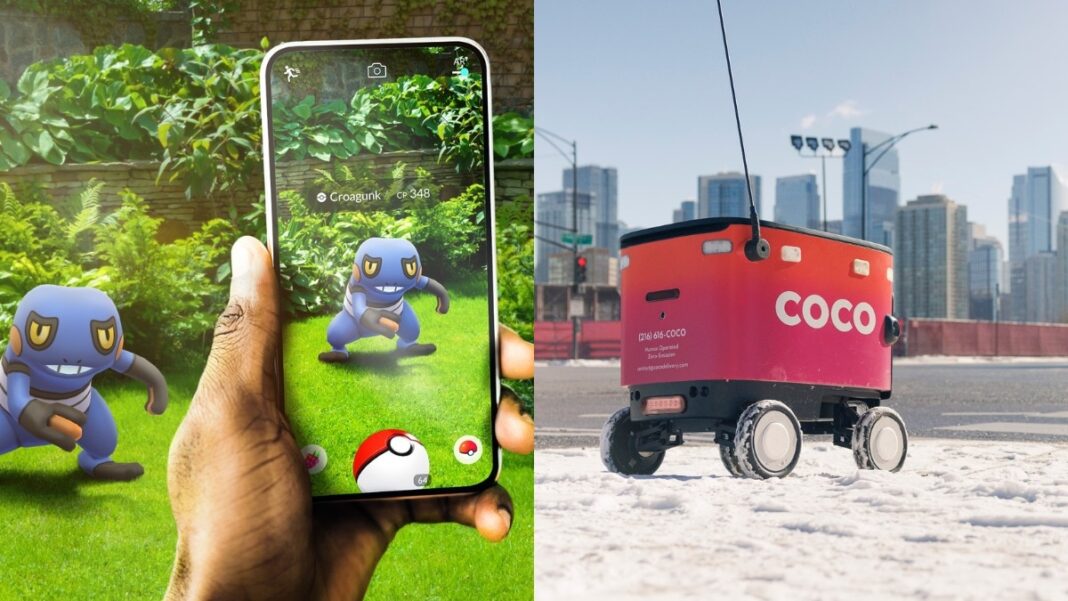
Did you play Pokemon Go, hunting those virtual Pokemons ? If yes, you might have unwittingly trained an AI system and robots in how to navigate around in a city. Niantic, the developer of the hit mobile game Pokemon Go, is reportedly using game data collected from millions of players to build a highly accurate AI navigation system. And this system is now being used by delivery robots in several cities.
According to reports, the company has been using its Visual Positioning System (VPS) to make the game’s augmented-reality features work better. Recently Niantic’s AI spin-out, Niantic Spatial, has partnered with robotics firm Coco to use this technology in delivery robots.
According to MIT Technology Review, the project is built around Niantic’s VPS, which was trained using 30 billion images captured by players while scanning PokeStops, Gyms, and landmarks during gameplay. Over time, these scans have created a vast database of real-world locations, complete with precise information. The system can now identify a location with extremely high accuracy by comparing camera input with this stored imagery, allowing machines to understand where they are even in environments where traditional navigation tools struggle.
According to the company, this approach solves a long-standing problem for robotics companies. Delivery robots typically rely on GPS, but signals can become unreliable in dense urban areas where tall buildings interfere with radio waves. However, Niantic’s VPS uses visual recognition instead, enabling robots to identify buildings, street signs, and other features to determine their exact position. With this method, robots can navigate sidewalks, intersections, and pickup points with far greater precision than GPS alone allows, making them more practical for last-mile deliveries in busy cities.
Niantic Spatial CEO John Hanke said the technical overlap between augmented-reality gaming and robotics is closer than it may appear. Systems that allow a virtual character to move realistically in the real world require the same spatial awareness that robots need to move safely through streets and sidewalks.
“It turns out that getting Pikachu to realistically run around and getting Coco’s robot to safely and accurately move through the world is actually the same problem,” said John Hanke, CEO of Niantic Spatial, in a statement to MIT Technology Review.
According to the company, the dataset includes not only images but also metadata such as GPS coordinates, camera angles, motion data, time of day, and weather conditions. Because players captured the same locations from different viewpoints and at different times, the system learned how places look under a wide range of conditions. This makes the model more reliable when used by robots, whose cameras may sit at a different height or angle than a smartphone.
Niantic has long-term plans to build what it calls a “living map”, which is a constantly updated digital representation of the world that can be used by both machines and humans. The company suggests that as delivery robots and other devices collect new data while operating, the system will keep improving, creating an increasingly detailed model of streets, buildings, and public spaces.


