
Iranian strikes have disabled about 17 per cent of Qatar’s liquefied natural gas (LNG) export capacity, risking nearly $20 billion in annual revenue losses and disrupting energy supplies to Europe and Asia.
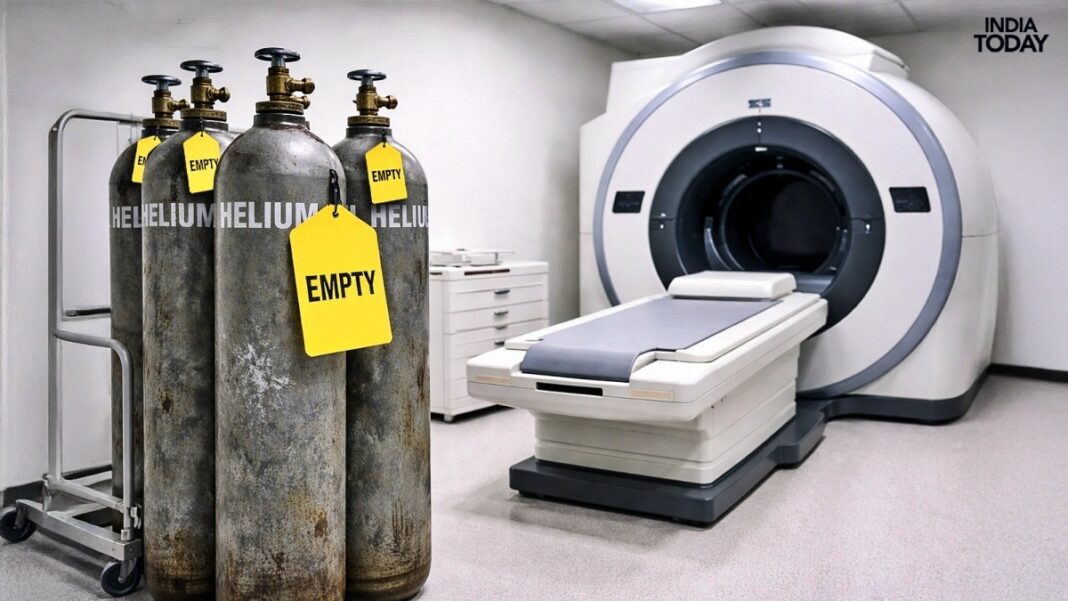
One of the major consequences of the ongoing war between the US-Israel, and Iran has led to a disruption in global helium supply following damage to key facilities in Qatar, drawing attention to one of the most unusual and irreplaceable elements on Earth.
Unlike most industrial gases, helium is finite, non-renewable on human timescales, and once released, it is gone forever. The shortage of this major element will be equally challenging to meet as the ongoing gas or oil crisis.
WHAT IS HELIUM?
Helium is a colourless, odourless, inert gas and the second lightest element in the universe after hydrogen. It does not react easily with other elements, making it extremely stable and useful in sensitive industrial processes.
Crucially, helium has the lowest boiling point of any element, which allows it to achieve extremely cold temperatures required in advanced technologies.
IS HELIUM FOUND NATURALLY ON EARTH?
Yes, but not in the way many might expect. Helium is formed deep underground over billions of years through the radioactive decay of elements like uranium and thorium.
The gas slowly accumulates in pockets trapped within natural gas reservoirs.
However, helium behaves differently from other gases. It is so light that when released, it rises through the atmosphere, escapes Earth’s gravity, and is permanently lost to space. This makes it the only element that cannot be recycled once used.
HOW IS HELIUM EXTRACTED?
Helium extraction primarily occurs from natural gas fields containing tiny percentages of the gas from underground radioactive decay. Specialised wells drill through cap rock to release the gas mixture, piped to processing plants.
Raw gas undergoes scrubbing to remove water, CO2, and hydrocarbons. Cryogenic distillation cools it to -269°C, liquefying all but helium, which is gaseous due to its lowest boiling point.
At facilities like QatarEnergy’s Ras Laffan complex, the world’s largest helium production base, natural gas is cooled to these extremely low temperatures.
During this process:
- Methane becomes liquid (LNG)
- Helium, which does not liquefy easily, is separated and purified
Further purification via pressure swing adsorption or membranes yields 99.99% purity by stripping nitrogen and traces from the mixture.
This means helium production is entirely dependent on LNG production. If LNG operations stop, helium extraction also halts automatically.
WHAT IS HELIUM USED FOR?
Despite its simplicity, helium underpins critical sectors of modern life:
Semiconductors: It cools silicon wafers, enables chip fabrication, and supports extreme ultraviolet lithography used in advanced processors powering AI and data centres.
Healthcare: Liquid helium cools superconducting magnets in MRI machines worldwide.
Space and defence: It pressurises rocket fuel tanks and purges propulsion systems ahead of launch.
Scientific research: Major facilities like particle accelerators depend on helium-based cryogenics for the smooth operation of heavy machines.
There is currently no viable large-scale substitute for helium in these applications.
WHY IS THE WORLD RUNNING OUT OF HELIUM?
Finite helium reserves, primarily in the US and Qatar, which together account for roughly 30-38% of global output, are steadily depleting. The shutdown of the US Federal Helium Reserve in 2021 alone removed about 10% of global production capacity.
At the same time, demand is surging. MRI machines consume around 25-30% of global helium supply, semiconductors account for 20-25%, and usage in space technology continues to grow.
This imbalance has been worsened by geopolitical tensions, with the 2026 West Asia conflict disrupting Qatar’s LNG-linked helium production. Attacks affecting routes through the Strait of Hormuz have halted an estimated 5.2 million cubic metres per month, pushing prices sharply higher, nearly doubling in some markets.
With the US and Qatar together supplying nearly 70% of the world’s helium, the market remains highly concentrated and vulnerable to disruptions. Adding to the challenge, there is currently no viable method to extract helium directly from the atmosphere at an industrial scale, making supply constraints even harder to address.
Countries like South Korea, heavily reliant on Qatari helium for semiconductor manufacturing, face potential disruptions within months. With limited reserves elsewhere, experts warn that the world cannot quickly replace such a large shortfall.
As industries from healthcare to artificial intelligence depend on helium, the crisis points to a grim reality: modern civilisation relies on an element that disappears into space once used, and cannot be made again.


