
Key Takeaways
- The Sun released an X8.3-class solar flare, the strongest since 2005.
- It caused a significant radio blackout affecting communications on Earth’s sunlit side.
- A coronal mass ejection (CME) from the event may trigger minor geomagnetic storms by May 17-18.
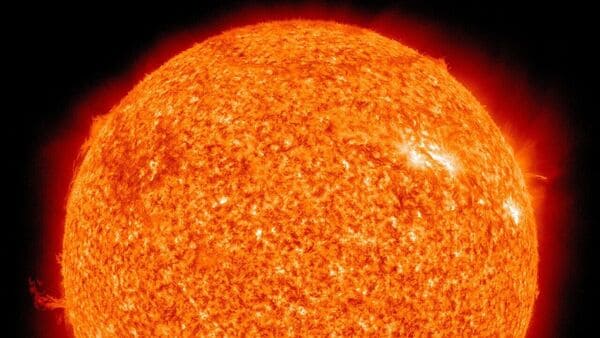
The Sun has unleashed the most powerful solar flare of the current cycle, an X8.3-class eruption, marking the strongest event in nearly two decades. The massive burst of radiation originated from sunspot region AR 3664 and peaked on May 14.
NASA’s Solar Dynamics Observatory captured the extreme ultraviolet flash. The flare triggered a strong (R3-level) radio blackout, disrupting high-frequency communications across the sunlit side of Earth, including parts of the Americas and the Pacific.
Coronal Mass Ejection and Earth Impact
The explosion also produced a massive coronal mass ejection (CME)—a cloud of solar plasma and magnetic field. While not directly aimed at Earth, NASA models indicate its flank could deliver a glancing blow to our planet’s magnetic field around May 17 or 18.
This interaction may spark minor to moderate (G1-G2) geomagnetic storms, potentially leading to auroral displays at high latitudes.
Connection to Recent Auroras
This powerful flare comes from the same active region that generated the spectacular global auroras, including sightings in India, over the past weekend. The sunspot has now rotated to the far side of the Sun.
Understanding Solar Flare Classes
Solar flares are classified by strength: B, C, M, and X, with X being the most powerful. The number indicates intensity within the class. An X8.3 flare is over eight times more intense than a baseline X1 flare.
While flare radiation cannot harm humans on the ground, it can disturb the ionosphere—the atmospheric layer where GPS and radio signals travel—causing temporary communication blackouts. This event underscores the significant impact space weather can have on modern technology.


