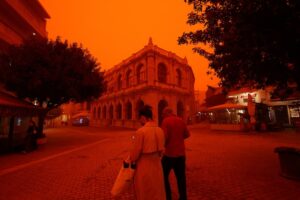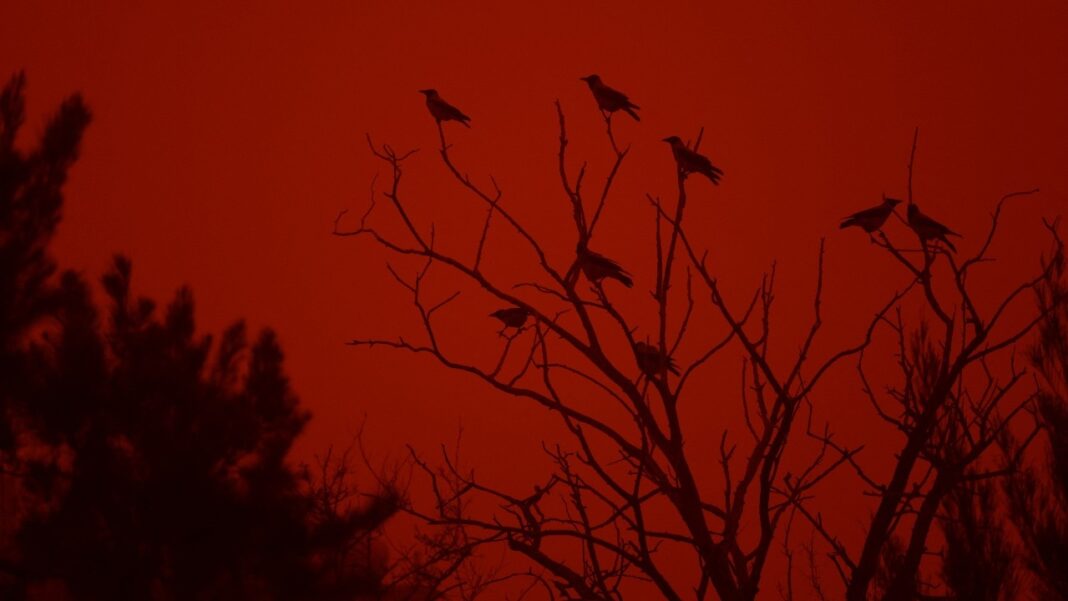
Skies over Greece turned blood-red this week, making it look like the end of the world.
On April 1, 2026, parts of Crete in Greece turned an eerie orange-red as a massive cloud of dust from the Sahara Desert in North Africa blew across the Mediterranean Sea.
Strong southerly winds, fuelled by Storm Erminio, picked up fine sand and carried it hundreds of kilometres to Greece and Libya.
The dust contains iron oxides that are tiny rusty particles that scatter sunlight and paint the sky in deep reds and oranges, like a permanent sunset.
As a result, the visibility in the area dropped sharply, sometimes to around 1,000 meters, creating an apocalyptic glow that feels straight out of a sci-fi film.
Surprisingly, this is not a new phenomenon.
The Sahara Desert’s dust reaches Europe every spring, but this outbreak was especially thick and dramatic, with wind gusts over 120 kmph in places.

IS THE RED TINT DANGEROUS?
It was mostly weather, not disaster, though it caused real disruption.
The storm brought heavy rain, thunderstorms, gale-force winds, and even a tornado that overturned a truck in Pachia Ammos, Crete.
Flights at the local airport were cancelled or diverted, with several international flights from the UK being rerouted to Corfu or Athens. Ferry services stopped, schools closed, and Easter holiday travel was hit hard.
Health officials also issued alerts because breathing the fine dust can irritate lungs, worsen asthma, or affect people with heart issues. Vulnerable groups were told to stay indoors.
Experts noted that these events can carry bacteria or raise air pollution levels, but they usually clear in a day or two when the wind shifts.
By the end, the dusty wave was moving east, towards Egypt.
The rare, striking phenomenon reminds us how connected our planet is, where one desert’s sand can colour another continent’s sky.