
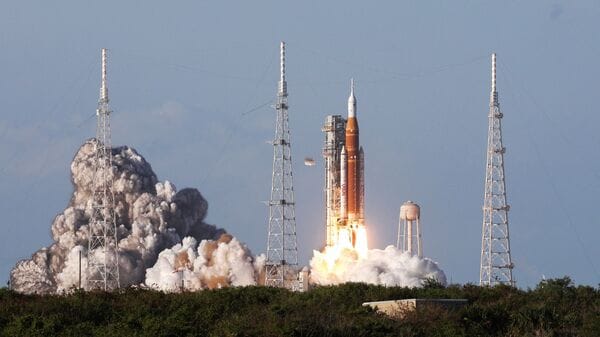
In humanity’s first lunar voyage in more than half a century, four astronauts aboard the Artemis II reached orbit within hours of launch on 1 April. They will circle the Earth for about 25 hours before catapulting toward the moon.
Artemis II commander Reid Wiseman led the charge into space with “Let’s go to the moon!” accompanied by pilot Victor Glover, Christina Koch and Canada’s Jeremy Hansen.
It is the most diverse lunar crew ever, with the first woman, a person of colour, and a non-US citizen riding in NASA’s new Orion capsule.
When will Artemis 2 reach the moon?
Artemis II will reportedly reach the moon on the 6th day of its 10-day mission, which is Monday, 6 April.
The spacecraft will approach the neighbourhood of the moon from the western lunar hemisphere, coming as close as 4,000 miles from the lunar surface.
The crew will perform a fly-around before returning to Earth. They will not orbit the moon, nor conduct a moonwalk – just a quick out-and-back lasting less than 10 days.
The to-do list for the Artemis II crew after launch
The four-astronaut Artemis II crew will be sticking close to home for the next day or so, checking out the capsule in orbit around Earth.
The upper stage of the rocket will separate, and the crew will manually fly the Orion capsule toward it to practice docking, preparing for future missions to the moon’s surface.
Tomorrow night, they will fire Orion’s main engine to escape Earth’s gravity and head for the moon, 248,000 miles away.
10 days of Artemis II: A timeline
- Earth Orbit – First 24 hours: Hours after the launch, the Artemis II crew is actually still orbiting the Earth. They will spend the first day in a “High Earth Orbit” to test the Orion spacecraft’s life-support systems before they commit to the long trip.
- Trans-Lunar Injection – The “Slingshot”: Later today or early tomorrow, the spacecraft will perform a major engine burn to break Earth’s gravity and begin the trek to the Moon.
- The 4-Day Transit: Once that burn is complete, it takes roughly four days to coast across the 240,000-mile gap between Earth and the Moon.
- Arrival at Day 6: The crew is scheduled to reach their closest point to the Moon on Monday, 6 April.
After swinging around the far side of the Moon, taking the crew farther from Earth than any human has ever travelled, the astronauts will spend in excess of 96 hours using the Moon’s gravity to “free-return” back home, with a planned splashdown in the Pacific Ocean on 10 April.
Why is it taking 6 days to reach Moon? The physics behind it
To ensure the safety of the crew, NASA deliberately limits the spacecraft’s speed during Trans-Lunar Injection (TLI) to 24,500 mph. While a speed of 25,000 mph or higher would reach the Moon faster, it would also mean reaching “escape velocity,” severing the gravitational link to Earth.
By staying slightly below that threshold, the mission utilises a free-return trajectory. This means that if the engines were to fail or the guidance system went offline, Earth’s gravity would still exert enough pull to bring the ship home. The Moon’s gravity acts like a second baseman in a double play: it catches the spacecraft as it whips around the lunar farside and “flings” it directly back toward Earth.
The risk of going faster
If the spacecraft exceeded 25,000 mph, it would break free from this gravitational loop. Although the Moon would still attempt to sling the ship back toward Earth, the excessive speed would cause it to overshoot the planet. Instead of a safe return, Artemis II would fly wide of its target and be lost in deep space.


