
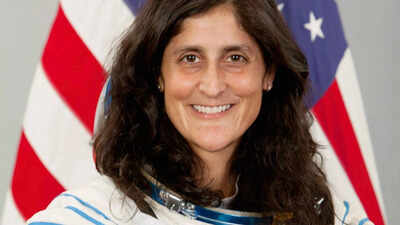
NASA Astronaut Sunita Williams Retires After 27-Year Career
NASA astronaut Sunita Williams, a record-holding spacewalker and veteran of two long-duration missions, has retired after 27 years of service. The agency announced her retirement on Monday.
Key Takeaways
- Sunita Williams retires after 27 years as a NASA astronaut.
- She holds the record for most spacewalks by a woman (7) and most cumulative spacewalk time (50 hours, 40 minutes).
- Williams spent a total of 322 days in space across two ISS missions.
- She was slated to pilot Boeing’s first crewed Starliner flight, which is currently delayed.
A Trailblazing Career in Space
Selected as an astronaut candidate in 1998, Williams flew on two missions to the International Space Station: Expedition 14/15 in 2006-2007 and Expedition 32/33 in 2012. During her first mission, she set a then-record for the longest single spaceflight by a woman at 195 days.
Her seven spacewalks, totaling over 50 hours, remain the benchmark for female astronauts. In total, she logged 322 days in space.
“Sunita Williams is a trailblazer who has inspired countless individuals around the world,” said NASA Administrator Bill Nelson. “Her dedication and contributions to space exploration have been invaluable.”
From Naval Aviator to Astronaut
Born in Ohio to Indian-American parents, Williams’ path to space began with a strong educational and military foundation. She earned a Bachelor of Science in physical science from the US Naval Academy and a Master of Science in engineering management from the Florida Institute of Technology.
As a naval aviator, she logged over 3,000 flight hours in more than 30 different aircraft before joining NASA.
Starliner Mission and Legacy
Williams was scheduled to pilot Boeing’s Starliner spacecraft on its first crewed test flight to the ISS earlier this year. However, the mission has been delayed due to technical issues with the spacecraft.
In a statement marking her retirement, Williams reflected on her service: “It has been an honor to serve NASA and contribute to human spaceflight,” she said. “I look forward to seeing the next generation of astronauts continue to push the boundaries of exploration.”


