
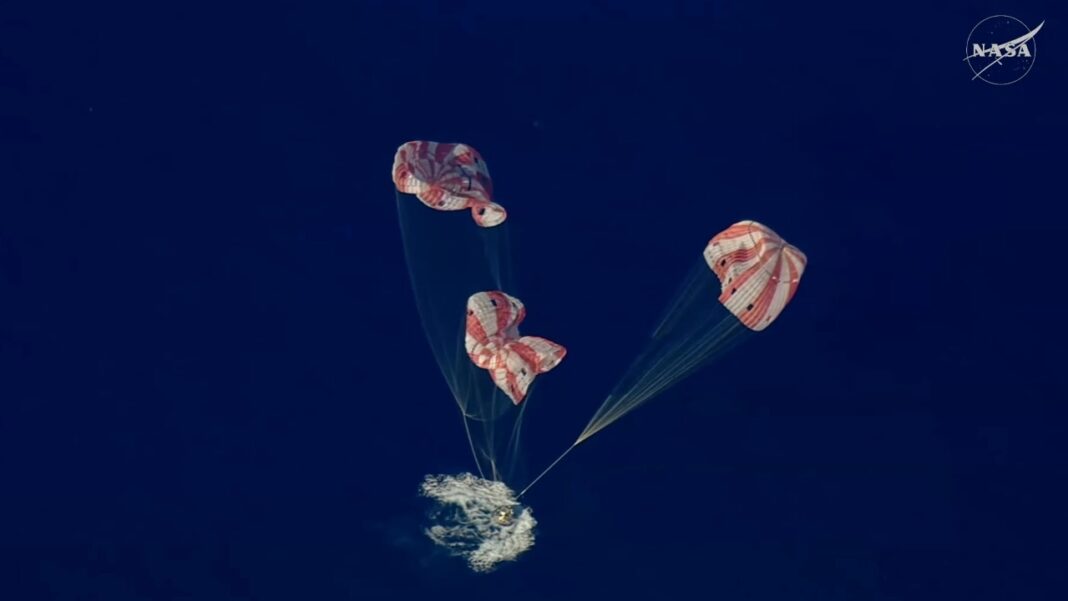
The Artemis II mission has successfully splashed down in the Pacific Ocean, marking a dramatic end to humanity’s first crewed journey to the Moon in more than five decades.
The four astronauts returned safely after completing a high-stakes lunar flyby, a key step in NASA’s plan to send humans deeper into space.
The crew travelled aboard the Orion spacecraft, which endured one of the most intense phases of the mission during its return to Earth.
WATCH ARTEMIS-2 LANDING FROM THE MOON
As the capsule re-entered the atmosphere at speeds approaching 40,000 km/h, temperatures around it soared to nearly 3,000°F, creating a fiery plasma glow that briefly cut off communications.
This critical re-entry phase tested Orion’s advanced heat shield, designed to withstand extreme conditions generated by high-speed travel from lunar distances. The successful descent demonstrated the spacecraft’s capability to safely carry astronauts back from deep space missions.
As Orion descended further, drogue parachutes deployed to stabilise the capsule, followed by three main parachutes that slowed it significantly before splashdown. The spacecraft gently landed in the ocean off the coast of California, where recovery teams were already in position.
Personnel from NASA and the US military quickly secured the capsule.
Artemis II is the first crewed mission to travel to the vicinity of the Moon since the Apollo program, making it a historic milestone in modern space exploration. The mission gathered critical data on life-support systems, navigation, and human performance in deep space.
With Artemis II now complete, NASA is preparing for the next phase, Artemis III, which aims to land astronauts on the Moon and establish a sustainable human presence, paving the way for future missions to Mars.


