
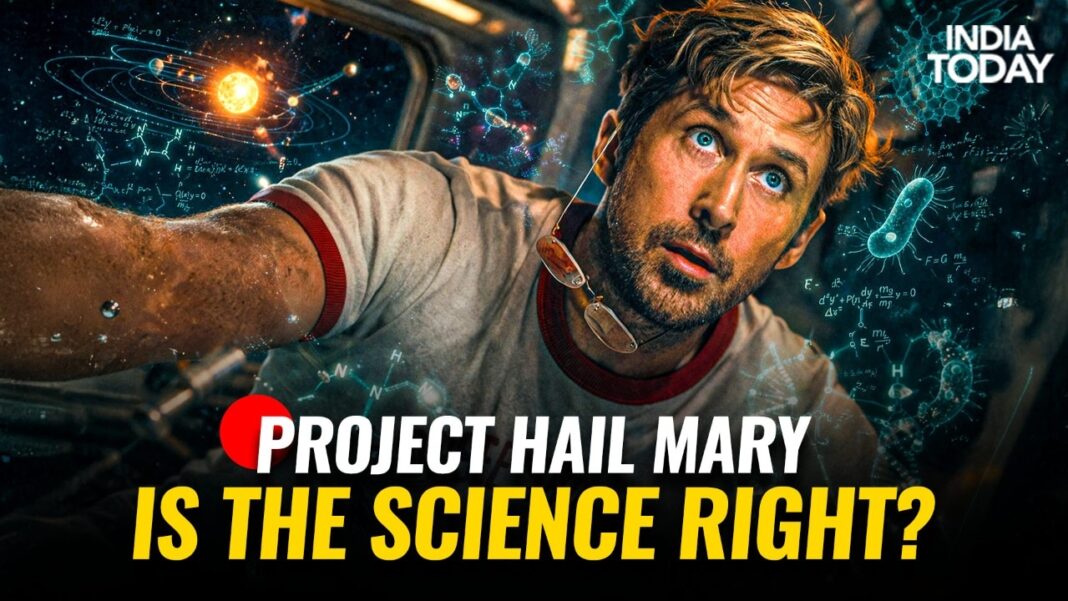
How accurate is the science of Project Hail Mary? A real astronomer answers

The new sci-fi film Project Hail Mary, based on Andy Weir’s bestselling novel, is drawing attention not just for its high-stakes story, but for how closely it sticks to real science.

Project Hail Mary has grossed over $300 million to $317 million globally, becoming Amazon MGM Studios’ highest-grossing film of all time.

The Ryan Gosling-led sci-fi film has achieved significant success with around $163.8-$164.3 million from the domestic (US) market and roughly $153 million internationally.

IS THE SCIENCE OF THE HAIL MARY RIGHT?

The sci-fi film is drawing attention not just for its high-stakes story, but for how closely it sticks to real science. Renowned astronomer Wendy Freedman of the University of Chicago, also a recipient of the US National Medal of Science, answers just how accurate the film’s science really is.

Starring Ryan Gosling as Ryland Grace, a school teacher-turned-astronaut tasked with saving humanity, the film explores complex ideas in astrophysics, biology and space travel. While the premise may seem extraordinary, Freedman says the film gets one crucial thing right: how science actually works.

“What really struck me was how well it represented how science is done,” she said, noting that the protagonist approaches problems thoughtfully, testing ideas and adapting when things don’t go as planned. She also praised the film for showing science as a collaborative effort rather than a solitary pursuit.
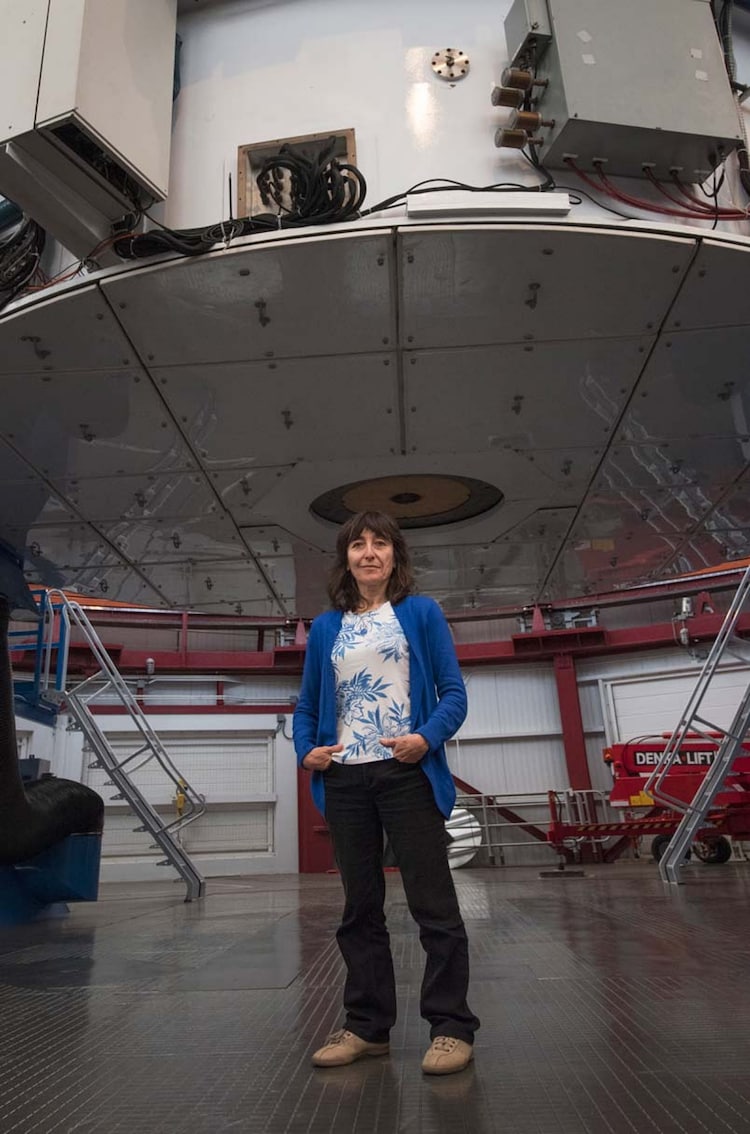
Wendy L. Freedman

Wendy Freedman, an astronomer at the University of Chicago. (Photo: UoC)

Freedman highlighted that several scientific elements in the movie are grounded in reality. Concepts like relativity, as well as the use of scientific tools to study unknown life forms, are portrayed convincingly.

The film’s blend of microbiology, chemistry, physics and astrophysics, she said, reflects real-world research practices.

One of the film’s most debated ideas, the possibility of life existing without water, remains speculative but not impossible.

Freedman emphasised that while scientists have yet to find such life, the vastness of the universe leaves room for possibilities.

“I wouldn’t rule it out,” she said, adding that discoveries of planets beyond our solar system have already challenged long-held assumptions about how planetary systems form.

However, not everything in the film mirrors reality. Freedman pointed out that the idea of Grace being ostracised by the scientific community for his theories is exaggerated. While disagreements and rivalries do exist in science, she said such extreme isolation is unlikely, though unconventional ideas can face scepticism.

The film also raises ethical questions about how humanity might respond to a global cosmic threat. Freedman compared such scenarios to classic moral dilemmas, suggesting that in a true emergency, people might act in unexpected or unconventional ways.

In the end, Project Hail Mary strikes a balance between imagination and realism, offering audiences a story that is both scientifically informed and dramatically compelling.

Latest

Nasa successfully launches four astronauts on a 10-day trip to the Moon

Nasa successfully launches four astronauts on a 10-day trip to the Moon

Airplane mode: Nasa astronauts carrying special iPhones to the Moon

The decision marks a shift in how space agencies approach documentation, allowing crew members to carry familiar consumer devices on a journey that will take th

Artemis II moon mission: Abort systems, 6-day survival suit — NASA leaves no stone unturned to keep astronauts safe

NASA is preparing to launch Artemis II from Kennedy Space Center to send astronauts around the Moon. The space agency is leaving no stone unturned to ensure cre

Artemis 2 launch: L Minus, Ingress, core stage & more – Space lingo cheatsheet to understand NASA moon mission better

The NASA moon mission, Artemis 2, is scheduled to take off from Florida as early as 1 April at 6:24 PM EST (3:54 AM IST on 2 April).

Indian astronomers decode mysterious repeating signal coming from deep space

The study also sheds light on the nature of the object at the centre. Earlier research suggested it might be a rare intermediate-mass black hole.

Topics

Nasa successfully launches four astronauts on a 10-day trip to the Moon

Nasa successfully launches four astronauts on a 10-day trip to the Moon

Small plane crash lands in Philadelphia park- Here is what happened

A small plane crash landed in a Philadelphia park and both people on board were rescued.

Iran prez writes open letter to Americans ahead of Trump’s big speech: ‘World stands at crossroads’

Iran’s President Pezeshkian wrote to Americans, signaling openness to talks while tensions remain high.

MS Dhoni comeback earlier than 2 weeks? CSK star back training at Chennai

IPL 2026: MS Dhoni’s viral net session, where he smashed sixes, has sparked hopes of an early CSK return after a calf strain, with the five-time champions eag

Artemis II countdown delayed? What NASA said about latest issues facing the moon mission

Just about an hour before Artemis II's launch, NASA issued a statement about an issue with communication

What will Trump speak about in his address tonight? Details on big Iran war decision emerge

In his address tonight, Trump may declare Iran war goals met, signal US drawdown, claim victory, and criticize NATO for not aiding in the Strait of Hormuz.

Iranian President writes open letter to Americans: Read full text

In the message, Masoud Pezeshkian rejected the idea that Iran poses a security threat, arguing that such claims do not align with "historical reality".

NASA’s Artemis 2: Why it took decades to send humans back to the Moon; expert explains

NASA’s return to the Moon took decades due to complex technology, funding challenges and changing political priorities.
spot_img

Related Articles

Popular Categories

spot_imgspot_img
