
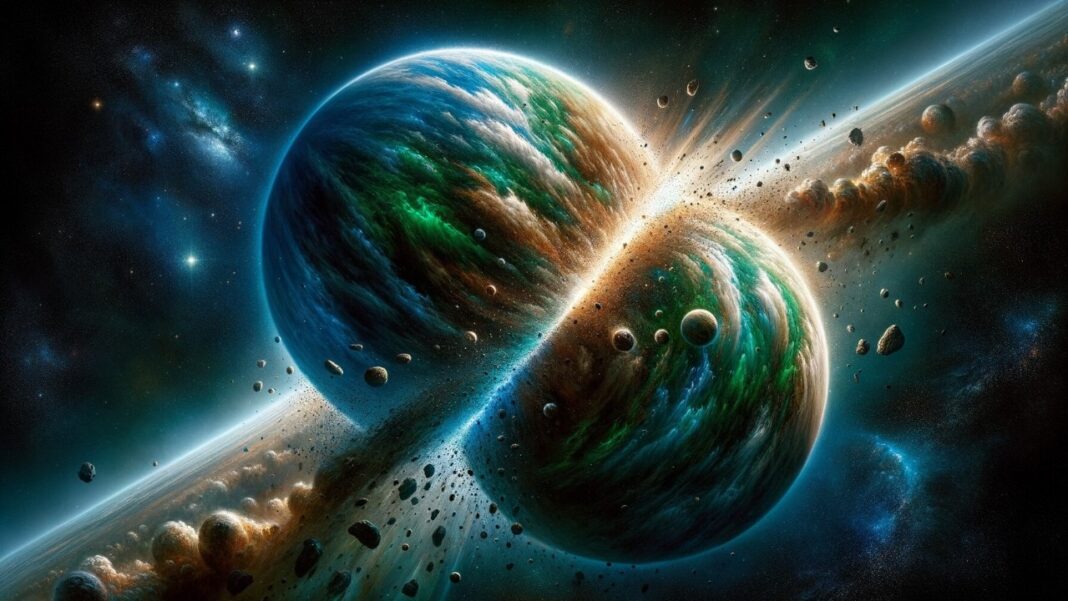
Collision of two planets seen from Earth reveals big secret about our Moon

A doctoral student scrolling through old telescope data stumbled upon one of the most rare, dramatic events in the universe. He saw two planets colliding in real time.

Anastasios Tzanidakis, a doctoral candidate in astronomy at the University of Washington (UW), was going through archival telescope data from 2020 when he spotted a stable, sun-like star called Gaia20ehk, located about 11,000 light-years from Earth, behaving very strangely.

Instead of emitting the steady, predictable light expected of such a star, it had begun to flicker wildly.

“The star’s light output was nice and flat, but starting in 2016 it had these three dips in brightness. And then, right around 2021, it went completely bonkers,” said Tzanidakis.

The findings were published in The Astrophysical Journal Letters.
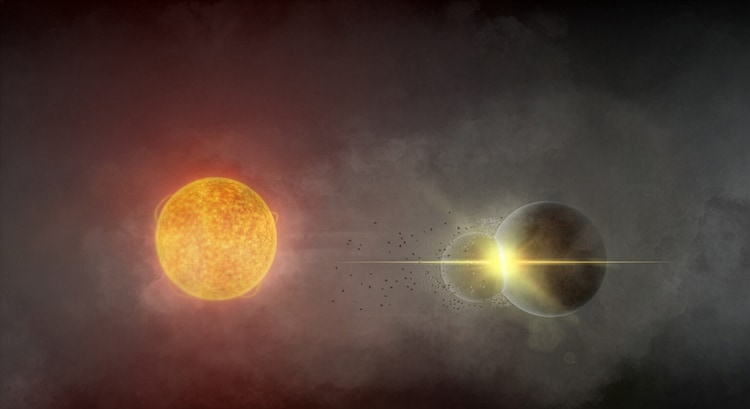
A rendering of the planets colliding. (Photo: Andy Tzanidakis)

A rendering of the planets colliding. (Photo: Andy Tzanidakis)

WHY WAS THE STAR BLINKING?

The flickering had nothing to do with the star itself.

Huge quantities of rocks and dust were passing in front of it, dimming the light reaching Earth as the debris orbited the system. The likely source of all that material was a catastrophic collision between two planets.

The conclusion came when the researchers switched from visible light to infrared data.

“As the visible light began to flicker and dim, the infrared light spiked — which could mean that the material blocking the star is hot, so hot that it’s glowing in the infrared,” Tzanidakis explained.

A planet-smashing collision would generate precisely that kind of extreme heat. The earlier, smaller dips in brightness, the researchers believe, were caused by the two planets spiralling closer together through a series of grazing impacts before their final, catastrophic crash.
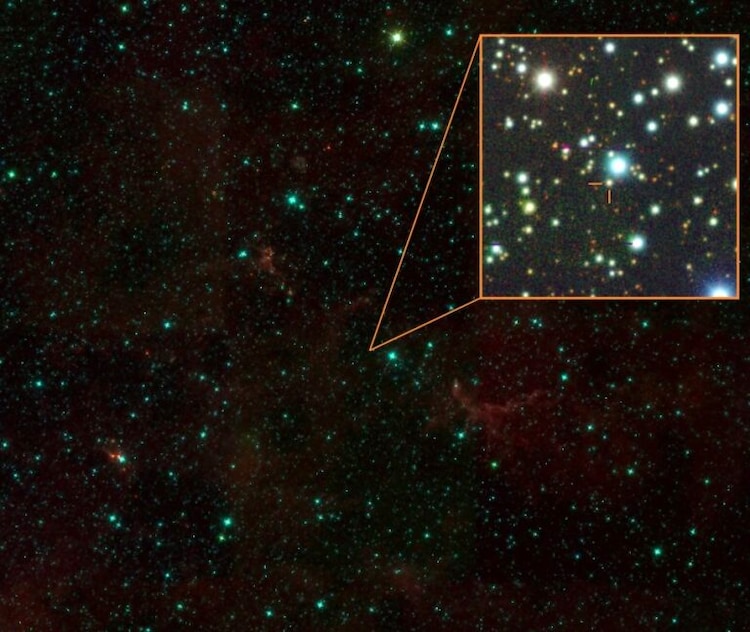
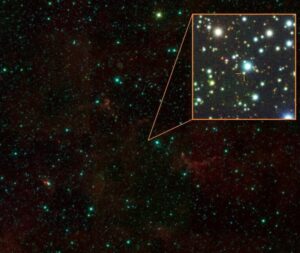
A captured image of the star Gaia20ehk. (Photo: Nasa)

A captured image of the star Gaia20ehk. (Photo: Nasa)

IS IT SIMILAR TO EARTH AND MOON?

The collision bears a striking resemblance to the one thought to have created the Earth and Moon about 4.5 billion years ago.

The debris cloud is orbiting Gaia20ehk at roughly one astronomical unit, which is the same distance as the Earth from the Sun. This means that the material could one day cool and solidify into something similar to our own Earth-Moon system.

“How rare is the event that created the Earth and moon? That question is fundamental to astrobiology,” said James Davenport, the study’s senior author and a UW assistant research professor of astronomy.

The Moon, he noted, may be one of the key ingredients that makes Earth habitable, shielding it from some asteroids, driving ocean tides, and potentially even fuelling tectonic activity.
Latest

US startup wants to sell sunlight at $5,000/hour, send 50,000 big mirrors to space — the idea is controversial

California-based Reflect Orbital has proposed deploying 50,000 large mirrors into orbit around Earth. The company wants to sell sunlight — brighting up the ni

Iran launches Sejjil missile against US: Why is it called the dancing missile?

The missile can carry a payload of around 500-1,000 kilograms, which may include conventional high-explosive warheads and potentially other types depending on c

Snowing in March: Unseasonal snowfall could enhance Ladakh’s water crisis

In the past, heavy snow arrived between December and February and stayed long enough to recharge underground water and keep springs flowing through summer. Now

Indian scientists discover how meditation rewires the brain

Scientists discovered that experienced meditators also exhibit higher activity in the gamma frequency range, which is associated with attention, perception and

How do ravens find wolf kills before the blood dries? We now know

Ravens rely on their memory to revisit spots favourable for finding carcasses hunted by wolves.

Topics

The Iran war is roiling commodities far beyond oil

The Gulf states, it is rapidly becoming clear, matter for the supply of much more than oil and gas.

Renault bets on Duster revival to power India turnaround

The original Renault Duster, launched more than a decade ago, effectively created the compact SUV category in India.

Reliance, Samsung sign $3-billion contract for green ammonia supply

The Reliance-Samsung deal, one of the largest of its kind globally, signals Chairman Mukesh Ambani's ambition to dominate the renewable energy value chain.

Sensex, Nifty set for muted open today due to higher-for-longer crude oil prices

Brokerages Citi and Nomura have lowered their year-end Nifty 50 targets, citing the impact of the surge in crude oil prices on India's growth and earnings.

Actor Navnindra Behl, known for Ishqbaaz, Queen, dies at 76; son Kanu Behl pens moving note: ‘Until you birth me again’

Veteran actor Navnindra Behl, best known for her work in Ishqbaaz and Bollywood film Queen, passed away at the age of 76. 

Hema Malini says ‘it’s a shame’ Dharmendra was left out of Oscars In Memoriam segment: ‘He was recognised everywhere’

Hema Malini criticised the Oscars for not including Dharmendra in the In Memoriam segment, stating that the late actor meant so much to people worldwide.

Pay first, fill later: Oil marketing firms suspend fuel on credit to pumps amid West Asia crisis

Oil marketing companies (OMCs) have suspended fuel on credit to limit offtake by retail outlets, four people aware of the development said.

‘Firms need to move to adaptive, energy-efficient AI models’

Sarah Hooker is convinced that the future lies in AI systems that use less computing power, cost less to run and can adapt to the needs of users.
spot_img

Related Articles

Popular Categories

spot_imgspot_img

