
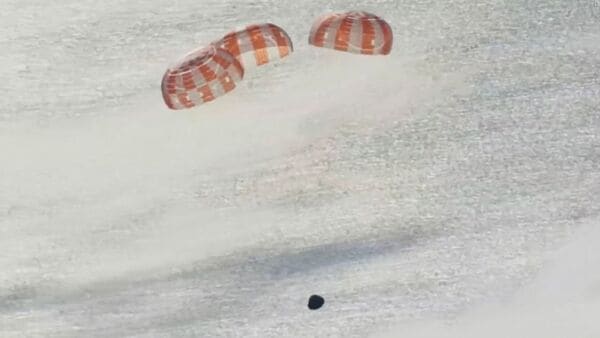
The last 13 minutes of the historic 10-day NASA moon mission, the journey back to Earth, were the most critical for the four astronauts – Reid Wiseman, Victor Glover, Christina Koch, and Jeremy Hansen – aboard the Artemis II flight. It was a test of the Orion spacecraft’s heat shield.
“It’s 13 minutes of things that have to go right,” Artemis II flight director Jeff Radigan said at a news briefing on Thursday.
Why?
NASA knew there was a problem with the Orion spacecraft, which the crew named Integrity, even before it left the Kennedy Space Center launchpad on April 1.
Orion had sustained an unexpected level of scorching and stress on re-entry during its 2022 test flight. Engineers had discovered over 100 locations on the heat shield that had cracked and broken off during reentry.
NASA engineers altered the descent trajectory for Artemis II to reduce heat buildup and lower the risk to the capsule and its crew.
Artemis II splashdown
The crew’s homecoming cleared a critical final hurdle for the Lockheed Martin-built Orion spacecraft, proving it would withstand the extreme forces of re-entry from a lunar-return trajectory.
It followed a white-knuckle, 13-minute fiery plunge through Earth’s atmosphere, generating frictional heat that sent temperatures on the capsule’s exterior soaring to some 5,000 degrees Fahrenheit (2,760 degrees Celsius).
At the peak of re-entry stress, as expected, intense heat and air compression formed a red-hot sheath of ionised gas, or plasma, that engulfed the capsule, cutting off radio communications with the crew for several minutes.
The tension broke as contact was re-established and two sets of parachutes were seen billowing from the nose of the free-falling capsule, slowing its descent to about 15 mph (25 kph) before Orion gently hit the water.
How did NASA make it work
Artemis II remarkably had an even less permeable shield than the one on Artemis I, ie, the same failure mode was even more likely to occur, according to Fortune.
However, the space agency had figured out that it was all about the right angle.
Therefore, rather than delaying the mission by more than a year to install a redesigned heat shield, which Fortune said one engineer wanted, NASA flew Artemis II with the same flawed design and simply changed how the capsule returned.
The solution was counterintuitive — NASA instructed the crew to apply more heat more consistently. This shortened the skip phase and maintained higher temperatures throughout the descent, ensuring the outer char layer never cooled sufficiently to trap gas beneath it.
For a perfect landing, these four astronauts had to enter the earth’s atmosphere at the right angle, at the right speed, and at the right time—and they did it.
Meet the historic crew
Veteran naval aviator Reid Wiseman led the mission as commander, joined by US Navy captain Victor Glover, who served as pilot and became the first Black astronaut assigned to a lunar mission.
NASA’s Christina Hammock Koch, who holds the record for the longest single spaceflight by a woman, served as a mission specialist and officially became the first woman to fly to the Moon.
Joining the trio was former fighter pilot Jeremy Hansen from the Canadian Space Agency, who became the first non-American ever to leave low Earth orbit.
Together, they made the most diverse lunar crew ever and became the first astronauts to fly in the vicinity of Earth’s only natural satellite since the Apollo program of the 1960s and ’70s.
(With agency inputs)


