Artemis-II launch on April 2: What happened when humans last went to the Moon?

With Nasa’s Artemis-II mission in the final stage before launch, four astronauts are once again getting ready to travel to the Moon for the first time in over half a century.

The final countdown of the launch began on Tuesday morning, March 31, and the liftoff is scheduled for Thursday, April 2 at 03:53 am IST.

But this is not the first time humans have travelled to the Moon.

The last time any human being ventured this far from Earth was in December 1972, aboard Apollo 17, the sixth and final crewed Moon landing in history.

What that mission achieved, and why it ended, is a story worth revisiting as humanity takes its next step.

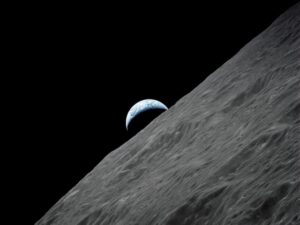
The Earth rises above the lunar horizon in a picture captured from Apollo 17 spacecraft. (Photo: Reuters)

The Earth rises above the lunar horizon in a picture captured from Apollo 17 spacecraft. (Photo: Reuters)

WHAT HAPPENED WITH APOLLO 17?

Apollo 17 launched at 10:03 am IST on December 7, 1972.

The fireball from the launch was so bright it turned night to day for the more than 5,00,000 spectators gathered near the Kennedy Space Center, and was reportedly visible as far away as Miami.

Commander Gene Cernan, lunar module pilot Harrison “Jack” Schmitt, and command module pilot Ronald Evans were the crew. Schmitt was the first and only professional scientist (a geologist) to walk on the Moon.

Four days after launch, Cernan and Schmitt landed in the Moon’s Taurus-Littrow valley while Evans remained in lunar orbit above.

WHAT DID ASTRONAUTS DO ON THE MOON?

The two astronauts spent 75 hours on the Moon and completed three moonwalks totalling 22 hours and 4 minutes, marking the longest surface stay of the entire Apollo program.

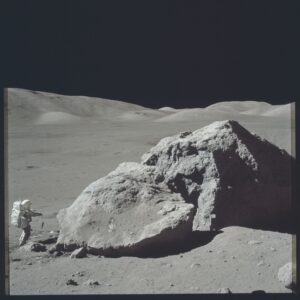
Scientist-astronaut Harrison Schmitt is pictured standing next to a boulder on Moon. (Photo: Reuters)

Scientist-astronaut Harrison Schmitt is pictured standing next to a boulder on Moon. (Photo: Reuters)

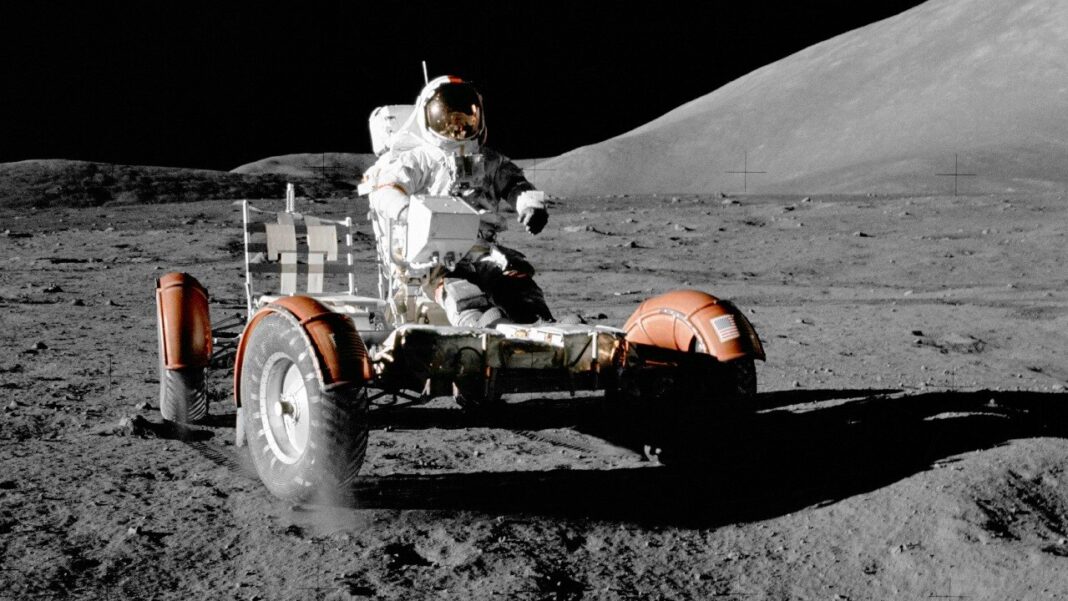
The lunar rover traversed a total of 30.5 kilometres across the surface, with the crew collecting about 110 kilograms of rock and soil samples, including orange soil near Shorty Crater that turned out to be evidence of ancient volcanic activity on the Moon.

Perhaps Apollo 17’s most enduring legacy was a photograph taken about five hours after launch. The “Blue Marble” image of a fully lit Earth against the void of space, became one of the most reproduced images in history and a galvanising symbol for the environmental movement.

A view of the Earth as seen by the Apollo 17 crew. (Photo: Reuters)

A view of the Earth as seen by the Apollo 17 crew. (Photo: Reuters)

WHY DID WE STOP GOING TO THE MOON?

The primary reason for ending crewed Moon missions was financial. Nasa was experiencing budget constraints as shifting political priorities redirected funding away from the Apollo program.

The space agency had already turned its human spaceflight efforts toward the Space Shuttle program by the time Apollo 17 launched, but nobody imagined the hiatus would last more than 50 years.

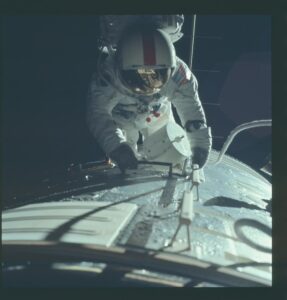
Astronaut Ronald Evans is pictured performing extravehicular activity during the Apollo 17 mission. (Photo: Reuters)

Astronaut Ronald Evans is pictured performing extravehicular activity during the Apollo 17 mission. (Photo: Reuters)

A commemorative plaque left at the landing site, signed by the crew and former US President Richard Nixon, read: “Here man completed his first explorations of the Moon.”

Now, with Artemis II getting ready to take flight after five decades, the next chapter has finally begun.
Latest

Around the Moon in 10 days: Countdown begins for NASA’s Artemis II launch — liftoff time, crew, mission details and more

With NASA's Artemis II mission slated to launch on 1 April, 2026, the 32-story Space Launch System (SLS) and the Orion spacecraft have been deployed at Launch P

We finally know some details about Isro’s reusable rocket program

Isro advances reusable rocket technology with new tender for landing leg hardware

Satellite captures 2,000-km-long wall of dust blowing through Sahara Desert

Dust storms of this magnitude can have widespread impacts. In affected areas, visibility can drop sharply, disrupting transportation and posing risks to aviatio

AI Data centres creating heat islands, raising temp by 9°C, scientists confirm

In extreme cases, the jump can be as high as the difference between a pleasant Delhi winter morning and a scorching May afternoon.

Heavy rain, hailstorms to hit India as western disturbance hits on Tuesday

Widespread rainfall, thunderstorms, gusty winds and hailstorms are likely to affect several regions between March 30 and April 5.

Topics

Mamdani puts New York City government back on TikTok

Mamdani puts New York City government back on TikTok

Elon Musk must face class action over late disclosure of Twitter stake, judge rules

X-CORP-MUSK-LAWSUIT:Elon Musk must face class action over late disclosure of Twitter stake, judge rules

Israel forging new alliances with key regional countries against Iran: Netanyahu

Netanyahu says Israel forging new alliances with important countries to counter Iran threat

Tiger Woods hydrocodone pills: Did he have a prescription for it? Golfer’s medication details emerge amid crash

Report doesn’t confirm hydrocodone prescription. Woods said he had meds for surgeries, denied illegal drugs; appeared limping, sweating, and talkative.

Tether Cuts Gold Traders Months After Hiring Them From HSBC

Tether Holdings SA has cut two senior precious metals traders just months after hiring them from HSBC Holdings Plc to create what it called “the best trading

Supergirl trailer: Milly Alcock, Jason Momoa lead James Gunn’s gritty superhero film

The trailer of Supergirl: Woman of Tomorrow was released on March 31. Milly Alcock’s Supergirl faces new dangers to protect her loyal dog, Krypto from the ali

Anthropic’s AI coding tool, Claude Code, accidentally reveals its source code; here’s what happened

Anthropic accidentally exposed the full source code of its AI tool Claude Code due to a packaging error. While no user data or core AI systems were affected, th

‘Today is your last working day…’: Oracle cuts jobs globally, thousands laid off in latest cost cutting move

Layoffs by the software maker appear to have reportedly affected employees in multiple regions across the globe, although the full extent of the cuts is not yet
spot_img

Related Articles

Popular Categories

spot_imgspot_img