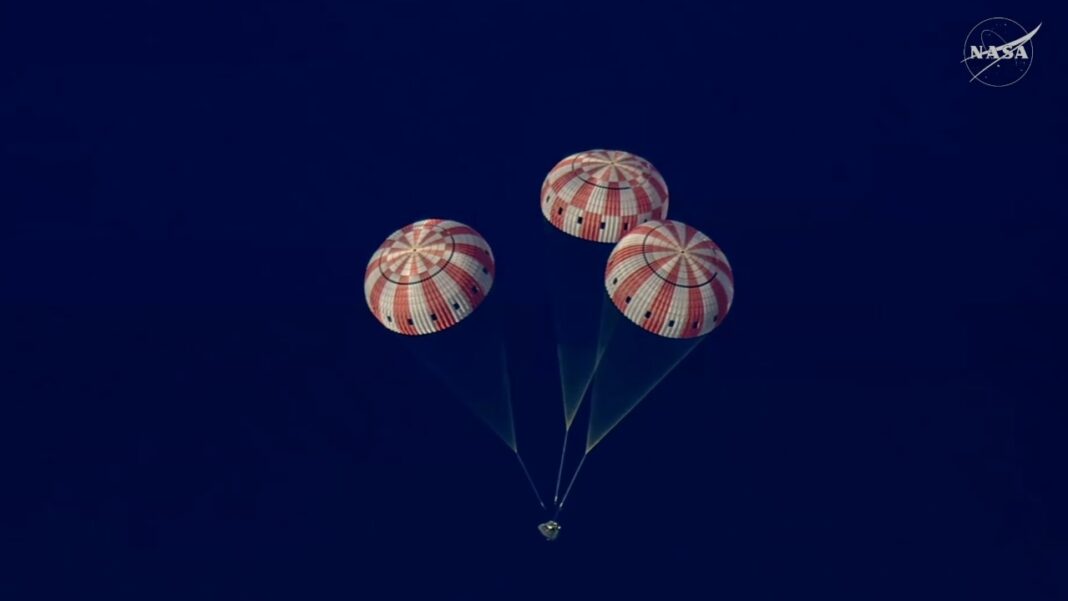
A daring voyage that took four astronauts 4,06,778 km away from Earth, farther than any human in history, the Artemis II mission successfully splashed down in the ocean acing a nerve-wracking fiery descent through Earth’s thick atmosphere.
As the parachutes opened above the Pacific Ocean, the splashdown marked the triumphant return of four astronauts who completed humanity’s first crewed journey to the Moon in the 21st century.
The historic mission, led by Nasa, signals a major leap forward in efforts to establish a sustained human presence beyond low-Earth orbit.
A FIERY RE-ENTERY INTO EARTH
The crew, which included Commander Reid Wiseman, Pilot Victor Glover and Mission Specialists Christina Koch and Jeremy Hansen, travelled aboard the Orion spacecraft and re-entered Earth’s atmosphere at blistering speeds before deploying parachutes for a safe splashdown.
Nasa and Navy recovery teams swiftly secured the capsule to assist the astronauts, who were smiling and celebrating after completing a high-stakes 10-day journey around the Moon and back.

Artemis II is widely seen as a defining moment in modern space exploration. It is the first time since the Apollo program that humans have travelled to the vicinity of the Moon.
Unlike its predecessor, Artemis I, which validated critical systems without a crew, Artemis II carried astronauts on a daring lunar flyby designed to test life-support systems, navigation, and deep-space operations.
ONE GIANT LEAP AGAIN FOR HUMANS
During the mission, the astronauts orbited the Moon, capturing stunning images of the lunar surface and Earth rising over the horizon, moments that echoed the iconic visuals of earlier lunar missions while showcasing new technological capabilities. The crew also conducted a series of experiments and system checks that will pave the way for future landings.
One of the most challenging phases of the mission was the fiery re-entry into Earth’s atmosphere.
Travelling at speeds exceeding 40,000 kmph, the spacecraft endured extreme temperatures before safely descending into the ocean. The successful return demonstrated the robustness of the Orion heat shield and recovery procedures.
Nasa officials hailed the mission as a critical step toward the next phase of lunar exploration, including landing astronauts on the Moon under the Artemis program.
The data gathered from Artemis II will be instrumental in planning future missions, particularly Artemis III, which aims to put humans back on the lunar surface for the first time in over five decades.
With Artemis II now complete, the world has witnessed the dawn of a new era in human spaceflight, one that promises to take astronauts not only back to the Moon, but eventually onward to Mars and beyond.