
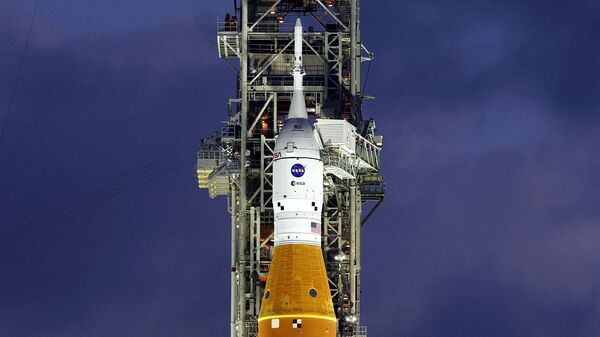
A four-member crew, including one woman, are all set to embark on the first crewed journey to the Moon since 1972.
The NASA moon mission, Artemis 2, is scheduled to take off from Florida as early as 1 April at 6:24 PM EST (3:54 AM IST on 2 April).
Here is a space lingo cheatsheet to understand the terminology surrounding the NASA moon mission better:
The liftoff lingo
The launch is a go: Things are on track to take off.
The launch is a no go: The launch may be postponed.
SLS (Space Launch System) is used to indicate the rocket.
SLS nominal: Things are normal or going as planned.
LOX and LH2: Liquid oxygen and Liquid hydrogen, used to load the rocket with cryogenic or supercold fuel for liftoff.
Slow fill, fast fill, topping and replenishing: Multiple phases of fuelling a rocket during launch.
L Minus: Used to indicate the time until liftoff in hours and minutes.
T Minus: Indicates events included in the launch countdown, like the retracting of the crew access arm, or the starting of the engines in the final seconds before liftoff.
Crew access arm: A platform that enables astronauts to board the spacecraft.
Hold: A natural pause in the countdown to allow last-minute tasks or waiting to align time with a specific schedule.
During a hold, the countdown clock and T Minus time stop, while the L Minus time continues.
White Room: An environmentally controlled staging area where the crew members will don their helmets and gloves.
Ingress: Boarding of the Orion crew module.
Mobile launcher: An all-in-one ground platform that can transfer the rocket and capsule out to the pad. This platform is used for testing and servicing of the rocket — and ultimately, launch.
Ground launch sequencer: A computer that tells the rocket when to launch. This is the final, and largely automated, phase of the countdown that spans the last 10 minutes before liftoff.
Umbilical separation: The disconnecting of power cables and fuel lines after the engines start and the booster ignites. This is the last step before the rocket launches.
Lingo used after launch
After the Artemis 2 launch, the team is expected to use the following terms frequently:
ICPS (Interim cryogenic propulsion stage): It is the upper segment of the rocket that will give the Orion capsule the propulsion it needs to continue in space.
Core stage: Backbone of the rocket, which includes engines, propellant tanks and avionics, or aviation electronic systems.
SRB (solid rocket boosters) & LAS (launch abort system): Two of the launch abort system’s three engines that can be used to return the Orion capsule safely to Earth in the event of a malfunction or systems failure during launch.
The third engine is used to jettison the launch abort system, which occurs shortly after launch if all goes well.
MECO (main engine cut-off): It occurs about eight minutes after launch, signalling the shutdown and separation of the SLS’s core stage from the ICPS and Orion.
Zero gravity indicator: An object that floats into view, in this case a plush toy chosen by the Artemis II crew, to show that the astronauts are in the space environment.
Burns: When the propulsion system fires up to help the spacecraft stay on course or reach a new orbit
Perigee raise maneuver:When the ICPS experiences a burn to raise Orion’s altitude and place it in a stable low-Earth orbit. It occurs about 49 minutes after launch.
Apogee raise burn: When the ICPS fires again about an hour later to boost Orion into a higher orbit. After this burn, it will separate from Orion.
Proximity Operations Demonstration: A series of orbital manoeuvres executed before the ICPS eventually burns up. The Artemis II crew will practise docking Orion. This will allow NASA to practise piloting the capsule toward and around the ICPS, as astronauts will need to do during future missions.
Perigree raise burn: An additional firing of the engine on the first day of flight to put Orion in the optimal position.
Translunar injection burn: It increases Orion’s velocity, allowing it to leave behind a circular orbit of Earth and transfer to an oval-shaped orbit that will help it reach the moon.
Words used after Orion reaches the translunar phase
Service module: Provides the spacecraft with power, propulsion and thermal control, giving the Orion capsule a big push to embark on a four-day trip around the moon before completing a figure eight to return to Earth.
Orbital trajectory correction burns: Smaller burns to ensure that Orion stays on target for its lunar flyby.
Lunar sphere of influence: The point in space where the tug of the moon’s gravity is stronger than Earth’s gravity.
Heat shield: After Orion is on the right course for splashdown, its service module will separate to expose a shield intended to protect the astronauts during reentry to Earth.
Lingo used while returning to Earth
Reentry: Reentering Earth’s atmosphere.
Drogue parachutes: Help to slow down Orion’s descent.
Pilot parachutes: Responsible for unfurling the capsule’s three main parachutes that further reduce Orion’s speed from about 200 to 30 kilometres per hour.
Once it has sufficiently slowed, the Orion capsule will splash down off the coast of California.


