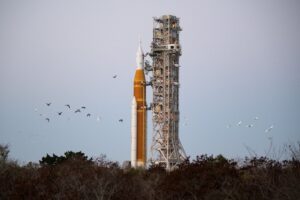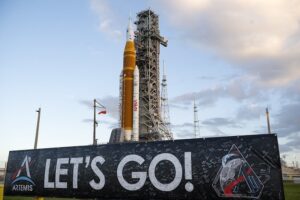
Nasa has sent humans towards the Moon for the first time in over 50 years.
The Orion spacecraft, part of the long-awaited Artemis-II mission, is carrying four astronauts after lifting off on April 2 atop the Space Launch System (SLS) rocket from Kennedy Space Center in Florida, US.
The launch marked the beginning of a 10-day journey that will take the crew around the Moon and back to Earth.
WHEN WILL ARTEMIS-II REACH THE MOON?
The crew aboard the SLS heading to the Moon is expected to take about four days to arrive at the Moon.
During the journey to the Moon, the crew will monitor spacecraft systems, gather data on the effects of deep space travel, and perform trajectory correction burns as needed.
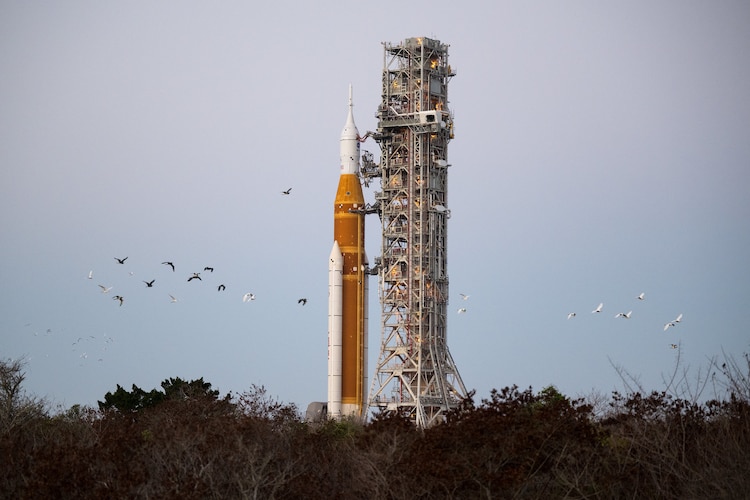
After liftoff, two engine firings place Orion on its outbound path.
The spacecraft does not fly in a straight line, the mission profile uses a free-return trajectory, meaning the Moon’s own gravity will curve Orion’s path and slingshot it back toward Earth, similar to what Apollo 13 used in 1970.
No engine burn is needed to turn the spacecraft around.
At its farthest point, which would be roughly 7,600 kilometres beyond the Moon’s surface, Artemis-II will set a new record for the farthest crewed spaceflight in history.
The crew will spend days four to six in the Moon’s vicinity, photographing its far side and collecting scientific data before beginning the four-day return journey.

Re-entry will be the fastest and most intense part of the trip.
Orion will hit Earth’s atmosphere at approximately 40,000 kmph, making it the fastest re-entry ever attempted by a crewed spacecraft.
The capsule will then splash down in the Pacific Ocean off San Diego, where the US Navy will recover the crew.
WHO IS GOING TO THE MOON?
The Artemis-II crew comprises Nasa astronauts Reid Wiseman, pilot Victor Glover, and Christina Koch, along with Canadian Space Agency (CSA) astronaut Jeremy Hansen.
With the mission underway and the spacecraft flying towards the Moon, Glover has become the first person of colour, Koch the first woman, and Hansen the first non-US citizen to travel beyond low Earth orbit.

As exciting as this mission might be, it’s worth noting that Artemis-II will not land on the Moon.
The mission’s core purpose is to test Orion’s life support and systems with a live crew.
The collected data will directly shape Artemis-III, currently targeting a crewed lunar landing in 2028, in what has become a direct race against China’s stated goal of putting its own astronauts on the Moon by 2030.