
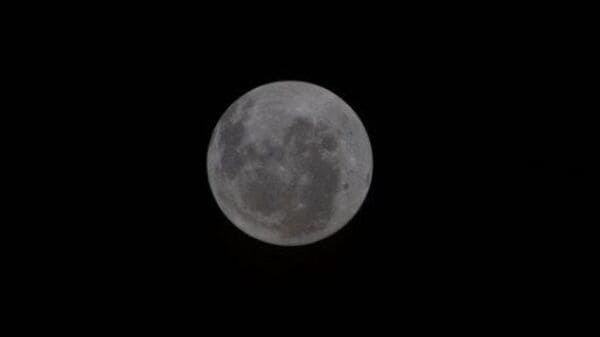
Artemis 2 astronauts made history by catching sight of never seen before entire ‘Orientale basin.’ For the first time in the entire existence of humanity, the crew members onboard the Orion spacecraft could see this celestial marvel.
NASA astronauts Reid Wiseman, Victor Glover, and Artemis II mission specialist Christina Koch, along with Canadian Space Agency astronaut Jeremy Hansen, not only became the first humans to travel beyond Earth’s orbit since the Apollo missions in 1972 but also the first to view entire ‘Orientale basin.’
The caption to the post shared on X by NASA states, “History in the making.” This post further reads, “In this new image from our NASA Artemis II crew, you can see Orientale basin on the right edge of the lunar disk. This mission marks the first time the entire basin has been seen with human eyes.”
Artemis II mission moon flyby on April 6
Artemis II astronauts are currently preparing for their fifth day of their 10-day lunar mission which began on 1 April and are all set for lunar flyby on April 6 (local time). With Artemis II’s moon flyby scheduled for Monday, astronauts will set the record for the farthest anyone has ever travelled from Earth.
After successfully completing a key burn of Orion’s main engine, the astronauts on NASA mission will fly around the Moon for the first time in more than 50 years. The lunar flyby is expected to last for about six hours, during which human eyes are going to see parts of the moon that haven’t been seen by anyone.
Artemis II Visualization Lead Ernie Wright in a video said that this mission “recommits us to exploring the solar system in a way that we haven’t in a long time.”
Describing the importance of this lunar flyby in a press conference late Friday a NASA official said that the aim of the Artemis II mission ” is to go back to the moon” and “being able to see with human eyes the lunar surface is a huge milestone.”
According to the official, the motive is not just to land on the Moon, but to stay there, making it “ the first step towards that. We’ll obviously build upon that. We’ll get eyes on the moon, kind of map it out and then continue to go back and in force.”
In a press briefing before Artemis II launch, NASA astronaut Christina Koch said that looking at the moon, what will it actually look like through our eyes, through the windows of Orion — “That is something we’re all really looking forward to.”
Artemis II mission day 4 update
Sharing an update on Artemis II, NASA said that the space vehicle covered “two thirds” mark of the journey to the Moon. “During Flight Day 4, the astronauts aboard Orion went over plans to study the Moon during their upcoming lunar flyby and are currently practicing manually controlling the spacecraft,” the US space agency said.


