
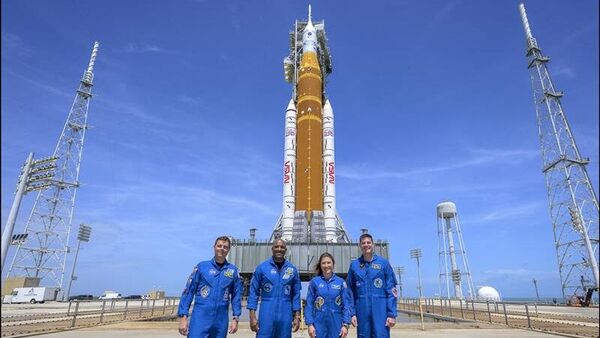
For the first time in over half a century, a crewed spacecraft is set to depart for the Moon, with NASA engineers having officially begun the countdown for the historic and much-anticipated Artemis II mission.
With Artemis II slated to launch on 1 April, 2026, the rocket and the spacecraft to be used for the mission—namely, the 32-story Space Launch System (SLS) and the Orion spacecraft—have been deployed at Launch Pad 39B at the Kennedy Space Center in Florida, from where the launch will take place.
As we count down for the historic mission, here’s everything you need to know.
Launch time and other details
The countdown to launch of the Artemis II mission has officially begun inside the Rocco Petrone Launch Control Center.
As it stands, the launch window for Artemis II is 6.24 pm EDT on 1 April (10.24 pm UTC and 3.24 am IST the next day).
As of writing this, US Space Force forecasters were predicting an 80% chance of favourable weather conditions for the scheduled launch.
The launch will be livestreamed on NASA’s website and social media handles.
After its launch on 1 April and its 10-day journey, the crew of Artemis II are slated to splash down in the Pacific Ocean on 10 April.
Four astronauts will be making the historic journey to the moon and back on board the Orion spacecraft, with three coming from NASA and one from the Canadian Space Agency.
Veteran naval aviator Reid Wiseman of NASA, who previously spent 165 days on the International Space Station (ISS), will lead the mission NASA Astronaut and US Navy captain Victor Glover will serve as pilot.
NASA’s Christina Hammock Koch, an engineer holding the record for the longest single spaceflight by a woman, will serve as the mission specialist, becoming the first woman to travel to the Moon.
Joining the trio will be former fighter pilot and mission specialist Jeremy Hansen from Canada, who will become the first non-American to ever leave now-Earth orbit.
What to expect from the Artemis II mission?
Although Artemis II is transporting astronauts to the Moon, there will be no lunar landing. Rather, the mission will serve as a high-stakes test flight designed to test the Orion spacecraft’s deep space capabilities.
After lifting off, Orion will separate from the SLS rocket’s upper stage and spend the first 24 hours in high Earth Orbit, where the crew will manually pilot the spacecraft and test vital environmental and life support systems.
Once these checks are completed, Orion will complete a massive engine burn to break out of the Earth’s orbit, before committing to a free-return trajectory that will see the spacecraft use gravity to naturally return to Earth without requiring another engine burn.
Subsequently, over the next few days, the crew will coast towards the Moon.
Upon reaching the Moon, the crew will not orbit or land, but instead execute a flyby, swinging around the lunar far side. At their closes approach, the Artemis II crew will be roughly 4,700 miles from the lunar surface.
A record could be broken as well: as the crew swing around the far side of the Moon, they will hit the absolute peak of their trajectory, and depending on the exact orbital mechanics of launch day, reach a maximum distance of nearly 250,000 miles away from Earth. At this exact moment, they will officially break the record for the farthest distance humans have ever traveled into space, surpassing the record set by the Apollo 13 crew.
After the flyby, gravity will pull Orion back towards Earth for the return leg of the journey, culminating in the spacecraft’s splashdown in the Pacific Ocean on 10 April.
Beyond testing Orion’s capabilities for supporting human spaceflight, Artemis II will carry a suite of scientific payloads for communications and biomedical research.
The mission will also carry four shoe-box-sized CubeSats provided by international partners for deep-space science and a a digital archive containing the names of over 5.6 million people from NASA’s ‘Send Your Name to the Moon’ campaign.
A stepping stone to Mars
Despite being a lunar mission, Artemis II is not a repeat of the 1968 Apollo 8 flyby, instead a stepping stone for the future of human space exploration, and the ultimate leap: crewed missions to Mars.
A demonstration of systems capable of supporting human spaceflight is an absolute pre-requisite for any crewed deep space exploration aspirations, and Artemis II is designed to deliver exactly that.
It will be followed by NASA’s Artemis III mission in 2027, which aims to land astronauts near the Moon’s south pole to search for water ice.


