
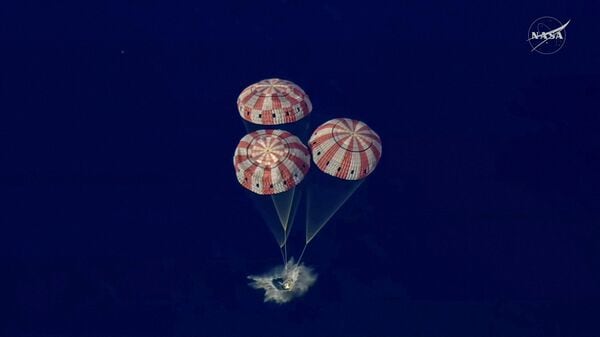
Artemis II is home! The Orion spacecraft carrying the four astronauts splashed down in the Pacific Ocean early on Saturday, 11 April, completing a historic flyby around the Moon and returning to Earth.
With NASA’s historic Artemis II mission concluding its monumental 10-day lunar voyage, the Orion spacecraft carried out a “perfect descent” and splashed down in the Pacific Ocean at 5.37 am IST on 11 April (5.07 pm PT on 10 April), making the overall mission time nine days, one hour, 32 minutes, and 15 seconds.
The crew, mission commander Reid Wiseman said, was in excellent condition following the splashdown.
However, there was some communication issues between the Orion spacecraft and the recovery team, resulting in a slight delay in the extraction of the crew.
All four members of the crew were extracted around 1 hour and 20 minutes after splashdown, with mission commander Wiseman being the last to exit the Orion spacecraft.
As the world celebrates the completion of this historic mission, here’s everything you need to know about what it has achieved.
A historic crew and shattered records
Since lifting off on 1 April aboard the 32-story Space Launch System (SLS) rocket from Launch Pad 39B at the Kennedy Space Center in Florida, Artemis II has scripted history on multiple fronts. It marks the first crewed flight beyond low Earth orbit in over 53 years, since the Apollo 17 mission of December 1972.
Four astronauts made the historic journey aboard the Orion spacecraft, named Integrity by the crew, bringing unprecedented diversity to deep space exploration. Veteran naval aviator Reid Wiseman led the mission as commander, joined by US Navy captain Victor Glover, who served as pilot and became the first Black astronaut assigned to a lunar mission.
NASA’s Christina Hammock Koch, who holds the record for the longest single spaceflight by a woman, served as mission specialist, officially becoming the first woman to fly to the Moon. Joining the trio was former fighter pilot Jeremy Hansen from the Canadian Space Agency, who became the first non-American to ever leave low Earth orbit.
What the mission achieved
Designed as a high-stakes test flight to validate Orion’s deep space capabilities, the mission successfully executed its primary objectives. After separating from the SLS rocket’s upper stage, the crew spent their first day in high Earth orbit manually piloting the spacecraft and testing vital environmental and life-support systems, including the Airbus-built European Service Module (ESM).
Once these crucial checks were completed, Orion executed a massive trans-lunar injection burn, committing to a free-return trajectory. The spacecraft did not orbit or land on the Moon but instead executed a precise flyby, swinging around the lunar far side at a closest approach of roughly 4,067 miles.
A monumental record was broken during this maneuver. On 6 April, as the crew swung around the far side of the Moon, they hit the absolute peak of their trajectory, reaching a staggering maximum distance of 252,756 miles away from Earth. At this exact moment, they officially broke the Apollo 13 record for the farthest distance humans have ever traveled into space.
The journey home and a stepping stone to Mars
After the historic flyby, lunar gravity naturally pulled Orion back towards Earth for the return leg of its 1.1-million-kilometer journey. Following a series of trajectory corrections, the spacecraft re-entered the Earth’s atmosphere early on Saturday (11 April, India time), where it deployed parachutes to slow down to a gentle 20 miles per hour before splashing down off the coast of San Diego.
Despite being a lunar flyby, Artemis II was not a repeat of the 1968 Apollo 8 mission, but rather served as a stepping stone for the future of human space exploration. The successful demonstration of systems capable of supporting human spaceflight is an absolute prerequisite for any deep space aspirations, and Artemis II’s success paves the way for NASA’s Artemis III mission in 2027, which aims to land astronauts near the lunar south pole, and the ultimate leap: crewed missions to the Red Planet, Mars.


