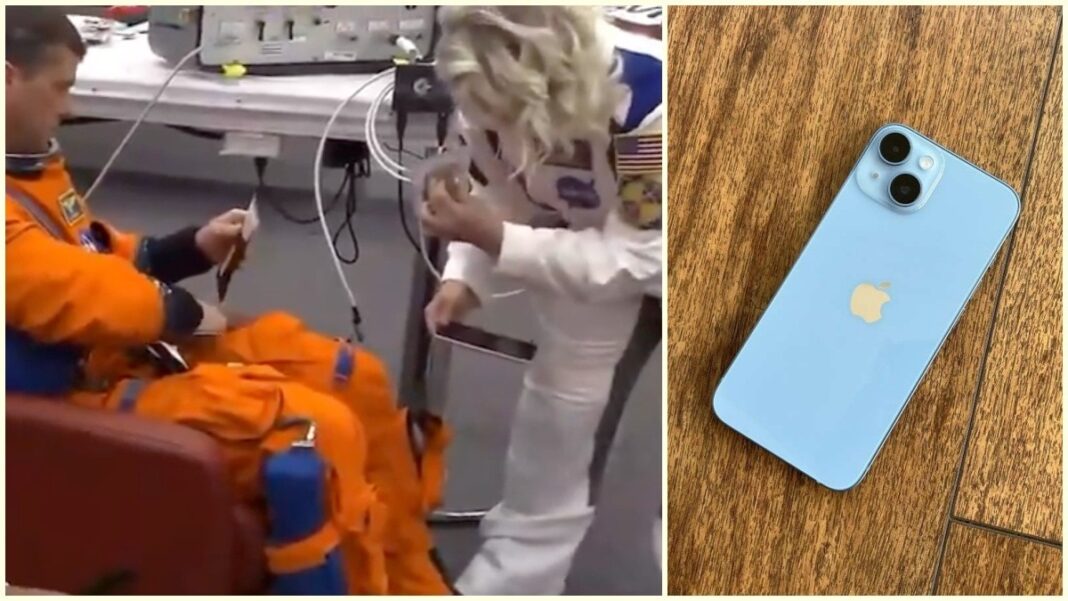
In a striking blend of everyday technology and deep space exploration, Nasa has approved the use of iPhones for astronauts aboard the upcoming Artemis II mission. Nasa team was seen placing the iPhones into the astronaut suits ahead of the Moon launch.
The decision marks a shift in how space agencies approach documentation, allowing crew members to carry familiar consumer devices on a journey that will take them around the Moon.
The new policy, introduced earlier in 2026 by Nasa Administrator Jared Isaacman, permits astronauts to pack modern smartphones into their suits. These devices will be used primarily to capture personal moments and record high-quality images during the mission’s historic lunar flyby.
However, the phones will remain strictly on airplane mode, ensuring they do not interfere with spacecraft systems or attempt to connect to terrestrial networks.
Artemis II, Nasa’s first crewed mission toward the Moon in more than 50 years, will carry four astronauts on a roughly 10-day journey. While the mission will not include a lunar landing, it is designed to test critical systems and pave the way for future missions that aim to return humans to the lunar surface.
The inclusion of iPhones reflects Nasa’s evolving strategy to make space exploration more relatable to the public.
By equipping astronauts with widely used devices, the agency hopes to capture images and videos that feel more immediate and personal compared to traditional space photography. Officials believe this could help bridge the gap between complex space missions and everyday audiences back on Earth.
At the same time, Nasa has emphasised that safety remains paramount. The smartphones will operate independently of onboard systems, with strict protocols in place to prevent interference.
Airplane mode ensures that all wireless communication features are disabled, effectively turning the devices into standalone cameras and recording tools.
Experts note that advancements in smartphone camera technology now rival some professional equipment, making them viable tools even in extreme environments.
Their compact size and ease of use also provide astronauts with a convenient way to document their experiences without relying solely on specialised gear.

As Artemis II prepares for launch, the presence of iPhones aboard the mission highlights a broader trend: the merging of cutting-edge space exploration with everyday technology.
For millions watching from Earth, the Moon may soon feel a little closer, captured not just through scientific instruments, but through the same devices they carry in their pockets.