826 years ago, Japanese poets wrote about a massive storm. It came from the Sun

Imagine a 13th-century Japanese poet looking up at the night sky and writing about mysterious red lights. And now, 800 years later, that same diary entry is helping scientists protect future astronauts.

Sounds like something out of a science fiction novel. But it isn’t.

Researchers at Japan’s Okinawa Institute of Science and Technology have uncovered evidence of a powerful burst of energy from the Sun that occurred around the winter of 1200 CE. To find it, they combined two very unlikely sources; the personal diary of a medieval Japanese poet and the rings inside ancient buried trees.
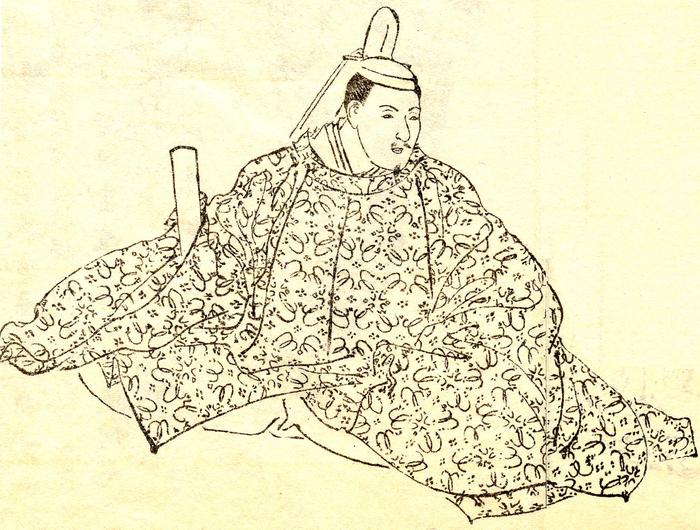
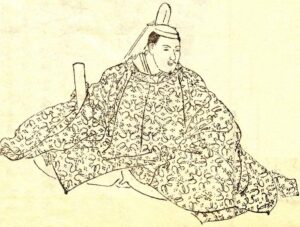
An Edo-period illustration of Fujiwara no Teika. (Photo: OIST)

An Edo-period illustration of Fujiwara no Teika. (Photo: OIST)

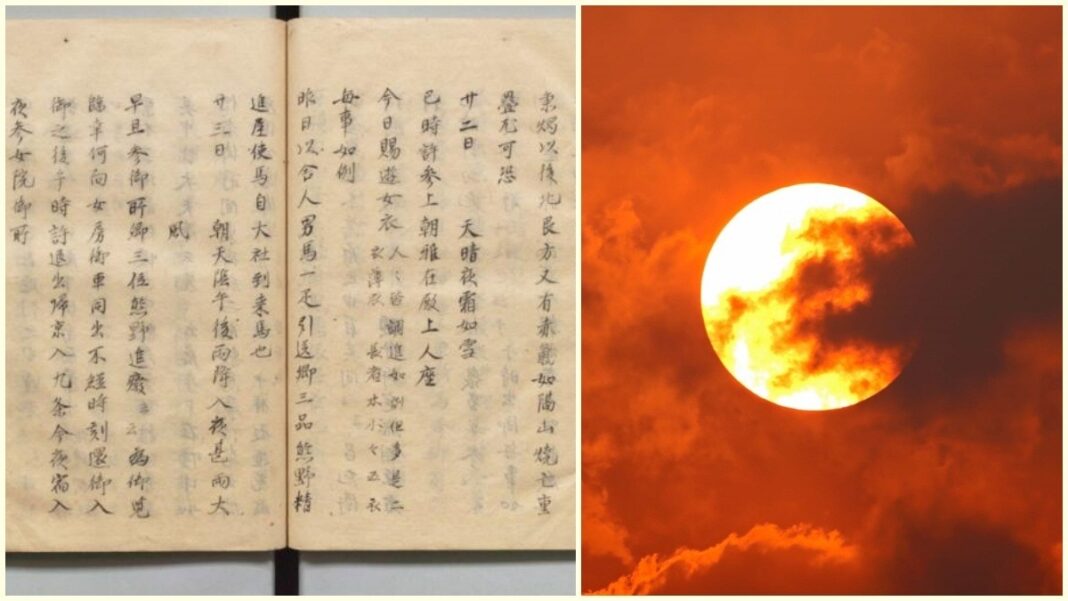
The first clue came from Meigetsuki, the diary of influential Japanese courtier and poet Fujiwara no Teika, who witnessed “red lights in the northern sky over Kyoto” in February 1204 CE. Those red lights were almost certainly a rare type of aurora. It was the kind that only appears when the Sun is in a very agitated, stormy state.

That diary entry pointed scientists to the right time period, allowing them to then study ancient buried trees from northern Japan.

When the Sun erupts, it sends high-energy particles towards Earth that get absorbed by trees and leave a kind of chemical fingerprint in the wood.

By measuring the carbon-14 content in preserved organic material such as buried trees, researchers can identify fluctuations in solar activity over the last 10,000 years. And that’s what they did.
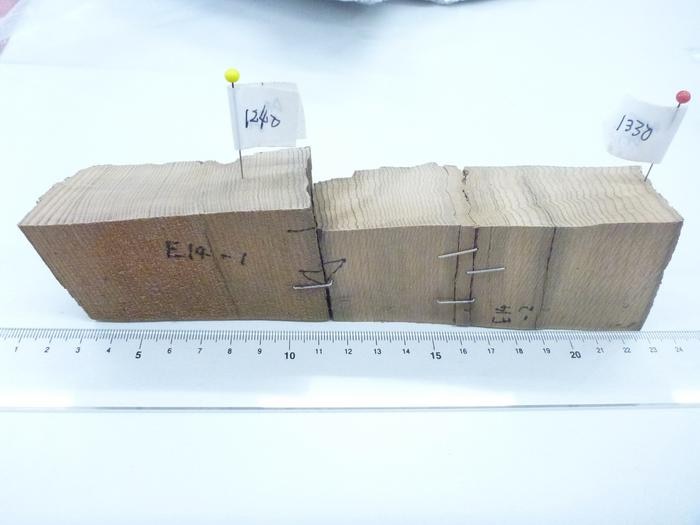
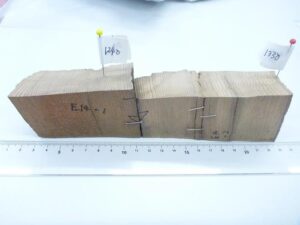
The asunaro cypress tree samples. (Photo: OIST)

The asunaro cypress tree samples. (Photo: OIST)

WHAT DID WE LEARN ABOUT THE SUN?

In 1972, a string of these solar particle bursts occurred between the Apollo 16 and 17 Moon missions. Had they coincided with either expedition, the astronauts would have been helplessly exposed to deadly particle radiation.

Today, the Sun’s activity fluctuates over eleven-year-long cycles, but researchers found that the cycle was just seven to eight years long back then, indicating a very active Sun. The solar burst they identified happened right at the peak of one of these shorter cycles.

The researchers say historical literature provides a candidate time window, and tree-ring studies enable direct comparison between detected solar events and reports of sunspots and auroras recorded in literature — and that integrated approaches like these are necessary to better understand extreme space weather.

This becomes even more relevant in light of the success of Nasa’s Artemis 2 mission that sent a crew of four astronauts around the moon. The success is to serve as a stepping stone for future lunar landings, and potentially sending humans to Mars.
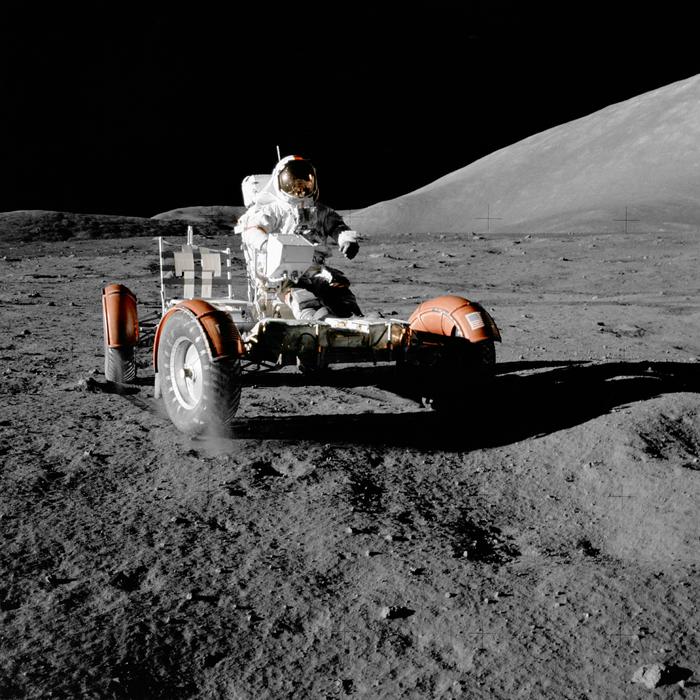
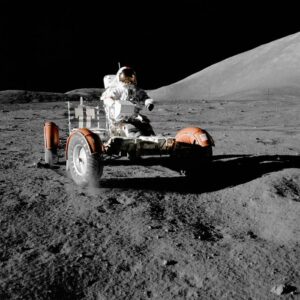
Until last week, Apollo 17 was the last time humans left low-earth orbit to visit the Moon. (Photo: OIST)

Until last week, Apollo 17 was the last time humans left low-earth orbit to visit the Moon. (Photo: OIST)

With space ambitions growing around the globe, knowing when and how these solar storms happen is no longer just a scientific curiosity but has become a safety issue.

Who would’ve thought that one day old poems and ancient wood would help us stay safe in space?
Latest

Heat ahead: Most parts of India cloud-free, temperatures to spike from Saturday

The lack of cloud cover plays a crucial role in this warming trend. Clouds typically reflect a portion of incoming solar radiation back into space.

When will Artemis 2 astronauts splash down on Earth? Check out timings, location

As the spacecraft travels through the void between the Moon and Earth, the crew is focused on preparing for a high-stakes reentry.

Make Pluto a planet again: 10-year-old’s letter makes Nasa chief pay attention

Nasa chief Jared Isaacman's brief but warm response has since drawn attention online, with many praising the agency for engaging with young space enthusiasts.

Isro drops Gaganyaan capsule into sea from 3 km above Earth

The test validated the crew module’s parachute-based landing system, crucial for safely returning astronauts to Earth.

Fireball, blackout, splashdown: How Artemis II crew will survive journey back to Earth — Here’s what to expect

NASA's Artemis II crew, having travelled farther than any astronauts before, is returning to Earth after a successful mission. They will splash down in the Paci

Topics

Bessent, Powell warned bank CEOs about Anthropic model risks, sources say

USA-BANKS-ANTHROPIC-CYBERSECURITY:Bessent, Powell warned bank CEOs about A

Lebanon, Israel hold first contact, agree to US-mediated meeting on April 14

The exchange involved ambassadors in Washington with U.S. participation, reflecting active mediation efforts, as both sides prepare to outline terms for a cease

Inside Tehran’s strategy: Why Iran picked JD Vance for crucial peace talks

Iran quietly preferred JD Vance to lead US talks, viewing him as anti-war, as high-stakes negotiations begin in Islamabad with deep divisions and uncertain pros

Look at the ball, not the bowler: Sooryavanshi’s mantra vs Bumrah, Hazlewood

Vaibhav Sooryavanshi revealed that his mantra is to “play the ball” and “not the bowler” after taking apart Josh Hazlewood in a successful 202-run chase

Iran delegation lands in Pakistan, says talks start only if US meets preconditions

Iranian delegation led by Speaker Mohammad Baqer Qalibaf arrives in Islamabad for US talks, saying negotiations will begin only if Washington accepts Tehran’s

Boaz Weinstein Scores Win After UK Trust Backs SpaceX Proposal

A Baillie Gifford & Co. trust that placed an early bet on SpaceX recommended a proposal backed by activist investor Boaz Weinstein after losing a key shareholde

Trump buying time before ground op: Ian Bremmer on US-Iran ceasefire talks in Pak

Bremmer suggested Trump may prefer de-escalation amid mounting domestic scrutiny, seeking to deflect blame for rising geopolitical tensions and economic fallout

AI warfare: Why CDS General Anil Chauhan says decision-making must get faster

Chief of Defence Staff (CDS) General Anil Chauhan said this demands seamless tri-service integration and innovative thinking; therefore, the focus has now shift
spot_img

Related Articles

Popular Categories

spot_imgspot_img