

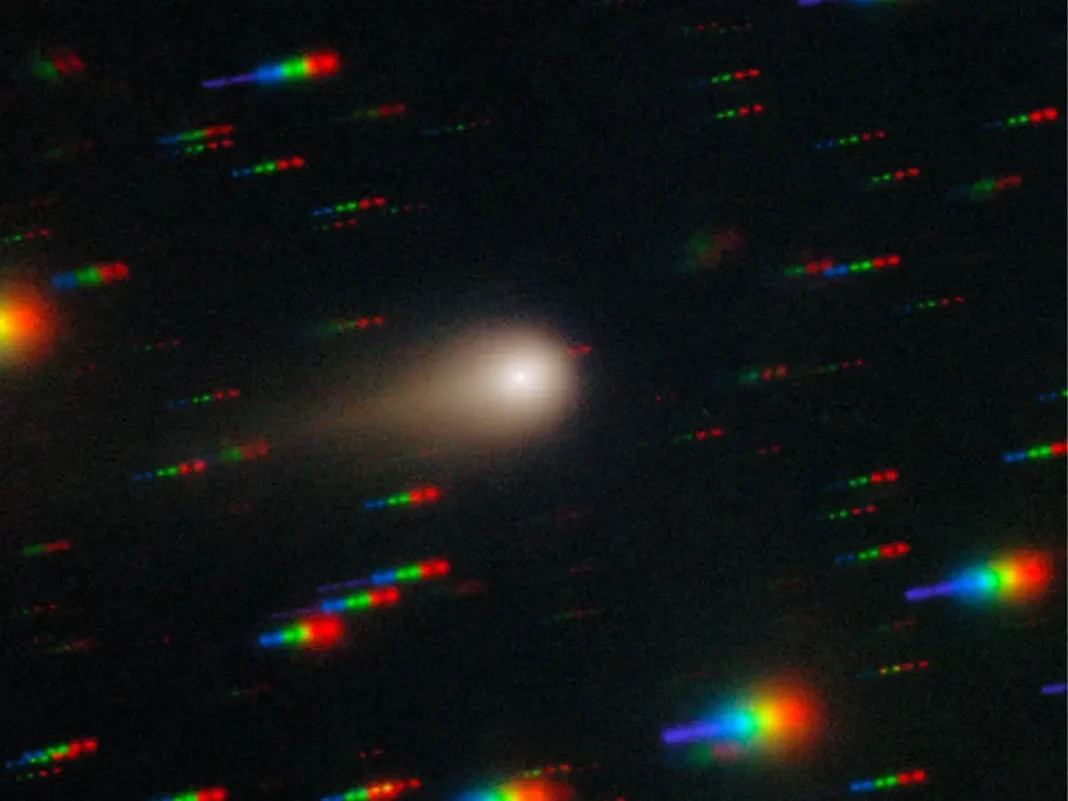
Interstellar Comet 3I/ATLAS: Key Updates and Scientific Mysteries
The interstellar comet 3I/ATLAS, discovered on July 1, 2025, by the ATLAS observatory in Chile, is currently hidden behind the Sun after reaching its closest point (perihelion) on October 29. This ancient visitor from another star system presents a unique scientific opportunity, with its reappearance expected in early November.
Key Takeaways
- Comet 3I/ATLAS reached perihelion on October 29 and is currently in solar conjunction
- Harvard scientist Avi Loeb suggests a 30-40% chance it’s not a natural comet
- The comet is estimated to be 7-14 billion years old – older than our solar system
- It poses no threat to Earth, with closest approach of 268 million km on December 19
Current Status and Visibility
The interstellar comet reached solar conjunction on October 21, placing it directly behind the Sun from Earth’s perspective. Following its October 29 perihelion, the comet remains invisible due to solar glare but is expected to reemerge in early November, giving astronomers their next observation window.
Scientific Controversies and Features
Harvard professor Avi Loeb has raised questions about 3I/ATLAS’s nature, pointing to several anomalies. The comet initially lacked a tail, moves at an extraordinary speed of 221,000 km/hr, and follows an unusual hyperbolic trajectory. Loeb estimates only a 30-40% probability that it’s a natural space rock.
Origin and Age
Astronomers have traced 3I/ATLAS’s origin to the thin disk of the Milky Way, a region rich with new stars and dust. A July 2025 study led by Matthew Hopkins determined the comet could be 7.6 to 14 billion years old, making it the oldest comet ever observed and predating our 4.6-billion-year-old solar system.
Trajectory and Planetary Encounters
The comet’s hyperbolic path brought it within 29 million kilometers of Mars on October 3. It will approach Jupiter on March 16, 2026, passing 54 million kilometers from the gas giant. Loeb notes the orbital alignment has only a 0.002% probability of occurring naturally.
Size Discrepancies
Size estimates vary significantly among scientists. While Hubble Telescope data suggests a nucleus between 0.32-5.6 km and most experts estimate about 1 kilometer, Loeb claims measurements indicate a massive 46-kilometer diameter based on brightness at 1 micrometer wavelength.
Detection History
NASA’s TESS satellite captured precovery images of 3I/ATLAS from May-June 2025, before its official discovery. Analysis of this data found no clear evidence of cometary activity, adding to the mystery surrounding this interstellar visitor.
Future Observations
When 3I/ATLAS reemerges from solar conjunction, scientists will closely monitor changes caused by its close solar encounter. The Oberth effect during its solar passage could potentially alter its trajectory, though it poses no threat to Earth.


