We are going back to the Stone Age. Or are we already there?
Last week US President Donald Trump rambled and ranted on his country’s war with Iran. He talked of the Stone Age. Not like an archaeologist would. But like a sociologist. Or an economist. Or just plainly as a war leader created in the mould of Stone Age era, focussed on annihilating and vanquishing his enemy with biblical fury. “We’re going to bring (Iranians) back to the Stone Ages, where they belong,” he said. To buttress the point that the commander-in-chief was serious, he was buttered up by the US Secretary of War. “Back to the Stone Age,” Pete Hegseth thundered on X.
Indeed, back to the Stone Age we go!
In 2017, I came across a remarkable video on YouTube. It was created by filmmaker Neil Halloran. He hoped to use data visualisation to tell a story. He succeeded, grandly and wildly. The 18-minute video, titled the Fallen of World War II, is an exemplary piece of data-driven storytelling. Watched, the clip stays in thoughts. Two segments stand out in particular. One is the part on the Russian casualties in the Great War. The bar showing Soviet deaths grows and grows forever, with the haunting sound of deathly air playing in the background. And the other one is the segment on Long Peace, which aims to end the clip on a note of optimism.
Long Peace, as the video recalls, is a phrase coined by American historian John Lewis Gaddis around the 1990s. It talks of the post-war world and how it has been relatively peaceful. At least as far as direct deaths due to wars and conflicts are concerned. And at least that is how it must have seemed to Halloran, a citizen of the developed world, around 10 years ago.
Standing now in 2026, it feels safe to say that the age of Long Peace is fading away. In its place, we have entered a world of chaos. Whether Pete Hegseth pushes and prods the world towards the Stone Age or not, we are already on our way to erase centuries of progress.
The signs of a breakdown are all around us, in everything big and small. The world, and along with it the people in it, are reverting back to a state where violence is a norm, decency is missing, and morality, at every level, has become a self-serving tool instead of something that anchors individuals, societies or nations. The impact is already drastic.
Just a couple of days ago, on social media there floated a few pictures from a front in the Ukraine-Russia War. The images, as someone noted, looked eerily like the monochrome and faded photos from Somme in 1916. Just like how it was at Somme during World War I, the place in this image from Ukraine looked torn and devastated, a piece of land where soldiers had nothing else to do but lie in trenches and then die while looking into the camera of a FPV drone.
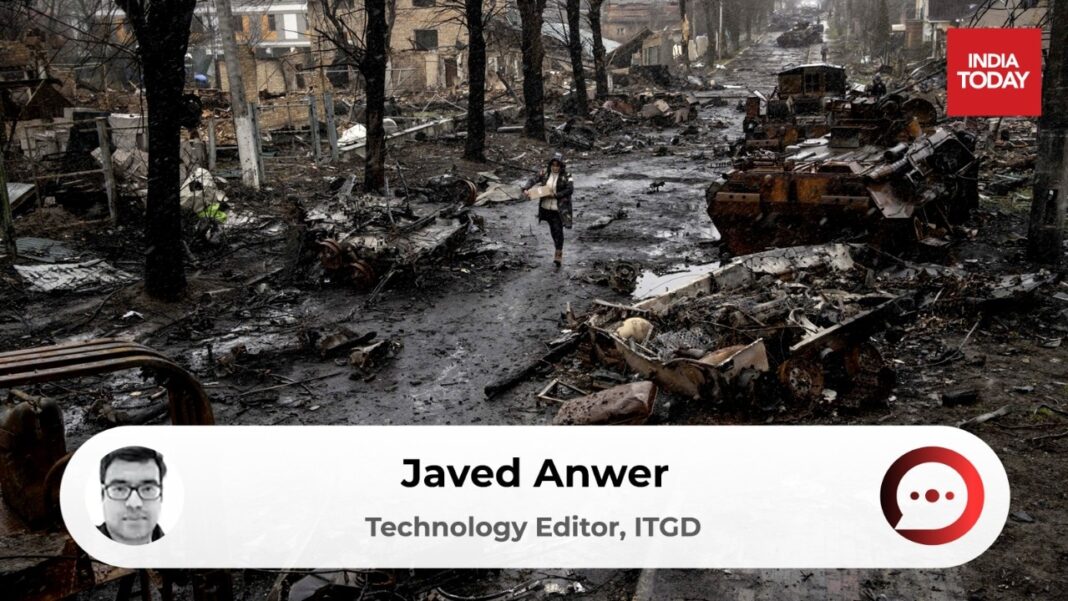
The deaths are increasing at a rapid clip now. Even conservative estimates note that over half a million people have died in the Russia-Ukraine war. Nearly one lakh, including thousands of children and women, have died in Gaza in little over two years. Nearly six lakh have died in Syria in one decade or so. Since the beginning of this millennia, hundreds of thousands have died in Iraq and Afghanistan in military conflicts. In Yemen, Sudan, Ethiopia and Darfur, the conflicts have been equally devastating and bloody, leading to lakhs of deaths. Now, there are bombs falling in Iran, a country of 90 million people, and Lebanon.
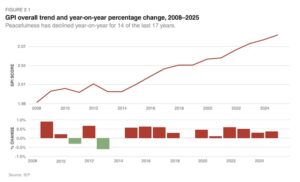
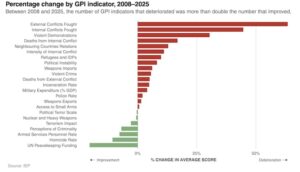
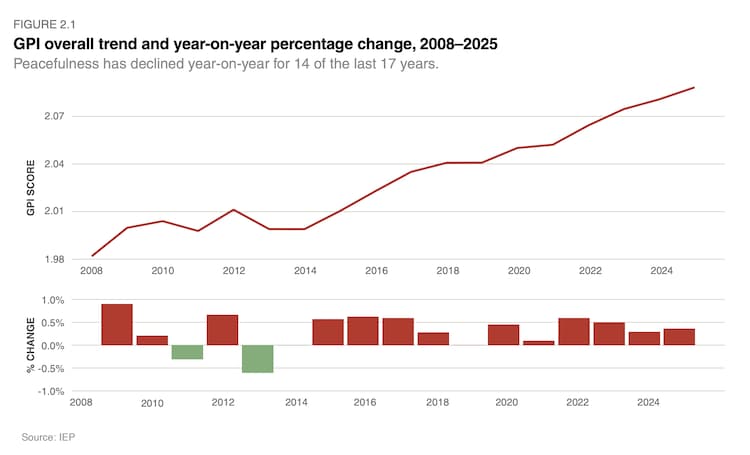
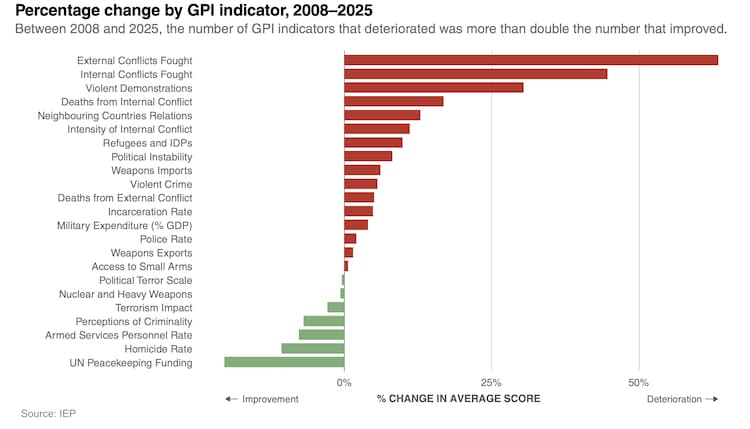
The bloodied and more violent state of the world has started reflecting in words. The Global Peace Index in 2025 highlighted that currently the world is the least peaceful it has been after World War II. “Global peace is at its lowest level since the inception of the Index, while the conditions that precede conflict are the worst since WWII,” the report noted last year. “Global peacefulness has deteriorated every year since 2014, with 100 countries deteriorating over the last decade. There are currently 59 active state-based conflicts – the most since the end of WWII, with 152,000 conflict-related deaths recorded in 2024.”
What does this say? We don’t need to go anywhere. The world is already at the gates of the Stone Age, even if the new reality has not yet reached the shores of the USA.
But it has reached our minds and thoughts. The kind of violence, the odious duplicity and devilry that once used to prick our senses and crawl our skin, has now become so normalised that we take a look at it and then go back to scrolling memes on Instagram. Everything is permitted now. Killing of heads of states, along with their families, barely makes the news the day after. Gaza was flattened and within months, it has gone out of conversation. The many conflicts in Africa don’t even make it to our X feed, let alone prime time news. There are people in positions of power whose names have featured in files related to sexual abuse of children, and they feel no shame and face no censure.
The violence of daily life too has become normal. We see that in India too, where increasingly the roads are more belligerent and people more eager to smash each other’s heads with clubs.
The world used to be different just three decades earlier. There was still a lot of violence, a lot of pain and a lot of wretchedness. But there was also the shame, which people, societies and countries would feel at their helplessness. Now, the shame has been replaced with indifference. In many cases, the indifference has mutated into impunity.
Writing in the mid 1990s, celebrated historian Eric Hobsbawm predicted the coming Stone Age. In his book Age of Extremes, which covers the 20th century, he attempted to read the coming decades. He wrote, “The world which enters the third millennium is not a world of stable states or stable societies the world is in a state of social breakdown.” Nearly three decades after Hobsbawm issued his dire predicament, the world has started to prove him right.