
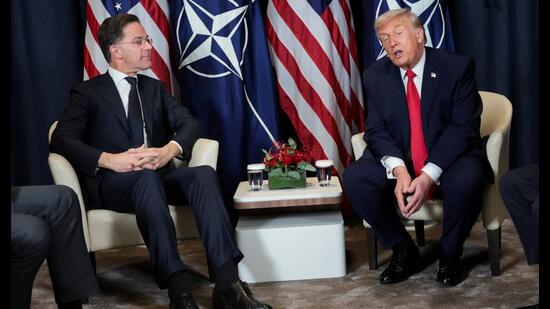
US President Donald Trump’s speech early Thursday (India time) reiterated many of his earlier threats to Iran while offering the American public his justification for the war that few at home seem to support. But it was most striking for what it didn’t contain — any announcement of change in the US’s membership of the North Atlantic Treaty Organization (Nato). Just hours before the speech, Trump had spoken disparagingly of this security and strategic coalition with a large part of Europe. Some, therefore, had anticipated a big announcement in this regard before Trump spoke on Thursday.
That Trump holds Nato in contempt was never in doubt. It 2017, he called the alliance “obsolete”, claiming it had outlived its Cold War purpose. In 2024, he called member States not paying their promised financial contributions “delinquents” and threatened that Russia “can do whatever the hell it wants” with them. The spectre of the US dishonouring Nato collective defence under Article 5 sent shockwaves across Europe. “Unfairness” is Trump’s criticism of choice: “We give so much and get so little in return.” When asked by a British journalist whether he is reconsidering US participation in Nato, Trump was quick off the mark: “… it is beyond reconsideration. I was never swayed by Nato. I always knew they were a paper tiger, and Putin knows that too.”
Compared to the earlier instances, there is much more menace in Trump’s latest threat to quit Nato. While it is possible that he won’t walk the talk after diplomatic lobbying by European leaders, the strategic context has shifted radically for the American president. Trump is beginning to intuitively understand that the US has lost its core objective of quick regime change and containment in Iran. That Europe refused to join and is actively stopping the US military from using some European bases is grating on the White House. Because admitting defeat is not in Trump’s vocabulary, the question for him now is how best to put up a masquerade of victory and end the war. There are three potential pathways to doing this.
The first pathway is to take credit for disabling Iranian military capabilities and killing its top leadership and announce a unilateral ceasefire. This is difficult both because it is untrue, at least at the present stage, and Israel will continue to fight. Iran’s military has been weakened but not destroyed. If anything, Iranian missile and drone attacks against Israel and American bases across the Gulf have become more sophisticated. Thanks to Russian and Chinese intelligence support, Tehran is systematically targeting the US military assets that work as enablers for other offensive systems. The impact rate of Iranian ballistic missiles inside Israel has also risen. More importantly, the Strait of Hormuz remains choked, and the global energy market is struggling as a result.
The second pathway is to use diplomacy via third parties such as Pakistan, Türkiye, Oman, and others to arrest this march of folly. Various capitals, especially Islamabad, are trying to pass messages with proposals and counterproposals for each side to reject. So fierce is the security dilemma for the warring parties that such negotiations cannot deliver any results without a temporary ceasefire in the first place. There is an associated problem of cognitive dissonance in the US. The White House is not just unclear about its objectives, but it is equally confused about the execution of this war. Both Trump and secretary of State Marco Rubio say that this war will “wind down” within weeks, but secretary of war Pete Hegseth’s words, actions, and decisions indicate a different reality.
The third pathway, much to Europe’s chagrin, is what is playing out in real-time. Trump is threatening to exit Nato, cut all arms supplies to Ukraine, and leave the war without reopening the Strait of Hormuz. He first vented on Truth Social about British and European concerns about oil supplies, posting, “Go and get it yourself.” He reiterated that in his speech on Thursday, saying countries that depend on oil passing through the strait must take care of the passage. He wants Europe, Gulf countries, and others to form an international coalition that will help reopen the Strait. In a letter to the UN Security Council, the Emiratis have requested an invocation of Article 7 of the UN Charter that will allow the use of force for this purpose. London is planning to host coalition talks to assess the viability of this option.
The problem with this pathway is that a coalition cannot reopen the Strait using military means alone. It will need to negotiate with Iran, which will expectedly shift responsibility onto the US and Israel, and pressure these countries to ask Trump and Israeli Prime Minister Benjamin Netanyahu to halt aggression. The other, more dangerous, concern is that amidst all this talk of ending the war and reopening the Strait, it is likely that the US will initiate a ground incursion of Iran. This could range from capturing the strategic Kharg Island from where Iran exports over 90% of its oil, to a massive commando operation to extricate nearly 1,000 pounds of enriched uranium, or both. If the US goes ahead with such operations, it will foreclose any possibility of a negotiated ceasefire. Such a move will further destabilise Iran and, with it, the global economy. There are no clear exits.
In this context, it is unsurprising why this war — which started shortly after an aborted American attempt to wrest control of Greenland — has put such extraordinary strain on Nato, the Five Eyes alliance, and the Trans-Atlantic partnership. The US has gone rogue as a global power, a partner, and an ally. So dire is the situation that even the UK, which has long prided its “special relationship” with the US, is struggling to manage Trump’s volatility. That Europe has more than stepped up on burden-sharing in Nato and taken the lead in supporting Ukraine has been lost on the White House. Trump is seeking a scapegoat for his deadly mistakes and Europe is an easy target.
Whether or not Trump pulls the US out of Nato is irrelevant. The spirit of the alliance is already severely damaged, if not dead. Even if established joint operational mechanisms continue to function, the trust required to operate in this space no longer exists.
Avinash Paliwal teaches at SOAS University of London and is a nonresident scholar in the Carnegie South Asia Program, Washington D.C. The views expressed are personal


