
As Tamil Nadu prepares for the April 23 polls, the gap between the constitutional ideal and the candidate calculus has reached absolute divergence. If the reservation regime that reigned from the mid-eighties was intended to be a bridge to equity, it has instead become a barricade of identity. It is a supreme irony of our times that Mandal has created more castes than Manu ever did, resulting in a social paradox where one must officially become backward to move forward. In the last four decades of Tamil politics, the script of the struggle may have evolved, but the caste of characters never changes.
THE CONSTITUTIONAL FARCE
On paper, invoking community, caste or creed for vote gathering is a legal heresy and a violation of the Election Commission’s sacred scripts. Yet, a forensic scan of the candidate lists reveals that for the political class, the Constitution is merely a polite suggestion, a piece of parchment to be bypassed in favour of the raw masonry of social stratifications. The selection process is a ballot box birthmark, a cynical spoof on the very foundation of democracy. We are witnessing a pedigree politics where the candidate is not chosen for their calibre but for close cluster.
AIADMK AND DMK: THE FENCE-JUMPING FEALTY
The two primary Dravidian behemoths remain locked in a community clasp that defines the geography of the state. The AIADMK has traditionally been the most unapologetic practitioner of this soap opera, but the 2026 list shows a fascinating shift in personalities without a change in the underlying lineage logic. In the west, the Kongu region remains a fortress of the Goundar birth-group. Even as leaders jump the fence, they rely on the same ethnic pocket to carry them through.
A striking example is KA Sengottaiyan, a long-time AIADMK veteran and former minister, who has now moved to Vijay’s TVK. Despite switching parties, his candidacy remains anchored in the same western stronghold, assuming that his community will follow him regardless of the flag he flies.
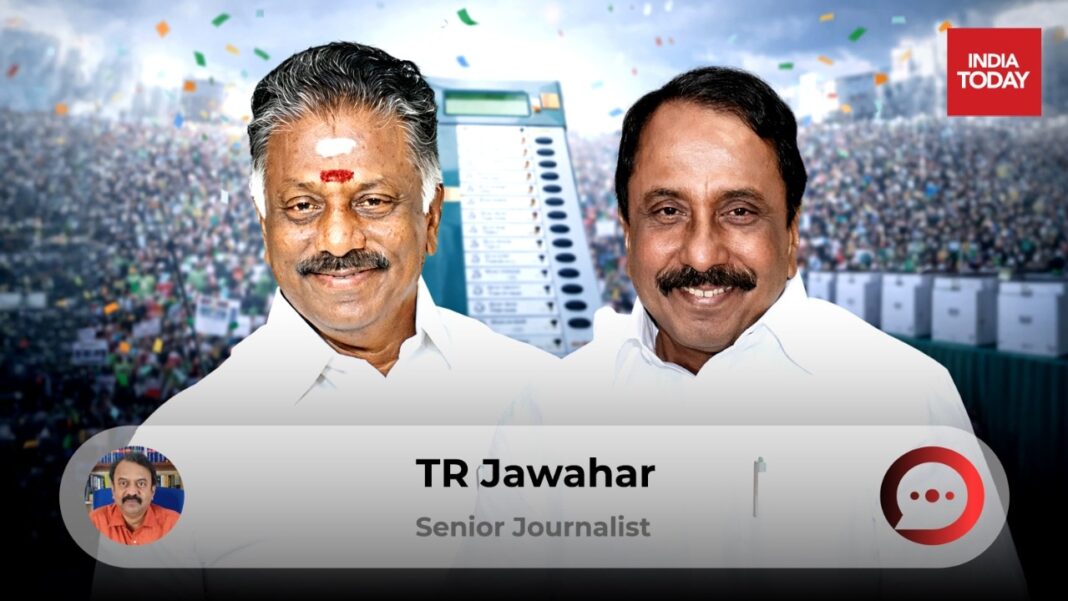
Similarly, O Panneerselvam, the many-time Chief Minister and once the most trusted loyalist of the Poes Garden era, has performed a tectonic shift to the DMK camp. Even as he operates within the Rising Sun’s shade, he remains tethered to the Thevar heartland in Bodinayakkanur.
These moves prove that in Tamil Nadu, political ideology is often just a temporary robe, but birth-group fealty is the permanent skin. The DMK and AIADMK have fielded close to a hundred candidates from these two dominant segments alone, a clinical study in community-based selection that mocks the idea of a secular mandate.
PMK AND THE VANNIYAR PIONEER
The northern districts remain sliced into regional silos of birth, dominated by the Vanniyar Sangam, which pioneered this brand of community-centric politics in the state. The PMK, since its inception, has shown zero reach beyond its original ethnic soil. Its strength is not an ideology but a community census. In the 2026 polls, the PMK’s list is a near total reflection of this social segment. The candidacy of Soumiya Anbumani in Dharmapuri is the ultimate proof of this ploy, where the community vote is treated as a family heirloom.
This Vanniyar obsession has forced every other party to play the same poker in the northern districts. From Cuddalore to Kanchipuram, the election is not a debate on development but a census of the cradle. The PMK’s pioneer status in this field has ensured that the northern landscape is a theatre of communal competition, between the two major formations, where the promise of a quota is the only tune that resonates. By reducing the political discourse to a single lineage demand, the party has created a state within a state, which is precisely not what Dr Ambedkar ordered through the constitution he chaired.
CASTE OUTFITS AND THE CAMOUFLAGE OF NAMES
A sophisticated layer of this electoral theatre involves the assiduous wooing of caste associations that hide under the camouflage of deceptively neutral political names. Major parties like the DMK and AIADMK spend months negotiating with these outfits to ensure a consolidated vote bank in specific pockets. These groups often masquerade as broader movements while their candidate selection remains strictly limited to a single kith-and-kin unit.
Consider the IJK of Paarivendhar, which effectively represents a specific agrarian cluster while using a generic name. Then there is the Puthiya Thamizhagam of Dr Krishnaswamy, which focusses on a specific Dalit segment in the south while projecting a pan-Tamil image. A.C. Shanmugam’s New Justice Party is another instance of this camouflage, where the historical weight of the Justice Party name is used to anchor a specific community interest.
There is a surfeit of Thevar outfits. At the top of the pecking order is the All India Forward Bloc. This party of Subash Chandra Bose had a parallel freedom struggle namesake legacy in Tamil Nadu in the towering personality of Muthuramalinga Thevar. This great nationalist with profound spiritual leanings has posthumously been reduced to a caste leader and deified by all and sundry. The Thevar puja is now part of the State’s religious calendar, with all parties lining up at his statues burying him in garlands across the geography. Indeed, it is political blasphemy not to be a part of the annual ritual.
DECEIVE AND DIMINISH
This TN franchise of great Bose’s legacy tops the charts in poll time deals. Forward Bloc’s backward push is a sterling example of one common denominator holding up a slew of identical denominations. As one comes down the Thevar ladder one can encounter such entities as MMK, Moovendar Munnetra Kazhagam, and actor Karthik’s party. Please google the name. And then if lucky—no, make that unlucky—one can even have a sighting of a Puli Padai, Tiger army, another Thevar outfit in fiery stripes. Generally, this community, with its many factions, may Bose forgive us, has come to be associated with the Sasikala clan.
Dr Ambedkar may have been the father of the Constitution for a casteless society. But he never bargained for the likes of Thirumavalavan. Yes, his Viduthalai Siruthaigal, Freedom Cheetas, with their own brand of Dalit politics have converted the Constitution giver into a complete communal, caste, clan icon. Come April 14, Dr Ambedkar’s birthday, and this being the apt season, expect him to be claimed by all, but for and on behalf of Dalits for sure. Even those who once riled against worshipping ‘false gods’ have no choice but to fall in line. Bose and Babasaheb are just a few examples of tall leaders being diminished and dwarfed by the very casteism they fought against.
A long-term duplicity passing muster is in the so-called ‘Secular Progressive Front’ of the DMK. There is this lofty sounding, but grossly deceptive Manithaneye Makkal Katchi (something to do with humanism, sort of) headed by Jawahirullah, who can lay claim to no vote beyond his communal fringe. In this context, the Indian Union Muslim League and Kongunadu Makkal Desiya Katchi, with their affiliations shining like neon signs, in contrast, seem like ‘secular’ saints.
These parties are often accommodated in seats by the major fronts as a way to outsource the caste arithmetic. It is a process of systematic integration where caste is the barter unit of currency, and the party label is merely the legal tender.
THE FAMILY CLUMP AND THE STAR AURA
New entrants and smaller allies have only sharpened this trend. The DMDK, under Premalatha, has performed a family and fold group manoeuvre, fielding candidates of her own community for 7 out of the 10 seats allotted to them. It is a selective selection that turns a political party into a community club, proving that even as the original leader’s pulse fades, the lineage logic remains the only inheritance. A footnote here: Premalatha secured a Rajya Sabha seat for her brother, Sudheesh, from the DMK.
The TVK, led by the cinema star Vijay, is attempting a different kind of dance. Built more on fan club craze than a deep-seated ideology, the party has made a show of fielding two Brahmin candidates and several others who do not fit the traditional strongman mould.
However, the move of Sengottaiyan to his camp proves that Vijay is still forced to accommodate the dominant local forces to remain relevant. In a theatre of the absurd where celluloid is a genetic obsession, the TVK is still relying on the charismatic halo of its leader to bridge the fractures.
While Vijay attempts to rise above the familiar logic, the ground-level reality of his candidate list shows that even a screen star must occasionally bow to the birth-group categories. It is a case of the devil and the deep sea; the fans want a hero, but the gears of the election still grind the same old community cogs.
THE NTK EXCEPTION AND THE BRAHMIN ABSENCE
In this landscape of symmetrical exclusion, Seeman of the Naam Tamilar Katchi remains a maverick voice. He has largely bucked the community race, attempting instead to build a narrative based on a broader Tamil ethnic identity. In a move that has shocked the Dravidian establishment, Seeman has fielded six Brahmin candidates. This is a significant departure in a state where the major parties have traditionally treated that community as a political pariah.
Aside from Seeman’s rare move and the tokenism in TVK, the major parties like the BJP, Congress, Communists, DMK, and AIADMK have not a single Brahmin candidate. This 0% bracket is the ultimate proof that the Dravidian drama has moved from parity to a localised erasure. The BJP, despite its Agmark Hindu unity narrative, is still playing a social segment game, prioritising the Nadar or Vellalar math over any broader religious monolith. It is a saffron seesaw where the Vedic verse is frequently drowned out by the sub-caste shout.
THE CINEMA TICKET: A CRAWL FROM THE CRADLE
If at all a leader can cut across the suffocating clasp of community in this state, it has unfortunately always required a screen star to rise above the logic of the pavement. Tamil Nadu has already paid a heavy price for its cinema ticket, but the pattern is inescapable. MGR was the original icon who could command a mandate that largely ignored the candidate’s birth, replacing the community club with a fan club. Vijayakanth tried to follow a similar path with his wide appeal, and now it is Vijay’s turn.
In a state immersed in celluloid, Vijay looks like one who can occasionally ignore the arithmetic because his image is a universal currency. This is the great irony of the Tamil theatre; the only way to escape the ancient codes is to seek refuge in the artificial glow of the cinema hall. The people will vote for a star simply because he represents a dream that is larger than their immediate ‘relative’ reality. It is a genetic obsession with the screen that provides a periodic, if shallow, relief from the grinding cogs of the caste crib.
THE FUTURE: A CENSUS OF SEGREGATION
The 2026 election is a cautionary tale of a democracy that has become a census of the cradle. As the common man prepares to ink his finger, he is not just choosing a representative; he is participating in a genetic gambit. District and street names may have lost their suffixes, but social segmentation remains the reality across the state.
The software of the screen is being used to hide the hardware of inheritance, and the retake of reason remains a distant dream. The Puratchi Thalaivi (Jayalalithaa) and the Pen Master (Karunanidhi) are gone, but the iron clasp they both utilised remains the only, Sengol, sceptre that rules the southern soil.
As votes are cast on April 23 and counted on May 4, segregation becomes starkly clear. As long as the candidate list remains a copy of the community roll-call, the Tamil soul will remain locked in the same ancient mould. The caste remains the same, and the state continues to pay for a ticket to a show that never changes its script.
(The author is a senior journalist. Follow his long series, Time, Tide and Tamil, for a deeper understanding of Tamil Nadu’s pulse and politics. Views expressed are personal.)


