
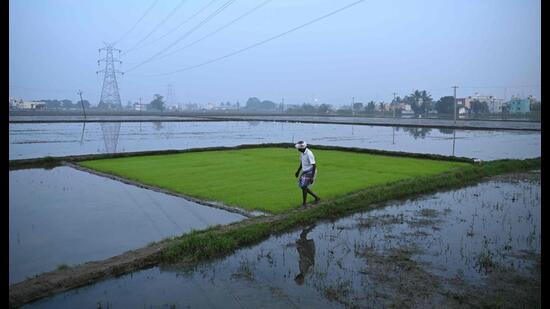
World Water Day, observed on March 22, is an occasion to remember the central role water plays in our lives and our shared responsibility to conserve and protect it for the future.
Water sustains life, ecosystems, and economic activity. Yet, pressures on this vital resource are rising. India is home to nearly 18% of the world’s population and livestock but has access to only about 4% of global freshwater resources. Rapid urbanisation, rising demand, and the climate crisis make efficient and responsible water management a national priority.
Recognising this challenge, under the leadership of Prime Minister Narendra Modi, India has adopted an integrated approach to water governance. The creation of the ministry of jal shakti brought diverse aspects of water management under a single framework, marking a decisive shift towards holistic planning.
This approach addresses water across its full cycle — focusing on conservation and groundwater recharge, strengthening storage with dams and reservoirs, enabling balanced distribution via river interlinking, expanding access under programmes such as the Jal Jeevan Mission and modernised command area development, improving quality under initiatives like Namami Gange, and building resilience with research, innovation, and awareness. Together, these efforts reflect a comprehensive vision for long-term water security.
At the centre of this vision is the recognition that water management, in all its aspects, must become a people’s movement. Government initiatives provide scale and direction, but lasting impact is achieved when citizens participate actively and take ownership.
The Jal Jeevan Mission is being implemented as the world’s largest programme to provide safe and adequate drinking water to every rural household. Tap water connections have now reached over 15.8 crore rural households, improving the quality of life. For millions of women, this has reduced the burden of fetching water, improved health outcomes, and enabled greater participation in education and livelihoods.
Beyond infrastructure, it places strong emphasis on community participation, with gram panchayats and village water and sanitation committees at the centre, and women trained to monitor water quality, strengthening local ownership.
The Namami Gange programme has improved water quality and supported ecological restoration in the Ganga and its tributaries, leading to improvement in habitat and numbers of key aquatic species, including the Gangetic dolphin.
Alongside its focus on Nirmal and Aviral Ganga, it advances initiatives such as Arth Ganga and Jan Ganga, which place communities at the centre of river rejuvenation by linking livelihoods, awareness, and local participation with conservation efforts.
Water conservation has become a mass movement through the Jal Shakti Abhiyan. The Prime Minister’s call of “catch the rain where it falls and when it falls” has inspired action across the country. Under the Jal Sanchay Jan Bhagidari initiative, communities are undertaking rainwater harvesting, restoration of traditional water bodies, watershed development, and afforestation.
Since September 2024, these efforts have led to the creation of over 45 lakh water conservation structures, demonstrating how community participation can deliver results at scale when supported by government initiatives.
Across India, examples of such participation are visible. In Banaskantha, Gujarat, dairy cooperatives have partnered with farmers to build low-cost recharge structures. In Korea district, Chhattisgarh, farmers have dedicated portions of their land for groundwater recharge.
In urban areas, residential societies are adopting rainwater harvesting and reuse practices. Initiatives such as Karmabhumi se Matribhumi reflect a growing sense of responsibility, with individuals contributing to conservation efforts in their native places.
Industry and agriculture play a critical role in ensuring water security. Many industries are voluntarily adopting practices such as water audits, recycling and reuse, zero liquid discharge, and rainwater harvesting, supported by continued innovation in water technologies.
In agriculture, micro-irrigation, improved on-farm water management, and better utilisation of available resources are being adopted across regions, supported by programmes like the modernisation of command area development, helping enhance sustainability while supporting farmers’ livelihoods.
Urban India should also embrace a culture of conservation through rainwater harvesting, wastewater reuse, and sustainable planning. Every household, institution, and community has a role in ensuring responsible water use.
India’s journey towards water security is a collective national endeavour, essential for building a Viksit Bharat. Water security ultimately depends not only on infrastructure and policy, but also on behavioural change.
On this World Water Day, let us move beyond awareness to action. If each citizen saves, reuses, or recharges even one litre of water, we conserve over 1.4 billion litres as a nation — an extraordinary impact from a simple act. Let conservation become a daily habit. A water-secure India will be built not by policy alone, but by the everyday choices of its people — where every drop is valued, every source is sustained, and every citizen becomes a custodian of this precious resource.
CR Patil is the Union minister of jal shakti. The views expressed are personal


